Earth's Flips of State
The co-evolution of life and planet
x + 380 pages, 42 figures,
hardback, £82 / US$127, ISBN 978-0-197-82536-5
paperback (medium octavo), £31.99 / US$49,
ISBN 978-0-197-82537-2.
DOI:10.1093/9780197825402.001.0001
30% discount offer below.
|
|
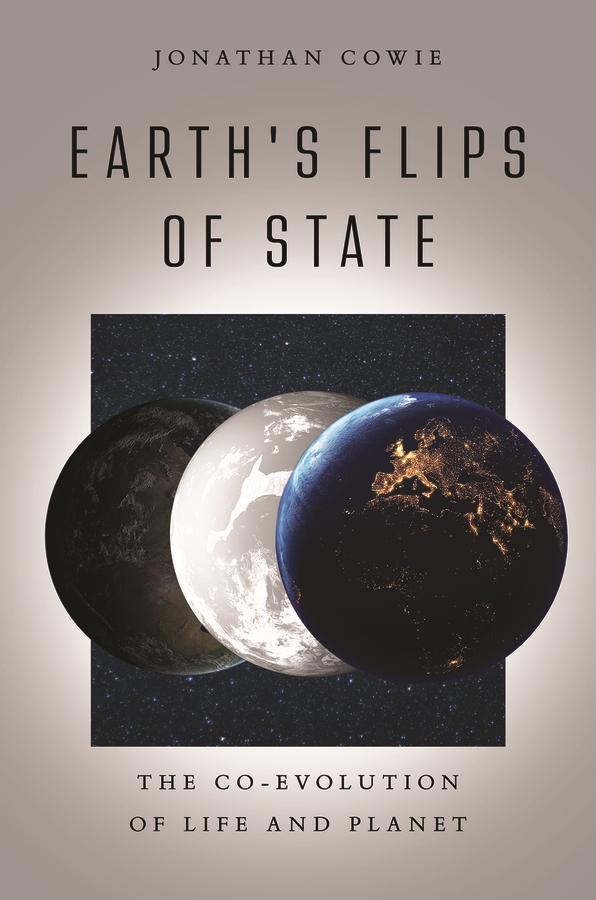
-- Cover descriptor --
Our present is shaped by the past. Beyond living history, exactly how is something we rarely consider in any depth, let alone on the grandest of scales over the billions of years of Earth’s existence. This book looks at how life and our planet have together co-evolved to the present. This book also takes a glimpse as to a possible future.
The Earth has not always been in its present state: it has existed in other states and ‘rapidly’ (in the broadest geological sense) flipped from one state to another. Each new state has seen a different form of life dominate, and so a co-evolution of life and planet narrative has developed. Indeed, all our planet's flips of state have certain characteristics. All these characteristics can be seen today, which raises the question as to whether we are about to see the Earth system transition (flip) to a new state as evolutionarily significant as the rise of multicellular life: one in which the planet’s state is determined by a single species and its technological complex. Whether or not this dominance is sustainable is a key issue.
Another question arises: if the afore co-evolution of life and planet narrative took place on our planet, could it take place elsewhere? There are implications for life elsewhere in Solar system and the Galaxy. It might even explain the Fermi Paradox!
Contents very briefly described
The first section (chapters 1 and 2) sets the scene with the length of Earth's history and the planet's origins and early biosphere. It also introduces the concepts of stability and transition – especially critical transitions – between one state and another.
The second section (chapters 3, 4 and 5) looks at two critical transitions in Earth's history with each marked by millions of years of the planet being in a Snowball Earth state. How these came about through the development of simple bacteria-like life (prokaryotes) into more complex (eukaryotic) life and the rise of oxygen-generating photosynthesis as well as multicellular life. It shows how biological evolution shapes the planet and how planetary evolution (such as with plate tectonics) impacts biological evolution: there is a co-evolution of life and planet. Snowball Earth II, and its associated events, is looked at in detail.
The third section (chapters 6 and 7) notes that not all critical transition in Earth's history are driven by key biological evolutionary developments, but by other, more random, acts. It then returns to the co-evolution of life and planet narrative and looks at the defining characteristics of the key, biological-evolution-driven transitions before considering what this narrative implies as to the probability of life on other worlds.
The final section (chapters 8 and 9) considers our current time and whether we might be in the midst of another critical transition driven by biological evolution: the rise of a technology wielding species. It details the evolution of Homo sapiens and how this was driven by climate change critical transitions. It also introduces another characteristic of all the biological evolutionary driven critical transitions, that of each successive transition seeing the Earth have a greater amount of 'information'. Finally, it looks at the implications of our current transition both for us, the planet, and the possibility of advanced life elsewhere.
Contents
Introduction &Acknowledgements
1 The young EarthA sense of scale
The formation of the Earth–Moon–Sun system
Evolution of the Earth–Moon system
The Earth and early biosphere
References
2 Towards A Flip
Carbon and the early biosphere
Energising early life
Biosphere stability
Flips – Thresholds – Critical transitions (and Chaos)
References
3 Towards a Snowball
Prokaryote (the first cell type) evolution and early photosynthesis
The evolution of oxygenic photosynthesis
Oxygen in the atmosphere
Summary of the evolution of bacterial photosynthesis
The first big flip
Snowball Earth I (~2.4 - 2.2 bya)
References
4 A billion years towards the second flip
The un-‘boring’ billion
Turbocharging life
The evolution of the eukaryotes 2.5 – 1.5 bya(?)
When did the first and the more complex eukaryotes evolve?
Going multicellular
Multicellular life and the world
References
5 The second flip and other Snowballs
When did multicellularity arise?
The move to land
The second flip and another Snowball
After Snowball II
Alternative Snowballs
Alternative Snowballs vs. the new narrative
Merging the old and new narratives
References
6 Jokers and Wild Cards
Large igneous provinces (LIPs)
The end-Permian event (251 mya)
The Cretaceous-Tertiary extinction (66 mya)
The initial Eocene CIE (~56 mya)
The characteristics of life-driven flips of Earth state
References
7 Exobiological implications
Implications for possible life elsewhere in the Solar System
The possibility of life on Venus
The possibility of life on Mars
The possibilities for life elsewhere in the Solar System
Life beyond the Solar system
References
8 A new flip?
The present-day carbon isotope excursion and climate change
Other human impacts on the carbon cycle
New mineral species
Information processing and the rise of humans
Biological information and information technology
The prospect of a new flip
References
9 Implications
A current critical transition
The need to manage the future
Problems in avoiding or managing the transition
Fermi re-visited. Who will inherit?
Possible solutions
Looking at information-processing in the future
Testability
In conclusion
References
Appendix I: Abbreviations & Symbols
Appendix 2: Nomenclature, Data and Terms
Appendix 3: Bio- Geological Timescale
Subject Index
£31.99 £22.39 /US$49 US$34.30
using the code AUFLY30 only at
global.oup.com
Paperback 30% discount promotional code AUFLY30 only at
global.oup.com/academic/product/earths-flips-of-state-9780197825372
Hardback 30% discount promotional code AUFLY30 at
global.oup.com/academic/product/earths-flips-of-state-9780197825365.