|
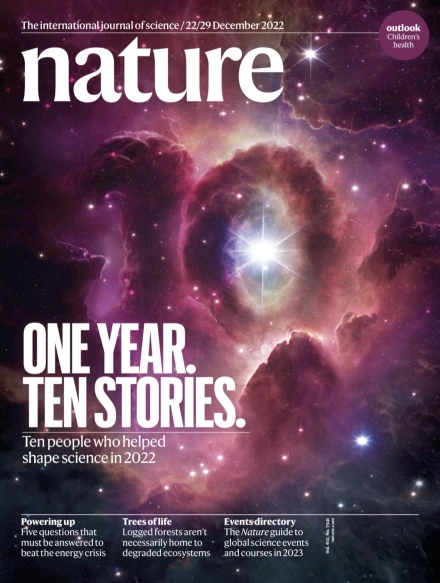 The 2022 Christmas/New Year edition.
|
Concatenation Science Communication
Past news 2021/22
Year end 2022 I have a letter published in the journal Nature's Christmas/New Year edition. Actually, this letter is nothing remarkable: pedestrian really. It's a comment on an earlier Nature article (Murdick, D. (2022) Nature, 611, 205) that was really a puff piece for the Center for
Security and Emerging Technology (CSET) at Georgetown University in Washington DC that aims to deliver technically sound policy insight that decision makers can use to improve global and national security. This is all very well and good but it did not mention, even in passing, the tremendous amount of science policy work that has been done for many decades by learned and professional scientific bodies, let alone the national academies (such as Britain's Royal Society). I just couldn't let that slip.
Cowie, J. (2022) In praise of policy initiatives at professional societies. Nature, 612, 631. (Archived here.)
|
|
|
Late autumn 2022 The world population tops eight billion. Hark back to the beginning of the year and I referred to the 1973 film Soylent Green set in a fictional overpopulated year 2022. Well, in reality we are now coming up to the year's end and it is worth noting that in November the World's population topped 8 billion!
When I was born, the World's population had not even reached 3 billion. I remember well when the population reach 5 billion: I was in the Birmingham National Exhibition Centre car park for the BECCON '87 set up. And when it reached 6 billion in 1999 I was giving a climate change lecture to Reading University agricultural biologists. In 2011, when Cambridge U. Press just commissioned a substantially expanded and updated edition of my 2007 book, it reached 7 billion and here we are today at over 8 billion.
|
|
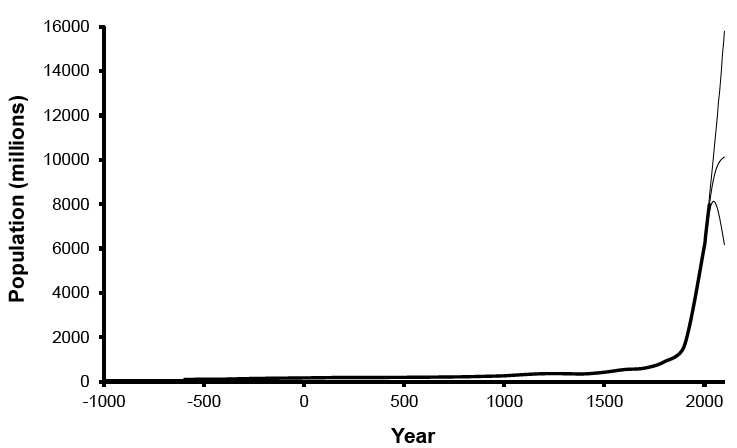
The graph above left depicts the global population over some three thousand years to 2100AD. The thick line represents actual population while the thin lines on the right of the graph are the UN's 2011 high, medium and low projections to 2100AD.
The below graph is a detail showing the global population 1950 to 2050AD. The dotted lines are again the UN's future projections to 2050AD. We can but hope to avoid the high scenario and pray for the low one.
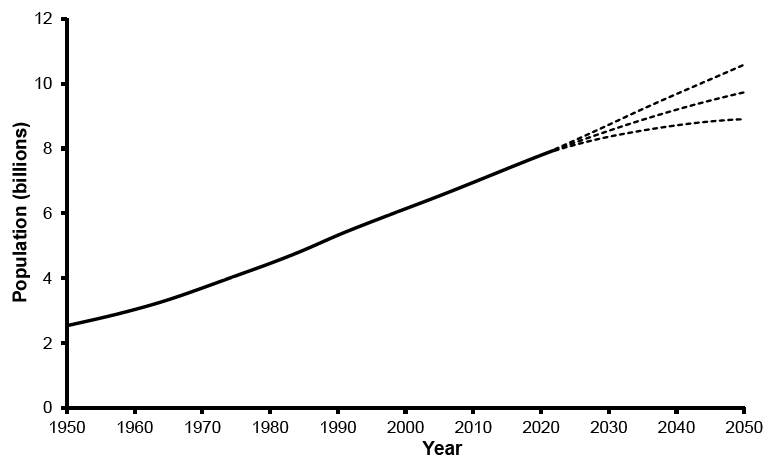 Global population (billions) -- actual and UN projections -- from 1950 to 2050
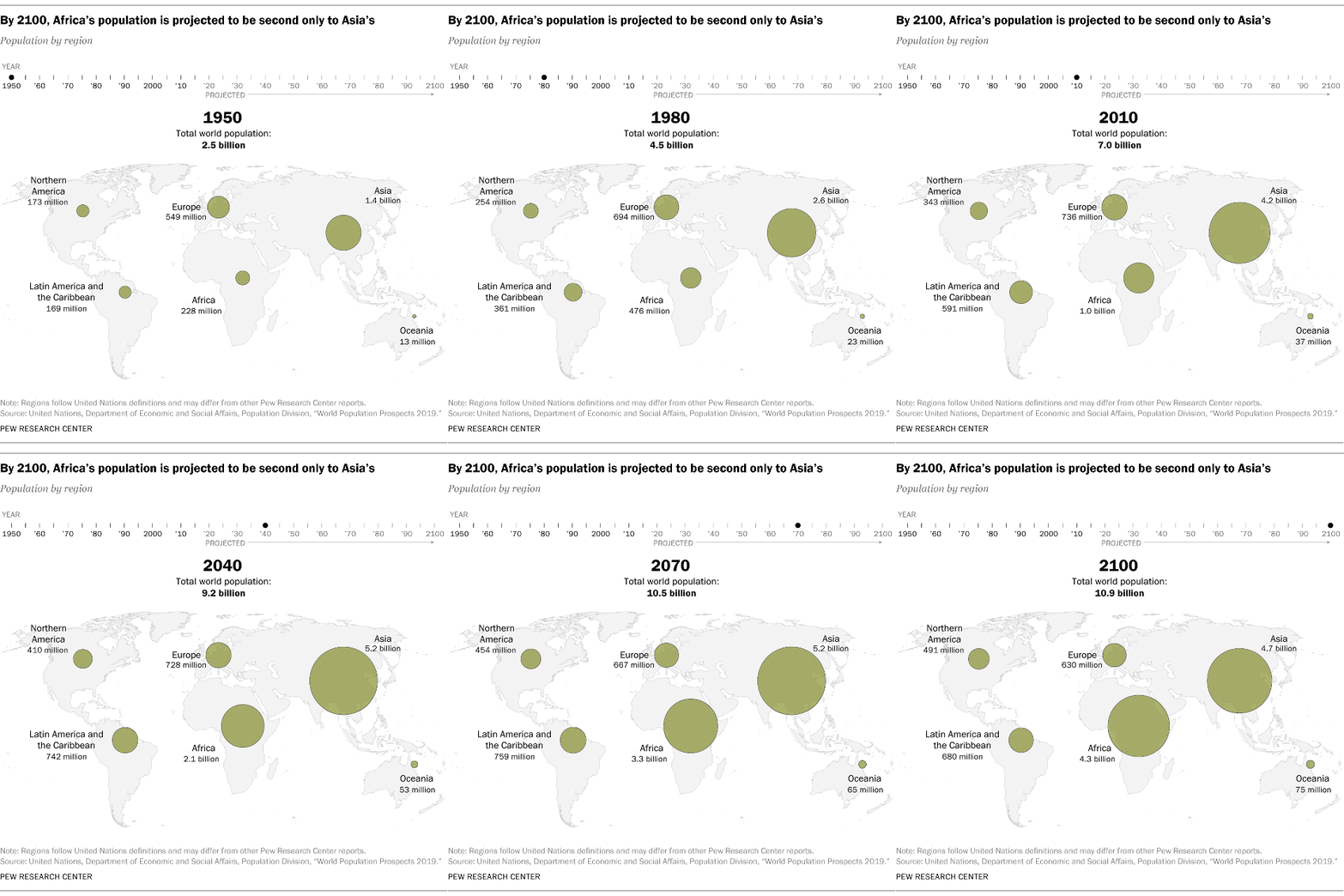
Below: where the growth will take place.
|
|
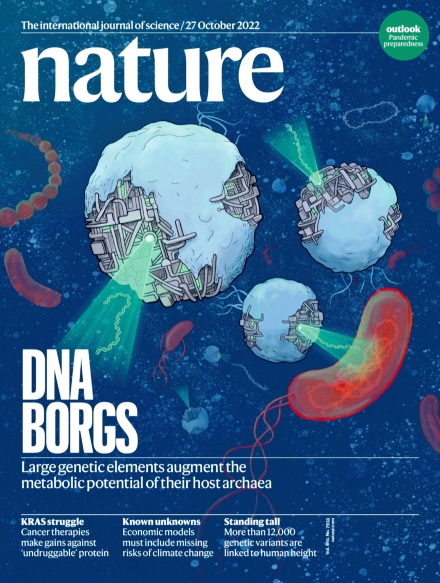 Borg species make the cover of Nature.
The paper's peer review took
around 15 months!
 I've been waiting much of this year
for peer review to complete.
Hoping that the proposed book's
peer-review does not take as long
as Nature's 'Borg' DNA paper.
|
Autumn 2022 Borg DNA paper takes well over a year to get through peer-review. 'Borg DNA'! What's that, I hear you cry? Borg DNA are extrachromosomal elements (ECEs) found in some Archaea (simple prokaryotes that are cousins of bacteria). It has taken over a year for the research paper (see Al-Shayeb, B. et al (2022) Borgs are giant genetic elements with potential to expand metabolic capacity. Nature, vol. 610, p731-6) to get through peer review!
Borg DNA are called such as they seem to 'assimilate' DNA from other prokaryotes, incorporating them in the Borg DNA. This is much like the hive alien species the Borg in Star Trek: The Next Generation who absorb new species they encounter into their collective. With Borg DNA, this assimilation of DNA from other prokaryotes gives the prokaryote as a whole (among other things) the ability to process methane that it would not otherwise have.
Why am I sharing this with you now? And why the big deal for the research paper taking some 15 months to get through peer review?
Well, the keen eyed among you past few years might have noticed (if there is anyone out there following these news pages closely) that I have been working on a 'co-evolution of life and planet across deep-time' narrative. One of this narrative's themes is information-processing across deep-time and DNA's function, as it happens ever increasingly with time, is to convey information. (Having said that, I do not refer to Borg DNA, as interesting as that is and tangentially relevant.) Back in January (2022), after over 160,000 words and 44 diagrams, I almost finished my deep-time narrative and so started composing a pitch document to a book publisher. This was submitted along with all but the final chapter for initial editorial commissioning consideration. And then, a couple of months later, it was taken on for peer-review by a major academic publisher in May (2022)
So for much of 2022 I have been biting my nails down to my elbows waiting for peer-review to complete... All the while completely unsure of the outcome...
However, life is busy, not least science research needs continual monitoring (including developments relating to my deep-time evolutionary narrative but these just slotted in -- simple additions, no major re-write), but the extra spare time while I waited had enabled my taking advantage of the CoVID-19 vaccine liberation with: press junkets and book/publisher launches, films at the cinema, exhibitions, a good few reunions and the resumption of face-to-face social gatherings. More news of just some of this below. So, scroll gently down...
|
|
|
Autumn 2022 Charles Partington has sadly passed. Once again this year, some sad news. Charles was an SF editor, publisher, printer and a director of an early computer games company, as well as in his youth an amateur short-film maker. Among much else, he was also briefly involved with Britain's New Worlds magazine in helping keeping it going in the 1970s. Chuck was a longstanding friend and also a longstanding friend of our SF² Concatenation genre wing: he was responsible for printing its first edition back in 1987 in its decade-long paper days. A number of the Concat' team had many good times with him. SF² Concatenation has a tribute article.
|
|
Policies currently in place with no additional action are projected to result in global warming of
2.8°C over the twenty-first century.
UNEP, 2022.
|
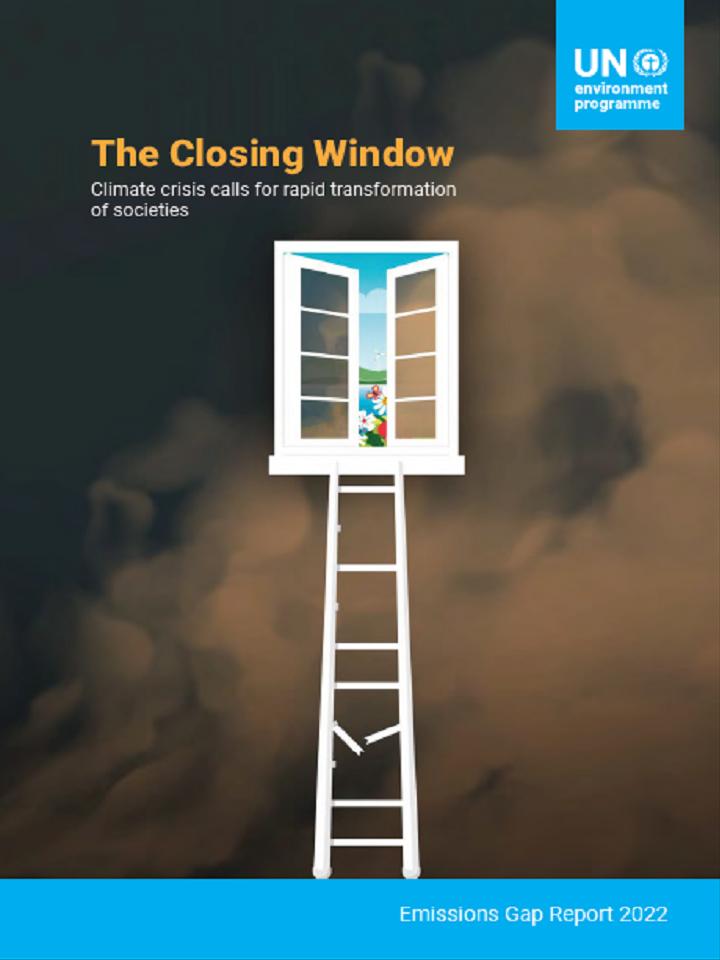
Autumn 2022 The United Nations Environment Programme (UNEP) reports that we will miss both the 1.5°C and 2.0°C global warming targets. Back in 2015 the UN Conference of the Parties (COP) to the UN Framework Convention on Climate Change (FCCC), created the Paris Accord that got 'world leaders' to strive to limit global warming to 2.0°C above pre-industrial, and preferably 1.5°C.
Alas for many years, despite political rhetoric, I have been fearful that we will miss such targets. Back in 1998, I outlined the scale of the problem in my book Climate Change: Disaster or Opportunity. I then estimated that by 2025 we would be emitting some 14 gigatonnes of carbon per year (GtC/yr) under business-as-usual (b-a-u) without meaningful measures to reduce emissions (p332): today in 2022 we are emitting around 12.3 GtC/yr. So it seems quite likely that in three years time we might be close to my 14 GtC/yr.
b-a-u prediction
I take no pleasure in being reasonably on the money with my over-a-quarter-of-a-century forecast.
Moving on over a decade and, back in 2009, I wrote the online essay 'Can We Beat The Climate Crunch?'. It concluded: 'it seems very likely (without a really major change in global human behaviour) that we will exceed our 'safe' 2ºC above pre-industrial level.' Since then, others better than I have concluded the same. This latest UNEP report, The Closing Window: Emissions Gap Report 2022, seems to be yet another nail in that target coffin.
|
 © Science Museum Group (2022)
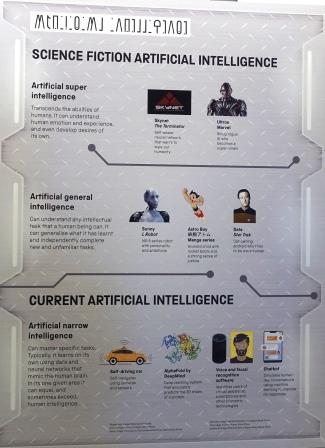 Part of SF and real
artificial intelligence display
Photo © All Tony Bailey & SF² Concatenation (2022) unless otherwise stated, in which case provided by the Science Museum press office.
|
Autumn 2022 The Science Museum has a new exhibition on Science and Science Fiction! One of the benefits of being part of Concatenation's genre wing is getting invites to press launches, and so SF² Concatenation's reprographic supremo, Tony B., and I found ourselves at the Science Museum's new exhibition Science Fiction: Voyage to the Edge of Imagination.
In essence the idea was that science fiction helps spark the imagination and stimulates an interest in science as well as that some of today's science fiction is tomorrow's science fact. Demonstrating that SF can turn folk on to science fact was the costume worn by the actress Nichelle Nichols. She is known for having played communications officer Lieutenant Uhura in Star Trek but was thinking of leaving the show after the first season for fear of being typecast. However, famously the civil rights activist, Martin Luther King, encouraged her to stay as she was a role model for African American women. This she did and the rest, as they say, is history.
One of those she inspired was Mae Jemison who went on to become an astronaut who had a mission on the International Space Station (ISS). Nichelle Nichols sowed the seed in Mae Jemison's mind that perhaps being an astronaut could be for people like her. Both Uhura's uniform from Star Trek: The Motion Picture and a picture of Mae Jemison in the ISS were on display.
On a personal basis, and on the science front, I was pleased to see James Lovelock's gas chromatograph that he used in Antarctica to measure ozone concentrations. (James Lovelock and I have crossed paths a few times over the decades.)
There was much else of SFnal and science interest. Definitely worth checking out especially if you have young teenage kids. But do take your time and read the displays explanatory notices, and if you are something of an SF aficionado then there are plenty of Easter eggs to uncover. A more detailed review is over at SF² Concatenation.
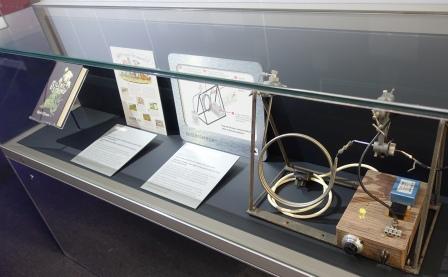 Lovelock's gas chromatograph
 |
 Maria from Metropolis (1926)
© Science Museum Group (2022)
|
 Gort
Gort
The Day the Earth Stood Still
(1951)
|
 A robot from I-Robot
(2004)
|
|
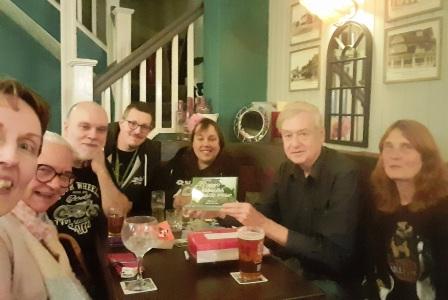 The unpacking on arrival (2022)
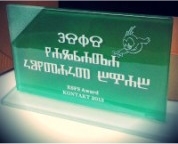 The 2012 Eurocon award
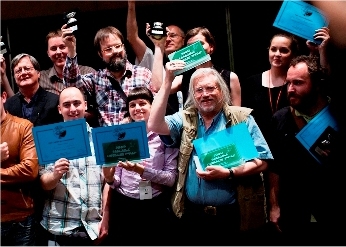 2012 Eurocon winners or their proxies after the presentation ceremony at the 34th Eurocon, Zagreb, Croatia.
Martin (blue shirt centre right) accepted on our behalf.
2012 Eurocon winners or their proxies after the presentation ceremony at the 34th Eurocon, Zagreb, Croatia.
Martin (blue shirt centre right) accepted on our behalf.
|
Autumn 2022 SF² Concatenation's 2012 European SF Society Eurocon Award has finally arrived after a decade! If any of you have been paying attention to this website's news over the years (not that there is any reason why you should) then you might just remember that a decade ago an award came our way... Our SF² Concatenation’s genre (science-genre arts wing) has now finally received its 2012 Eurocon Award from the European SF Society. This delivery time possible could be something of a record?! Way back then, the SF² Concatenation won the 2012 Eurocon Award for 'Best (European SF) website', that was among other award categories, as voted on by those at the European SF Society’s convention which, that year, was held in Croatia.
This was our fourth Eurocon Award. The previous being: 'Best Fanzine' (given in Romania in 1994); 'Best Promoter' (Ireland, 1997); and 'Honorary' (Bulgaria, 2004). It is somewhat pleasing to note that other than 1997, all the others were in non-British Isles European countries and so their votes' ambience was not dominated by a home crowd.
None us were at the Croatian Eurocon convention and so a friend, Martin Hoare, kindly collected it for us. It was due to be handed on at the following UK Eastercon with, if that failed, a stop-gap handover at the Loncon 3 Worldcon. Alas, on both occasions Martin forgot. Then, sadly, Martin passed away.
Dave (Ansible) Langford managed to find it at Martin's home and so plans were made for a pick-up in Reading, Berkshire, en route to a NIRD luncheon (National Institute for Research into Dairying and not a geek gathering). But the gods were conspiring, and a global pandemic put matters on hold.
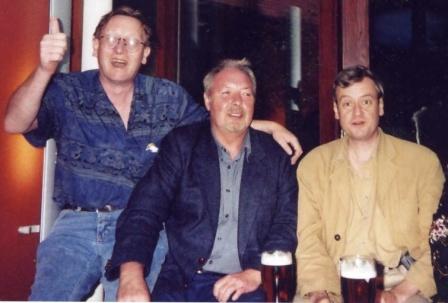
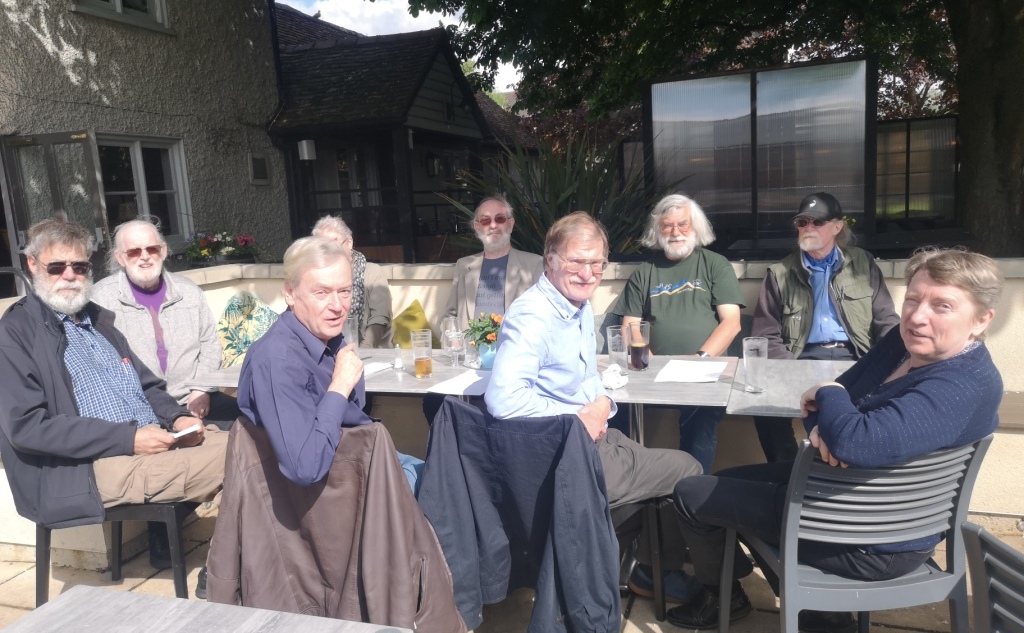
With the easing of CoVID-19 restrictions, diaries were consulted, the upshot of which was that a handover was made last month en route to this year's NIRD luncheon. And so we come to the Award's unpacking -- see picture top left. (Note the beautifully balanced blend of books and beer on the table.)
|
|
 © Science, used under fair use in the context of a review
 © Science, used under fair use in the context of a review
|
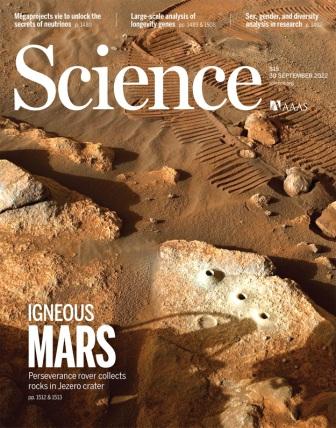
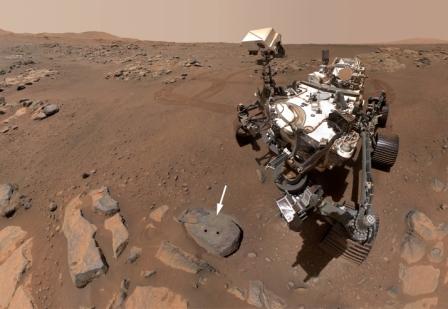
Autumn 2022 More news from Mars, which once more has made the cover of Science. The Perseverance rover is under a third of the way to the delta in the Jezero crater (see the picture in my post last year below) and has taken samples of the crater floor. These will eventually -- it is hoped -- be returned to Earth. Purely from a visual observation, it seems that there are two main types of mineral at the site. The first is informally known as Máaz rock which is igneous and common across the crater (two samples of this have been taken -- see picture left). The second, informally known as Séítah rock, consists of 2- to 3-mm-diameter crystals of olivine, surrounded by pyroxene. (Olivine being minerals all consisting of silicate (SiO4) combined with the elements of either magnesium, (ferrous) iron, manganese or calcium or mixtures thereof. Pyroxine being various ferromangesian silicates.) The olivines are rimmed with magnesium-iron carbonate, likely produced by interaction with carbon dioxide-rich water. The crater was a lake billions of years ago. (See Farely, K. A., et al (2022) Aqueously altered igneous rocks sampled on the floor of Jezero crater, Mars. Science, vol. 377, eabo2196) It has to be said that this sort of geology is largely what would be expected: no real surprises here.
It is likely to be the best part of a couple of years before the rover reaches the delta proper (see the top left quadrant of the top left inset below), and that is the area, with regards to this mission, most likely to have signs of past life should it have existed.
As I previously mentioned in my post last year below, having recently developed a co-evolution of life and planet narrative for the Earth, I am of the opinion that it is highly likely that there was once microbial life on Mars and that it may very well even be extant today!
Picture left: The Perseverance rover having taken two samples from igneous Máaz rock.
|
|
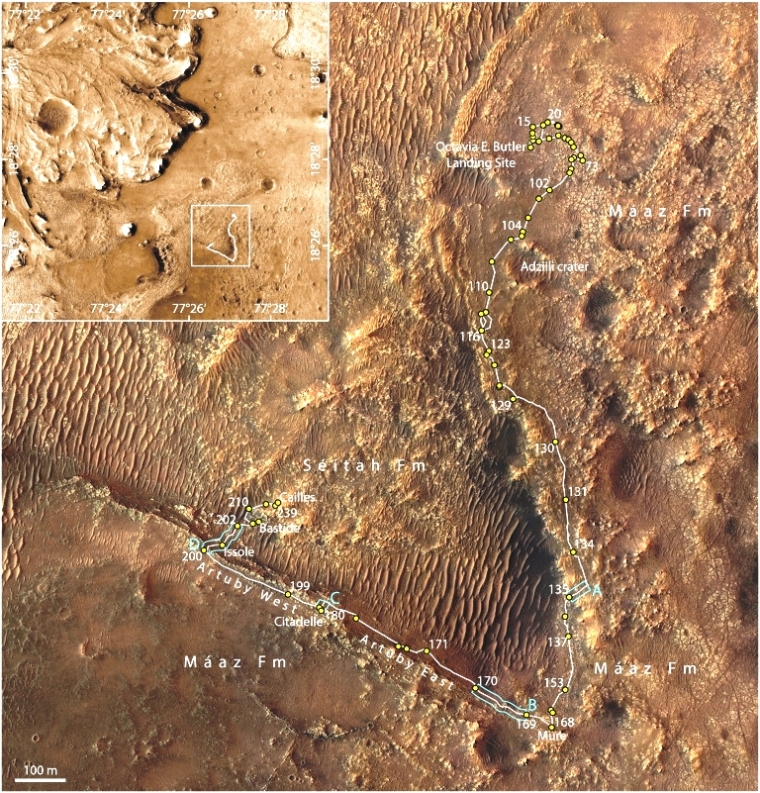 Path of the Perserverence rover. The numbers represent the Sols (Martian days) since landing.
 |
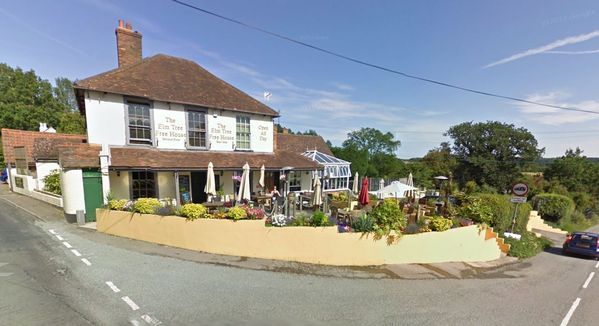 Elm Tree at Beech Hill
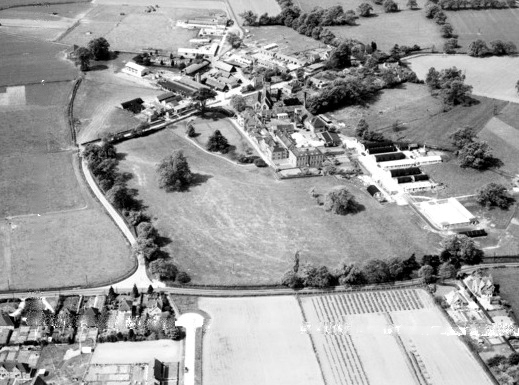 NIRD as in the early 1960s. The field in the bottom of the picture was to become a housing estate in which I had my digs. I had the shortest commute of my career.
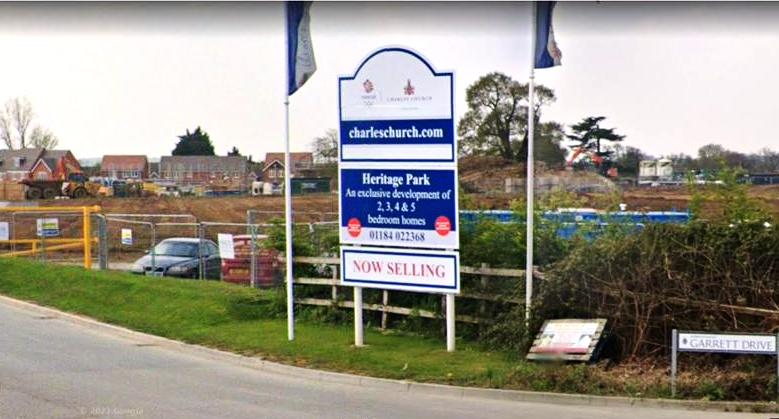 NIRD is now a housing estate
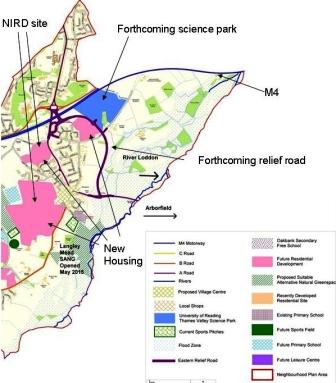 Shinfield parish plan 2017
 The new Shinfield Studios in front of the Thames Valley Science Park. The M4 is on the right. Shinfield old and new is in the background.
|
Autumn 2022 The 2022 NIRD reunion was the first since CoVID-19. It was also my first NIRD reunion… “NIRD?” I hear you cry. Yes, NIRD, the National Institute for Research into Dairying. It was where I spent over a year, it being my gap time between school and college, as a junior technician: at first Experimental Worker and then – once my A-level results came through – an Assistant Scientific Officer. I have been in regular Christmas card exchange over the decades with a former PhD student for whom I occasionally worked (making specific nutrient feed) during my time at the Institute. Anyway, it was good to actually meet up and reminisce along with about 25 others, one other of whom I also worked for (extracting cows' milk protein) and another whom it transpired went to the same school as I in Reading (though he was 20 years ahead of me but we shared the same biology teacher). All in all a pleasant gathering.
The venue, sadly had no public transport access, so the last several miles were undertaken by more fossil fuel intensive taxi (there was a spur railway line but the two miles from the station was along a narrow country lane with no pavement and I was not going to risk it). The venue, the Elm Tree gastro-pub in Beech Hill, had good beer but is not one I'd recommend for food. Gastro-pub prices but not concomitant gastro-pub standard food which was more style over substance: ultra finely chopped veg in some obscure solution, fish smothered in batter (but dissection did reveal there was a marine metazoan there) and (dry) unseparated ribs served on a small wooden plank. (You know the sort of thing: too much watching Master Chef but being unable to deliver.) But the food was not why I was there and it was good to have a wander down memory lane and talk of mutual friends, sadly some no longer with us (including my first boss at the Institute of Biology, who helped build it up, who – at first unknown then to me – also previously worked at NIRD).
NIRD's Wikipedia page has sadly been deprecated, so visitors to it get an auto-redirect to the former Ministry of Agriculture, Fisheries and Food (MAFF) page. A great shame considering the Institute's contribution to improving our nation's dairying productivity (we won't mention that NIRD also was the birthplace of commercial UHT milk -- note the 'commercial' as UHT milk was 'invented' elsewhere). Actually, though much of its funding came from MAFF, NIRD was part of the University of Reading (originally the College at Reading also known as University College Reading). It was originally founded following food issues arising from the First World War as the Research Institute in Dairying and was based in Reading itself. As Reading grew, and required more space, so the Institute moved to Shinfield in 1921 and re-named NIRD by the Board of Agriculture. Over the subsequent decades it acquired more agricultural land and expanded; the last farm to be bought for it was in 1971.
I myself worked there 1976-7 (I am listed in the 1976-7 and 1977-8 NIRD annual reports by Reading U.) and was lucky enough to have a variety of jobs including some germ free and also specific pathogen free (SPF) work. This included providing germ free eggs for hospital patients in SPF isolation undergoing bone marrow transplants. (One of whom I saw on TV after a long day trying to get the egg quota – nature takes its course in its own time – who, when asked by the reporter what was the worst thing about being in isolation, replied: “the food.”)
|
|
NIRD closed on 31st March 1985 (by which time I had completed my studies and was working at the British Medical Association). The government of the day, who felt that agriculture benefitted too much from Common Market agricultural policy, cut agricultural research investment: now somewhat ironic given the reasons for NIRD's creation and that in 2022 the nation produces less than half the food it needs and is in a period of geo-politically induced food inflation, let alone facing a future that will need climate-change-adapted farming… (Ho hum…) On 1st April 1985 the Institute was replaced by the Grassland Research Institute, Hurley and the Food Research Institute, Reading. The latter subsequently closed as a result of the Prior Options rationalisation of mid-1990s, while under the leadership of someone who was to become the Institute of Biology's last General Secretary/Chief Exec' before it lost its prestigiously-located, South Kensington offices (literally within sight of the Natural History Museum), rebranded as the Royal Society of Biology and got a new Chief Executive. (So you can see that there is a web of connections.)
In 2003, following a science management meet, I did briefly visit the deserted NIRD, courtesy of a taxi driver who happened to be a graduate member of the Institute of Biology (my one time of fame with a member of the public). The Old Barn, (converted inside to a lab which had held protected heritage status) where I worked, was still there. Jump forward to 2022, I had a lift back from the NIRD reunion and we passed by the old place. The Old Barn and Manor building have both gone! (Planning regulations having been relaxed by the late 2010s government: the inside of the barn could have been converted to a shop and the Manor a library, but, hey, modern communities don't need facilities do they.) It is all now a brand new, housing estate (called 'Heritage Park') which will home some of the staff at the new Reading University Science Park (no doubt part funded by selling NIRD's land for development) as well as the new Shinfield film Studios next to the said Science Park, on the east of the parish and also on university land. The Black Boy pub (where we used to socialise) is still there on the Shinfield side of the bridge over the M4, but has just been renamed (for very understandable reasons), as are other landmarks, but new housing – not countryside – now dominates the area around Shinfield centre and a new Shinfield centre will be created on the south side of the old village centre.
|
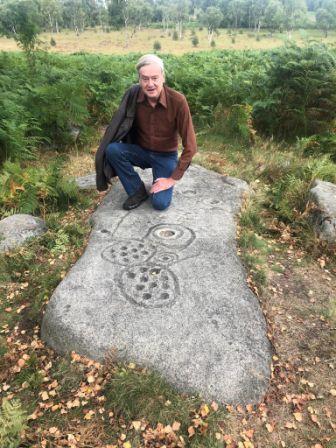 Late Bronze Age early Iron Age stone
Gardom's Edge
|
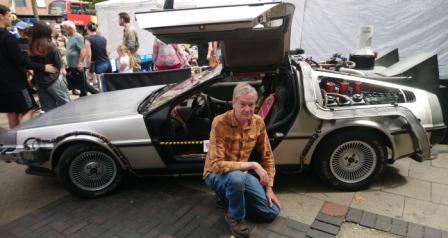
Summer 2022 Rural sojourn. A welcome catch-up with old friends: another first time since CoVID-19. Also a chance to get out in the field. This is a late Bronze Age cum early Iron Age carved stone at Gardom's Edge. If so, this would date from 750 – 800BC some 2,800 years ago. However, some say that it is even older dating from the Bronze Age so it could be as much as 4,000 years old. (Iron, would make the carving easier.)
The meaning of the image is unknown but it could possibly be a map representation of a local community?
By the way, in the picture (left) I am not kneeling on the actual rock but a clever, rock-looking protective cover over the real carved rock below. So I am not adding to its erosion. (In case you were worried.)
There are other stones nearby as is Eaglestone Flat where ancient farming took place.
The view is excellent looking out towards Baslow in the Derwent valley below.
|
|
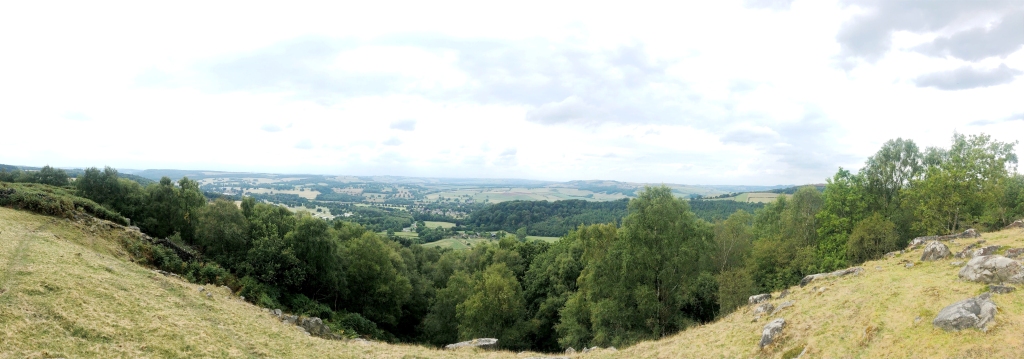 View looking west from Eaglestone
 |
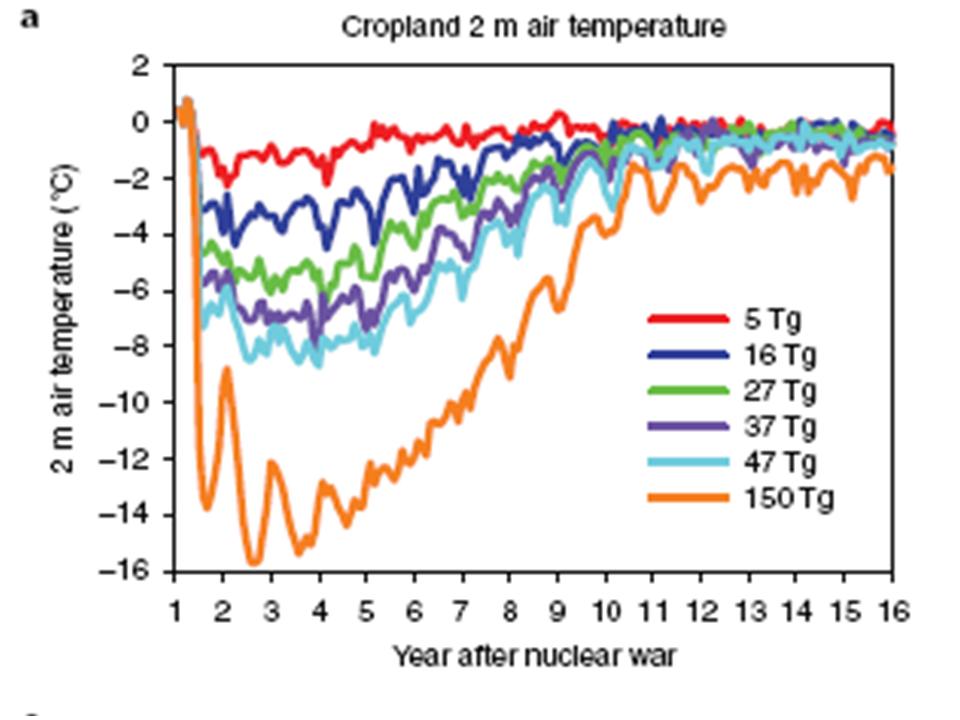 Simulated crop air temperature over 16 years following nuclear exhchanges generating 15 kilotonnes to 100 kilotonnes soot.
© Xia, L., et al. (2022) Open access.
Reproduced in the context of a review.
|
Summer 2022 Thinking the Unthinkable: Nuclear war. A paper in Nature Food has examined the climatic effect of nuclear winters from nuclear war on agriculture and livestock by nation for various scenarios ranging from a 15 kilotonnes of TNT equivalent exchange to 100 kilotonnes. An exchange involving the two smallest nuclear powers (India and Pakistan generating 16–47 Tg soot) would see between 52 and over 100 million die in the exchange and between nearly a billion to over two billion starve by the end of year two. In all but the lowest scenario, 5Tg soot released, temperatures would be depressed for the best part of a decade. The only countries escaping food decline would be Australia and Argentina.
With Russia's invasion of Ukraine, let's hope some nutter does not do anything stupid... Here in all but the lowest scenario, Russia sees some starvation. Only in the lowest three scenarios does the United Kingdom escape starvation.
Xia, L., et al. (2022) Global food insecurity and famine from reduced crop, marine fishery and livestock production due to climate disruption from nuclear war soot injection. Nature Food, vol. 3, p586-596.
|
|
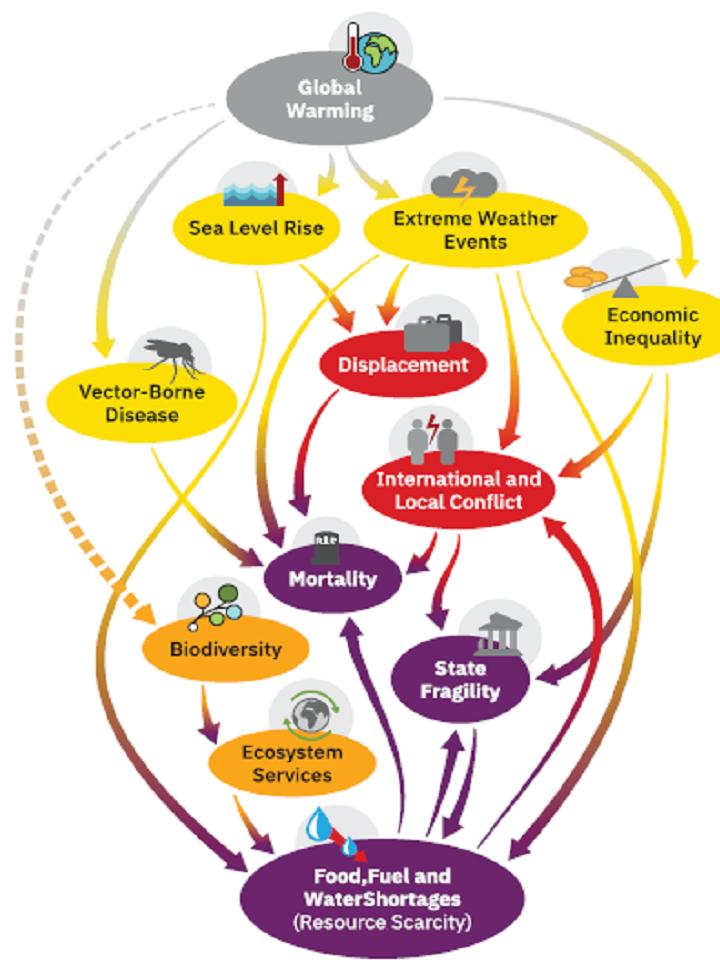 Climate-driven societal cascades
© Kemp, L., et al. (2022) Open access.
Reproduced in the context of a review.
Kemp, L., Xu, C., Depledge, J., et al. (2022) Climate Endgame: Exploring catastrophic climate change scenarios. PNAS, vol. 119 (34), e2108146119.
|
Summer 2022 Thinking the Unthinkable: Climate Endgame -- Exploring catastrophic climate change scenarios. Believe it or not, up to recently, we in the climate science community have been remarkably restrained in formal science proclamations. For example, while the small print in the IPCC reports plainly say that their future scenarios do not include feedback effects (such as melting permafrosts with warming release methane that furthers warming), they do say we need to "be aware of surprises". So perhaps it is time to think the unthinkable and formally look at what might happen if the worse comes to the worst. If you thought it was bad, think again.
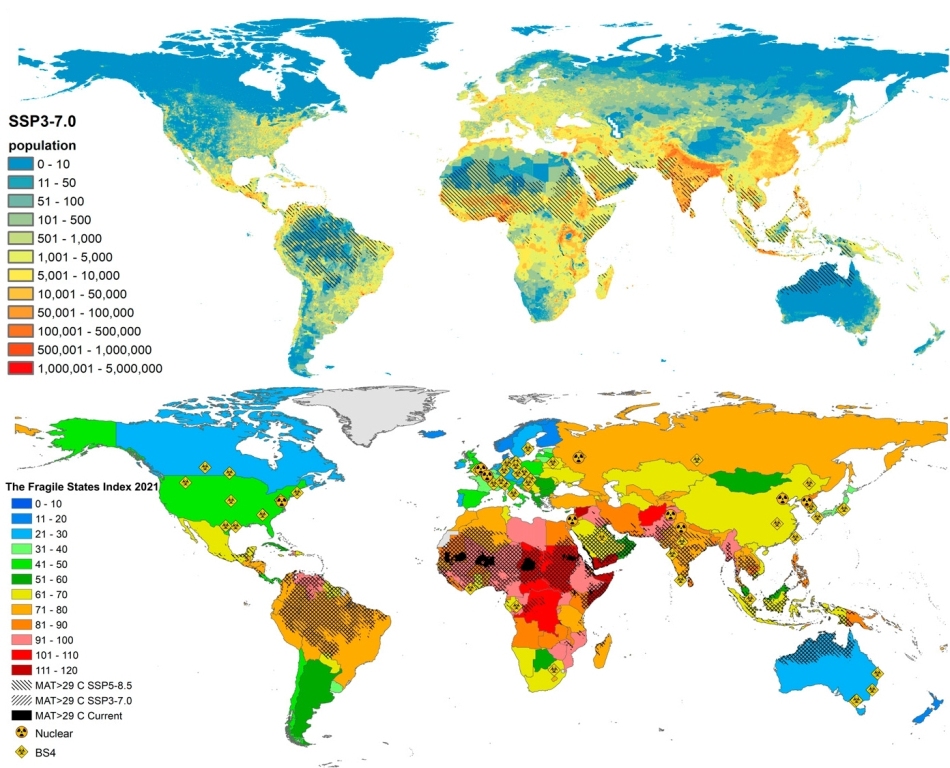
The worst that could happen is that some areas of high population become impossible places to live without universal air conditioning: they'd be too hot. And if those areas were socio-politically unstable, this could lead to societal collapse (there would be climate-driven societal cascade effects (see illustration left)), or if they had nuclear weapons there might be a nuclear incident with neighbours. Both possibilities have global impacts. Even if everything remains peaceful, we are likely looking at hundreds of millions, if not a billion, affected in the middle of the second half of this century and a migration pressure unparalleled in human history.
A small international collaboration, led by Luke Kemp of Cambridge University, have taken a preliminary look in the journal Proceedings of the National Academy of Science (PNAS). See below for where it all is likely to kick off...
|
|
 © Kemp, L., et al. (2022) Open access. Reproduced in the context of a review.
 The bottom map solid black areas represent places (only 0.8% of Earth’s land surface area) where the mean annual temperature (MAT) is today above 29°C and so have extensive periods where it is physiologically too hot for humans. The top map depicts likely future (2070AD) population in the bottom map's black areas, which demonstrates that people do not like to live in these currently too hot areas (blue denotes low population and orange and red very high population densities). The top map's shaded areas and the bottom map's hashed areas are the places in 2070 under the IPCC mid-range forecast (SSP3-7.0) where it will be too hot for humans (without extensive air-conditioning etc). The bottom map also depicts state fragility (as defined by the 2021 Fragile State Index (FSI)): blue is most stable, and orange & red least stable. The capitals of nations with nuclear weapons are marked with a radiation symbol. Looking at both maps together, areas where it will be too hot to live include west sub-Saharan Africa, much of Amazonia, India, SE Asia and NW Australia. Too hot areas with likely high population densities are sub-Saharan Africa, India and SE Asia. Currently, only 30 million people live in hot places, primarily in the Sahara Desert and Gulf Coast. Whereas, around 2 billion people are expected to live in the extremely hot areas of 2070. Factor in state fragility and nuclear weapons, then India and Pakistan is the principal touch point.
|
|
|
 Fossil of Auroralumina attenboroughii
© F. S Dunn et al, reproduced under fair
use in the context of a review
 How A.attenboroughii might have looked
560 million years ago
© F. S Dunn et al, reproduced under fair
use in the context of a review
 Charnwood rocks in Charnwood forest.
 Snowball Earth II of the Neoproterozoic.
(Actually, imaged here
is a slushball Earth.) |
Summer 2022 A fossil of the earliest animal predator has been discovered dating to around 560 million years ago (mya). This discovery is of interest to those in the Earth systems science community looking at the co-evolution of life and planet. Shortly after Snowball Earth II (around 720 – 635 mya) and in the Ediacaran Period (~635–542 mya) there was a boom (the Avalon boom, of rather strange forms of life of which much is still unknown. These were the Ediacara. The thing is that they were wiped out and completely replaced around 541 mya subsequent to which there was the Cambrian boom of species.
Their extinction is thought to have been due to the evolution of species with a mouth and gut. Any animal predators around at the time would have preyed on Ediacarans. So, when did the first of these predators evolve?
As more and more fossils have been found, so the date of the earliest has slowly been pushed back. Now, Frances Dunn and palaeobiological colleagues have discovered a fossil of an animal predator, Auroralumina attenboroughii. It is some 20 cm long, and it is the earliest animal predator so far discovered. Dated to around 560 mya, it is firmly in the Ediacaran period and maybe among the first of the predators that began to wipe out the Ediacaran biota.
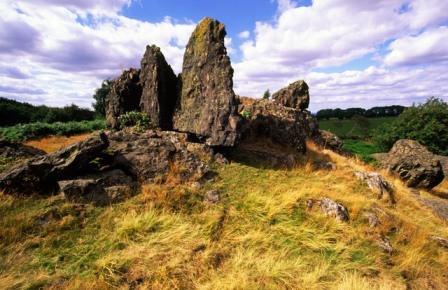
Auroralumina attenboroughii is a coelenterate and belongs to the phylum Cnidaria. It does have a gut of sorts, but not a 'through gut'. Its name, Auroralumina attenboroughii is derived from Aurora (Latin = dawn), referencing the great age of the fossil; lumina (Latin = light), alluding to the torch-like appearance of the species; attenboroughii, after Sir David Attenborough FIBiol for his work raising awareness of the Ediacaran fossils of Charnwood Forest. And as it happens Charnwood Forest is not too far from my part of the world, and so an afternoon out to it is in order.
In terms of being only loosely connected to my own work, I am of the opinion that animals, and possibly Coelenterates, evolved earlier before Snowball Earth II (around 720 – 635 mya). I should say that this is for some a controversial view as some consider the atmospheric concentration before Snowball II was too low for animal life: the atmospheric concentration was somewhere around 2% (very approximately a tenth of today's) and, over around 80 or 90 million years from roughly 720mya, grew to close to today's levels during Snowball II. However there is firm evidence that animal life could survive this low oxygen level: don't knock it until you have tried it and there is clear evidence that small coelenterates can survive under low (around 2%) levels (Mills, D,. B., Ward, L. M., Jones, C. et al. (2014) Oxygen requirements of the earliest animals. Proc. Natl. Acad. Sci., 111 (11), 4168–4172. doi/10.1073/pnas.1400547111.). The problem is that such animals lacked hard structures and were small (far smaller than Auroralumina attenboroughii), so finding them -- assuming they exist -- in the fossil record is extremely difficult (they don't form easily identifiable fossils). Having said all of this, I am happy to go along with Auroralumina attenboroughii being one of the earliest of the larger animals so far discovered, even if it was only 20cm long and after Snowball II: the closer we find animals to Snowball II the greater the odds there were proper multicellular animals (not just things like sponges) before that Snowball. (See Dunn, F. S., et al (2022) A crown-group cnidarian from the Ediacaran of Charnwood Forest, UK. Nature Ecology & Evolution.)
Why (if it did happen) is early (before Snowball II), widespread multicellularity important? Well, the conventional view is that the earlier Snowball Earth II was caused by the break up of a supercontinent: the supercontinent over the tropics blocked tropical ocean water from warming higher polar latitudes, so cooling the Earth and the continent's breakup releasing sulphates furthered the cooling driving the Earth into a Snowball condition. Ultraviolet light on the global (or near-global if you are a slushball person) ice sheet generated hydrogen peroxide which decomposed releasing oxygen and this enabled multicellular animals to survive and oxygen-generating plants to evolve (before that there was only prokaryotic, oxygen-generating cyanobacteria). That is the very short version of the traditional view. A new 'co-evolution of life and planet' narrative has it that multicellularity evolved well before Snowball II and that some multicellular species, possibly including proto-lichens, colonised the land and, growing on rocks, released nutrients (including phosphorous) into the oceans, especially the semi-confined inland seas of the supercontinent break up, so causing a boom in eukaryotic photosynthesisers (such as true algae) and these boosted the Earth's atmospheric oxygen levels around ten-fold to near present-day levels. So the more examples of early, true multicellularity (such as multicellular animals -- and not just things like sponges) then the greater the likelihood of terrestrial multicellularity before and during the various stages of Snowball II. The old and traditional narratives from here on in are the same, there was a boom in the mysterious Ediacaran life, modern day species then evolved (including this newly discovered, and so far recorded early animal, Auroralumina attenboroughii) and completely replaced the Ediacarans. These new species then thrived following their own Cambrian boom... Until half a billion years later, one other new species (H. sapiens) evolved that once more disrupted the Earth's carbon cycle, and again causing global climate change, only this time warming, not cooling. And just as multi-cellular, predator and herbivore animals, of which Auroralumina attenboroughii is an example, that wiped out the Ediacarans, this current, new species is also causing a mass extinction... (Someone should write a book on this.)
Meanwhile, below there's a 10-minute PBS Eons video on Auroralumina attenboroughii...
|
|
 Meeting James Lovelock who devised the notion of the Earth's biosphere as a semi-self-regulating cybernetic system a.k.a. 'Gaia theory'. The occasion was a two-day symposium in 2011 on 'Life & the Planet' and the launch of a 3-year NERC programme.
 2001 Geoscientist article on Gaia theory
gets the Lovelock seal of approval |
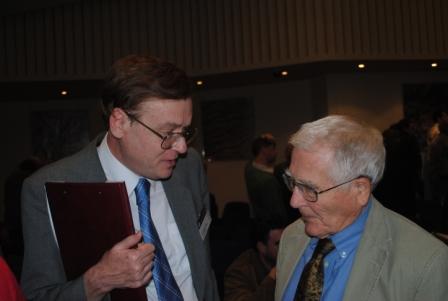
Summer 2022 James Lovelock has, alas, passed. He died on his 103rd birthday, so we were lucky to have him for so long. An independent scientist, he trained as a chemist and then as a clinician, James Lovelock was the first to detect the widespread, low-level presence of chlorofluorocarbons (potent greenhouse gases and atmospheric ozone depletors) using an electron capture detector he invented. Subsequently, after hearing a lecture by Lovelock, Sherwood Rowland and Mario Molina researched ozone depletion for which they received a Nobel Prize.
James Lovelock is best known for developing the Gaia hypothesis, that the entire Earth system (both living and non-living components) act as a single, self-regulating system. This he popularised with his book Gaia: A new look at life on Earth (Oxford University Press, 1979) which I read as a student and found fascinating. I did not know it, but a few years later, as Publications Manager at the Institute of Biology, one of my first jobs was to liaise with James Lovelock to get copyright permission on one of his Gaia articles for reprinting in the journal Biologist (it shifted from being a peer-reviewed journal to a magazine in the 2000s a few years after the Institute became the Royal Society of Biology, so you won't find such articles in it today). Lovelock was rather pleased to have his article reprinted in the journal as his Gaia theory had had, at the time (the 1980s), short shrift from many biologists. Subsequently, on just a handful of occasions, I was able to meet the man.
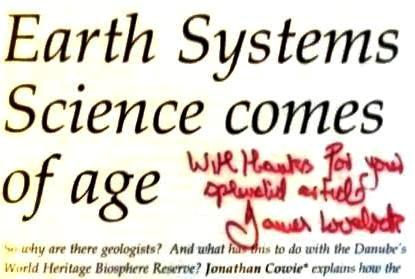
Jumping forward to 2001, I wrote an article in Geoscientist to introduce the Geological Society's latest specialist interest group, the Earth Systems Science group. In it, I touched on some scientists' misunderstanding of what Gaia theory was all about. A few weeks later, I met the man at the Earth Systems Science group's inaugural meeting and he had read the article: he even gave it his personal seal of approval with an autograph... (See picture left.) Finally, in recent years I have been developing a co-evolution of life and planet narrative and have been re-reading Lovelock's books. For very much the most part -- certainly in all the key aspects -- they stand as sound today as they did decades ago. He was inspiring.
|
 a) All species range-shift encounters
b) Excluding bat species range-shift
encounters with warming to 2070.
© Nature, 2022, reproduced under fair use in the context of a review
 Present-day viral linkages
© Nature, 2022. Silhouettes are from
http://phylopic.org
under Creative
Commons license (creativecommons.org/licenses/by/3.0).
Reproduced under fair use in the
context of a review. Rodents, as
illustrated, currently dominate species
to species transmission; in the future
it will be bats. |
Summer 2022 Was it just chance that SARS-CoV-2 originated in bats? Or could climate change have played a part? For a few years now I have been working on a co-evolution of life and planet narrative; indeed, I am close to completing it. A few years is sufficient time for new research to be published and this needs to fit in the narrative I have already devised. Fortunately, so far all new research has either neatly slotted in to the existing narrative developed, or added ancillary detail. And so we come to the question of our species, H. sapiens aided by technological 'success', dominating the planet. Alas, the past century or so has seen the erosion of natural systems through our encroachment on them.
Now, we have known for a while that human encroachment on natural systems means that humans will increasingly encounter mammals that share viruses with other animals and that some of these can infect humans. Just a couple of years ago, a small team of British-based bioscientists with lead authors Rory Gibb and David Redding, of University College London, noted that as human-dominated land use increased, so did the total number of zoonotic hosts (species hosting pathogens capable of infecting humans). (See Gibb, R., Redding, D. W., Chin, K. Q. et al (2020) Zoonotic host diversity increases in human-dominated ecosystems. Nature, vol. 584, p398-402.) However, could other factors add to the risk of disease transferring from mammals to humans?
One dimension to our species technological 'success' has been our short-circuiting the deep carbon cycle, harnessing fossil carbon to develop and power our global society which has resulted in human-induced climate change. So, question, could climate change affect viral spillover from animals to humans?
Those of you who have read my climate change biology books will be aware that as the Earth warms, so species ranges (where they live) change, but the thing is that species react to warming differently and so species that were not in contact with each other before will now meet. This will mean an increased chance of a virus transferring from one species to another.
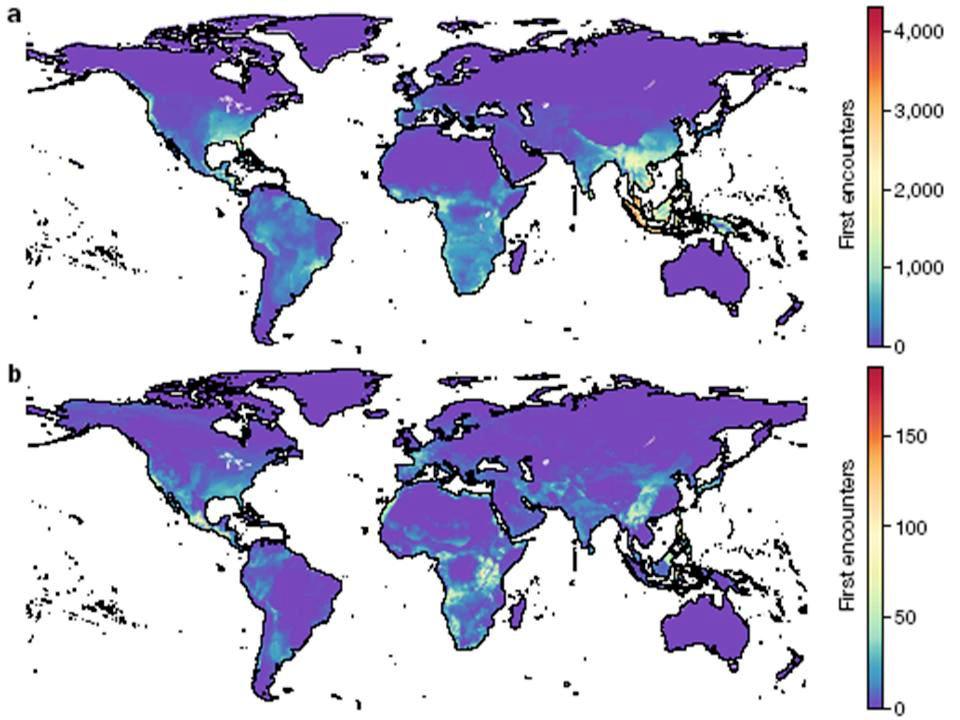
Just published is work by a small research collaboration, led by Colin Carlson and Gregory Albery of Georgetown University in Washington DC. They analysed projections of geographical range shifts for 3,139 mammal species under climate-change and land-use scenarios to the year 2070. They found in particular there will be new species encounters at higher altitudes and in areas of existing high biodiversity in Asia and Africa. Worryingly, these areas additionally tended to be of high human population density. They also found that with warming bats would be the single species family with the greatest likelihood to be the source of a new viral infection of humans.
Taking out land-use scenarios, and looking just at climate change, they found that climate change scenarios, even scenarios in line with the Paris Accord, would essentially lead to a doubling of species-to-species contacts. So, along with human encroachment on natural systems, climate change also likely played a role on the SARS-CoV-2 outbreak. (See Carlson, C. J., Albery, G. F., Merow, C. et al. (2022) Climate change increases cross-species viral transmission risk. Nature, vol. 607, p555-562.)
|
 Alan Grant in the 2000AD Command
Module during a Hatfield PSIFA visit 1979.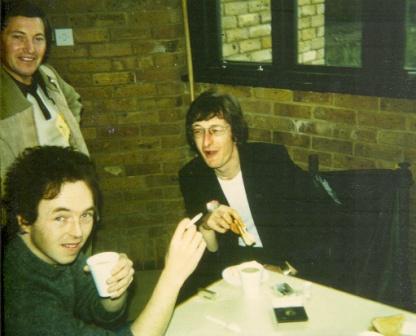 Alan Grant (right) and 2000AD colleagues
at an early Hatfield PSIFA Shoestringcon
including Mike McMahon (bottom).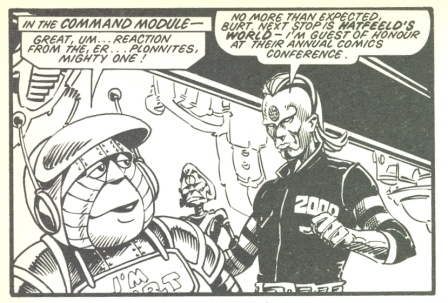 From the 2000AD 1983 annual (1982).
'Hatfeeld' gets a mention. |
Summer 2022 Sad news with the passing of Alan Grant.
The British comics writer, has died aged 73. Alan is arguably best known, in Britain at least, for his work on 2000AD including a stint as its editor. He is also well known for his writing partnership, before, during and after his time at 2000AD, with John Wagner including on Judge Dredd, but in the USA perhaps on Batman (occasionally again with John Wagner). With regard to Batman, he was responsible for the story arc Batman: The Last Arkham among much else. All the above does not do justice for a long and active career in comics.
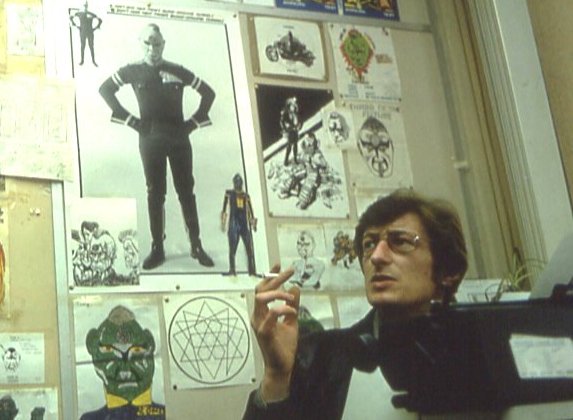
For some of us associated with the first generation of Hatfield PSIFA (at the Polytechnic, now Hertfordshire University), we met a couple of times in the late 1970s at the former Tharg Command Module (in IPC's King's Reach Tower) and again when half a dozen of the 2000AD crew were guests at an early Hatfield PSIFA Shoestringcon.
We were sufficiently taken with Alan that he was the Guest of Honour at one of PSIFA's annual (Chinese) dinners after which time was spent with several of us at our student digs. Hatfield and PSIFA had several cameo mentions in 2000AD strips and PSIFA (along with the Cambridge University SF Society) was granted permission for the Strontium Dog support character, the Gronk, as PSIFA's official mascot.
Alas, I am of an age when those a decade or two older than I and my cohort to whom we looked up are sadly going. Of the early 2000AD generation, we have already lost Tom Frame and Carlos Ezquerra. Others of the 2000AD crew of that time include Colin MacNeil, Mike Mahon, Pat Mills, Steve MacManus and, of course, John Wagner. Make the most of them.
|
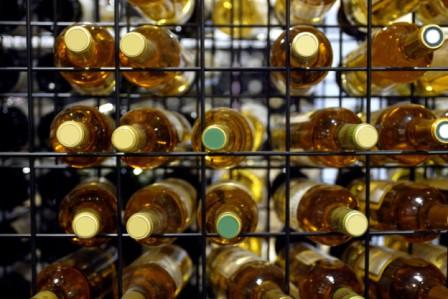 Silvia Carlin's and Fulvio Mattivi's key
study. Research you can drink to. |
Summer 2022 Clear bottles ruin white wine research shows. As science continually reveals, it is the best way to reveal key life lessons... And so everyone, take note... Supermarkets are increasingly selling white wine in clear bottles as this shows off their colour. However, Silvia Carlin and Fulvio Mattivi of the Edmund Mach Foundation (Italy) looked at 1,052 bottles of white wine -- some clear-glass, some coloured -- stored under supermarket shelf conditions. They then analysed the wine's aromatic compounds. These molecules give the wine its fruity aromas. What they found was that that wine stored in clear-glass had 70 molecules degraded by light by 70% in 7 days. Conversely, those stored in green glass were protected from change even after 50 days. (See Carlin, S. et al (2022) Flint glass bottles cause white wine aroma identity degradation. Proceedings of the National Academy of Sciences, vol. 119, e2121940119.)
|
|
 The lime hawkmoth, Mimas tiliae,
the 60th species to be sequenced.
Only 69,940 to go. |
Summer 2022 The Royal Society Summer Exhibition 2022. I simply have to give another shout-out to this annual Royal Society event and especially this year as it is the first year we have had it since the CoVID-19 lockdowns.
If you have never been to this, and you are into science, then you are in for a treat. It consists of about 20 or so small exhibits, stands (poster, displays, models etc.) of different areas of science research. And here's the thing. It is staffed by research students who actually work on the projects and who will explain things to the kids, usually with aids and there are always leaflets and such. And for those grown-ups with a little general science knowledge, there is usually a senior researcher on hand for some in-depth discussion. What's not to like?
To give you a flavour, one of this year's exhibits concerned a project to sequence the genomes of 70,000 species living in Great Britain.
This year I went with a local friend as well as a former colleague from the Institute of Biology and her partner.
As said, this exhibition happens every year so bear this in mind for next year. Tip: Go with some friends but agree to have a rendez-vous time and place for the end of your visit. That way, you and your friends can each decide how much time you want to spend there, and so arrive separately. Then meet up at the rendez-vous for a meal or drink after.
Details on the Royal Society website royalsociety.org or Google "Royal Society" and "summer exhibition".
|
|
 Andy Weir's The Martian
published by Del Rey
Following the vaccine rollout,
with publisher launch parties,
science fests, reunions etc,
all resuming, it's
Back to the Future.
|
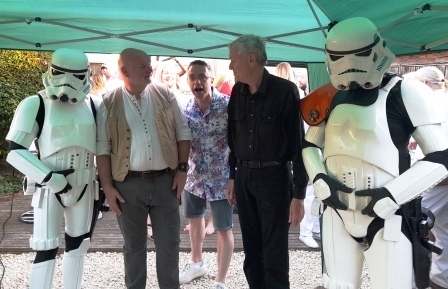
Summer 2022 The first publisher jolly since the CoVID lockdown. Usually I get to two or three publisher events a year for Concatenation's genre wing, the Science Fact & Science Fiction Concatenation (in case you are reading this in the far future, it is archived at the British Library Web Archive). However, since the first SARS-CoV-2 / CoVID-19 lockdown in 2020 such publisher bashes (along with physical science symposia and other events) had ceased. This event was my first publisher do for a couple of years and a day out down to London and also to do a quick check on Concatenation's Kent mission control.
This party was run by the SF imprint Del Rey who has re-launched in a new home. You may not have known it, but Del Rey moved from Ebury (in Penguin Random House) to Cornerstone (also in Penguin Random House) in 2020. Del Rey is the publisher of Andy (The Martian) Weir among others, and Cornerstone also do Star Wars books. So even though Ebury also does Doctor Who books, they did not seem to be developing their SF imprint, Del Rey. However, Cornerstone were keen to have an SF imprint of their own.
OK, so if this happened back in 2020, why is it news now? Well, Del Rey had hoped to have a launch party back in 2020 and bring over Andy Weir for it. However, that little thing of the aforementioned SARS-CoV-2 / CoVID-19 global pandemic happening and so there was no formal launch party: that event has now happened! The end of June saw a gathering of some of the SF publishing scene in Clerkenwell to see Del Rey re-launched. (SF² Concatenation thanks Del Rey for the hospitality, our first publisher bash since CoVID.)
The Del Rey imprint will be helmed by Sam Bradbury (formerly of Hodder and prior to that had a junior role at Jo Fletcher Books (Quercus)). In addition to publishing British talent, Del Rey (UK) will partner with Del Rey in the US and so we may see a few more North American authors over here: not all N. American authors get the profile over here afforded over there. Hopefully, this will be reciprocal with more Brit author exposure State-side.
For my part, I alerted them to there being an SF Worldcon in Glasgow in 2024. True, the Worldcon site selection bid for 2024 will not take place until later in the year at the 2022 Worldcon in Chicago, but the deadline has passed for additions to the site ballot paper. As there are no other serious bids on the ballot (the others are the customary joke bids – Worldcon on the Moon etc.) So Glasgow will win. And, of course all the major SF imprints have publisher parties at the Worldcon for their authors and SF trade. So possibly we'll get a Del Rey invite?
|
 The programme book front cover. This was back in the days (prior to the 2010s) when Eastercons had a souvenir programme book in addition to the schedule timetable booklet. It is particularly notable as being the first British Eastercon programme book to have a full colour cover. The cover art was by one of the convention's GoHs, Keith Roberts.
 |
Spring 2022 BECCON 41st year reunion. This was meant to be our 40th year get-together but SARS-CoV-2 / CoVID-19 lockdowns in 2021 put paid to that. BECCON was a series of biennial conventions in the 1980s: 1981, 1983, 1985 and the 1987 UK Eastercon. BECCON standing for the Basildon Essex Centre CONvention with 'Centre' becoming 'Crest' when the hotel changed its name. The 40th anniversary reunion would have taken place last year but was postponed due to CoVID. The gathering took place in Arlesey, Bedfordshire, where previous reunions had taken place so as to give one of BECCON's film projectionists and Concatenation's physicist, Graham Connor, a fan experience (Graham had severe mobility issues several years prior to his passing and could not get to conventions).
BECCON may be a thing of the past but those involved with it, for the most part, are still very active in fandom and BECCON did spawn two spin-out ventures still going today: Beccon Publications (a number of whose books have been short-listed for Hugos) and the SF² Concatenation (the winner of a number of Eurocon Awards). SF² Concatenation's first edition, in print back then, came out at the 1987 BECCON. And guess who print farmed the programme book?
|
|
|
|
Spring 2022 First public relations venture since CoVID lockdown. Once again, I have been asked to undertake press liaison for a volunteer event. However it will also probably be my last. Since CoVID local and regional press has taken a dive. Some newspapers are simply no more. Others have become more regional covering news from three times the area of their former incarnations. This means no column space for really local events even if they are ones that attract hundreds. The future of local PR seems to be social media. So after four decades of undertaking occasional PR for voluntary groups – heritage ventures, conventions, parish councils and aforementioned beer fests, etc., which built on my previous occasional science media liaison – it is time to call it a day! Indeed, as you can see from the logo (left), this beer fest was meant to celebrate the 75th anniversary of VE day (Victory in Europe at the end of WWII) which would have been in 2020 but alas CoVID lockdowns prevented that event though the organisers had already created the graphics, had T-shirts made, glasses engraved and so forth.
|
|
|
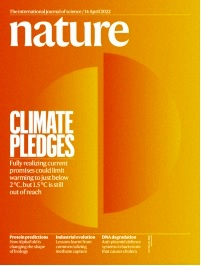
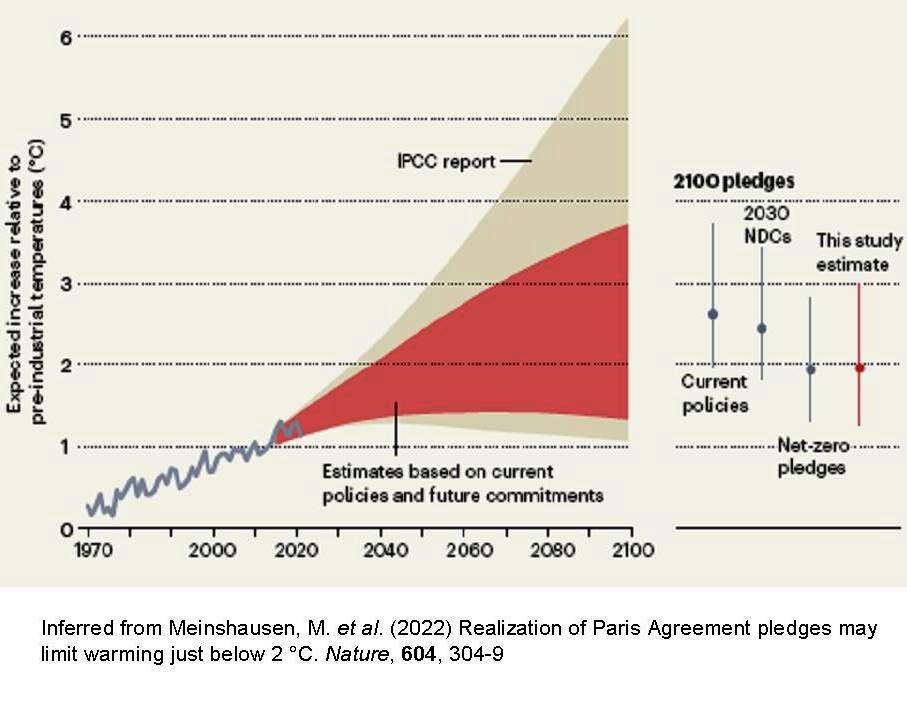
Spring 2022 There is just a chance of our meeting the COP Paris Accord target of limiting warming to 1.5°C. The COP 21 Paris Accord (2015) called for warming to be kept to below 2°C and ideally within 1.5°C above pre-industrial temperatures. As those who are acquainted with me will know, I have for decades felt that we would be unlikely to keep warming below 2°C.
The latest research, by Malte Meinshausen, Jared Lewis, Christophe McGlade and colleagues in the journal Nature, suggests that warming may be kept to just below 2°C if (note the 'if') all (note the 'all') the Paris Accord pledges were kept and speedily adopted (which so far they are not), but not to below 1.5°C.
See Meinshausen, M., Lewis, J., McGlade, C. et al (2022) Realization of Paris Agreement pledges may limit warming just below 2°C. Nature, 604, 304-9 and Hausfather, Z. & Moore, F. C. (2022) Commitments could limit warming to below 2°C. Nature, 604, 247-8.
All this sadly echoes the appraisal made in my 2009 essay Can we beat the climate crunch whose sentiments in turn were subsequently reflected by several others.
|
|
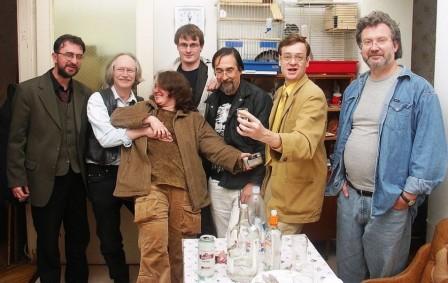 East meets west in Kyiv 2006. From left: Romanian fan, Imants Belogrivs (Latvian publisher) Latvian fan (in front), Martin Untals (Latvia), Jean Pierre Laigle (France), Jonathan Cowie (Great Britain) and Sergei Slyusarenko (Ukranian author). Photo by Roberto Quaglia (Italy)
 |
Winter 2022 Russia's invasion of Ukraine is a tragedy on many levels. Any war results in death and suffering and so is a tragedy; doubly so because this one is so needless, it being waged just to serve one lunatic's warped ambition. For those who have connections with that country it is not just a tragedy on the television news: it is personal. Here, what you may not realise is that for one and a half decades this website's (and its genre wing's over at SF² Concatenation) internet service provider (ISP) has been arranged and supervised by Boris Sidyuk in Kyiv which is currently under missile onslaught. It is all very worrying. (Fortunately, Boris in Kyiv has arranged for our ISP to be one in the West.)
These worries aside – though it is impossible not to see the awful news – there are other concerns. For example, the yellow in the Ukrainian flag (see left) represents Ukraine's wheat: it is a major wheat producer and exporter, and its production will be impacted by a prolonged conflict. Further, if Europe and the West impose economic sanctions (as seems likely) then there is an European energy security issue: Europe – especially Central and Eastern Europe – imports fossil energy, especially gas – from Russia. If only someone decades ago has said that one of the opportunities of adopting climate change policies (weaning off fossil carbon) would be greater energy security through decreased reliance on energy imports… Hang on… Climate Change: Disaster or Opportunity? (1998).
|
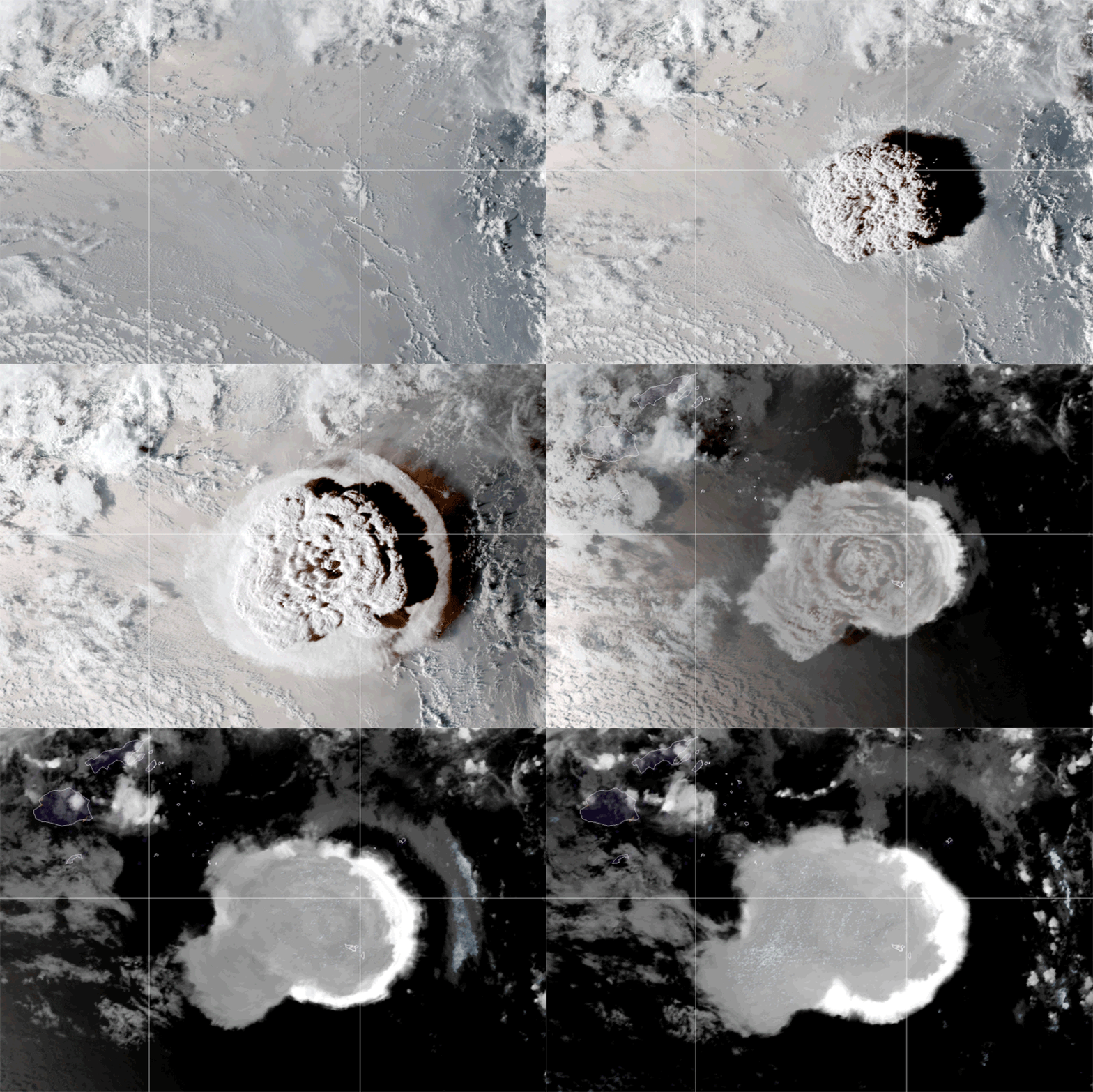 15th January 2022
 |
Winter 2022 The submarine volcanic explosion of Tonga as seen from space. As if we did not need reminding, the Earth system is capable of giving us abrupt shocks. The eruption was the largest explosion recorded in the atmosphere by modern instrumentation, far larger than any 20th century volcanic event or nuclear bomb test. This one, though, is nothing to the kick we are giving to the Earth system through the 20th and 21st centuries release of fossil carbon to the atmosphere. Though big, this Tonga explosion released comparatively little sulphate and so any short-lived (a year or so) climatic impact is likely to be minimal (less than 0.5°C).
|
 Soylent Green (1973)
 |
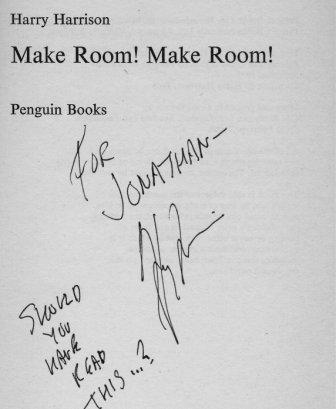
New Year's day 2022 Welcome to 2022! Now, let me take you back to the 1970s and there I was studying chemistry, physics and zoology for A-levels and wondering what on Earth I was going to do with my life. Two things happened. First, a morning assembly by my chemistry teacher on the theme of oil reliance (the oil crisis was topical). Second, at school's film appreciation class we saw Soylent Green. This was based on the novel Make Room, Make Room (1966) by Harry Harrison whom I later met and became acquainted as sometimes we were on the programme together at SF conventions. (He wondered whether I should have read his novel…) But I digress, welcome to 2022 and the year in which Soylent Green (1973) was set.
Fortunately, the real 2022 does not have the resource-depletion, climate change, pollution, degraded oceans and population to the extent of the Soylent Green 2022, but it is only a matter of degree: the issues are still all there.
But why did the 1966 novel and 1973 film depict such an overpopulated planet? Well, if you get an early edition of Make Room, Make Room you will see an appendix containing a reading list of environmental reports and science books: the novel (less so the film) did have its roots in environmental science but alas recent editions have dropped this appendix. Back then, in the early-to-mid-1960s the world population was not growing exponentially (like your savings account at say 5% per annum); instead, it was growing super-exponentially. Super-exponential growth sees the growth rate itself growing. This is a bit like your savings account having an interest one year of 5%, then the following year 6%, then 7% and so forth. So, for a while there was a real concern that we were headed for a grossly overpopulated world (much more so than the grossly overpopulated world were are now in) to the extent that the issue was commonly described as 'the population bomb'.
Sadly Harry is no longer with us but you can enjoy 2022, especially following the global pandemic years we have had. You might also check out Make Room, Make Room and, if nothing else the Charles Braverman two-minute opening introductory set-up to Soylent Green that you can see for yourself on YouTube. Harry really liked that opening sequence.
|
|
|
Autumn 2021 COP 26 in Glasgow has ended – Not enough done to limit warming to below 2°C let alone 1.5°C. The 26th United Nations Climate Change Conference of the Parties (COP26) has ended with same old, same old. Even though negotiations overran by a day the 'Glasgow Climate Pact' which is meant to provide a roadmap for the COP 21 Paris Accord (2015). That Accord called for warming to be kept to below 2°C and ideally within 1.5°C above pre-industrial temperatures. The Glasgow Climate Pact suffered from objections from China and India, among others. But even nations, such as Britain, with laudable climate goals don't seem to be properly on track to meet them. The saga continues with COP27 in Egypt next year (2022).
|
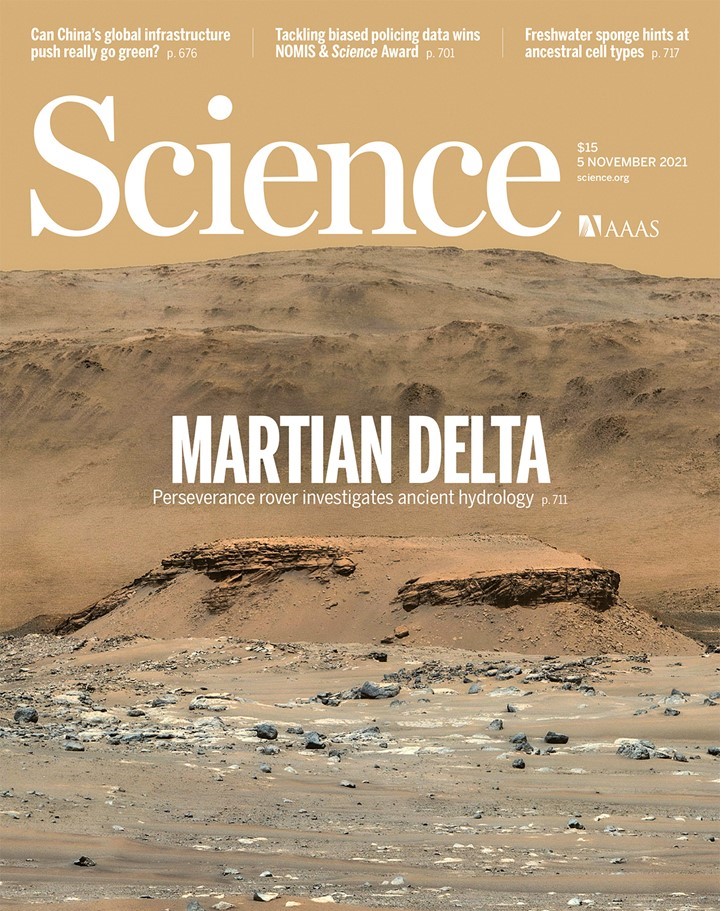 © Science, used under fair use in the context of a review
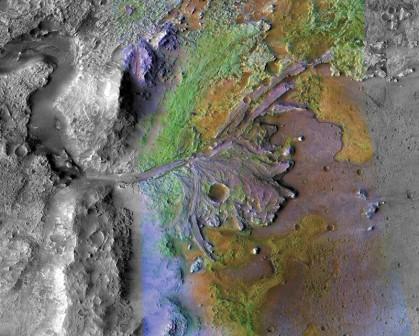 Jezero delta, false colour as seen from orbit. © NASA. Under its non-commercial use terms
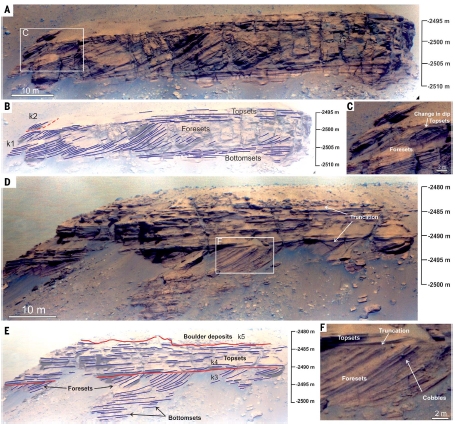 Jezero delta geology. © Science
 |
Autumn 2021 Science is coming in following the Perseverance Martian rovers' travels. The Perseverance rover landed on the floor of 29-mile-(45-km)-diameter Jezero crater on 18th February (2021). The landing site is informally named Octavia E. Butler after the US science fiction author. (Wuhayyy!)
The journal Science has just published an analysis of distant delta features formed by an incoming river into the crater. The research was even front page news for the issue in which it appeared. (See Mangold, N., S. Gupta, S., Gasnault, O. et al (2021) Perseverance rover reveals an ancient delta-lake system and flood deposits at Jezero crater, Mars. Science, 374, 711–717.) This delta is the target for Perseverance to reach. It is thought that the lower strata in some of these outcrops might contain biosignatures of life, if it ever existed that is.
Octavia Butler is well over a mile from the delta, but to reach it Perseverance will have to travel a few miles the long way round to avoid unduly rough terrain. Nonetheless, Perseverance's long-range cameras could easily image delta outcrop profile details that are invisible from orbit. These suggest that the delta formed as the water level in the crater was lowering and the crater ceased being a lake with an outflow river but just had an incoming one.
Personally, I am hoping for plenty of carbonate in the crater as that would preferentially take up calcium which would otherwise bond with phosphorous so reducing the latter's availability for life. (Phosphorous is a key element that life needs.)
As it happens, the past few years, I have been developing a co-evolution of life narrative and, as it happens, I have just been applying this to the possibility of there having been life on Mars. I will try to get this into print, and if so you can read the details there. However, if I were a betting person (and I am not) then I'd say that it was odds on that Mars once had life. Billions of years ago, Mars had a sea with a large land-area-to-sea ratio (good for eroding rock and releasing nutrients). It also had many crater pools prone to occasional partial desiccation and exposure to UV light which are all necessary for nucleic acid synthesis. Some may have had thermal vents and some think primitive photosynthesis first rose in such environments. Anyway, in a few years time we may well know…
|
|
|
Autumn 2021 Dune's world of Arrakis could exist, sort of… With the CoVID-19 vaccination rollout things have eased and we have been getting out more including to the cinema: the mid-week afternoons are a quiet time and so a low transmission risk.
Anyway, one of the films I was looking forward to was director Denis Villeneuve's Dune and how this would stack up against David Lynch's 1984 adaptation. (Villeneuve's part one is, I reckon, better but decidedly a little long at two hours and thirty-five minutes. This extra time is not used to character build, nor include some elements: apart from their ships, the space guild are missing, as is Feyd-Rautha, Baron Harkonnen's younger nephew, which was played by Sting in Lynch's version and the Emperor of the human worlds is a menace off-screen. Instead we get loads of landscape visuals: great eye-candy but a bit too much – we get the idea, loads of sand and it's hot.)
As most of you know who are familiar with me, two of my twin passions are science and science fiction. The novel Dune has always been bitter-sweet for me. It is heralded for its ecological theme and even (by non-ecologists) for its ecology. Yet, as any ecology undergraduate will tell you, as a biosphere let alone an ecosystem, it is farcical and completely ludicrous: you have to suspend any biological and geoscience sensibilities to enjoy the otherwise great story.
|
|
|
OK, so as a biosphere and ecologically the world of Dune sucks, but what of the planetary climate? That's a fascinating question. Fortunately, some Brit climate modellers created a model and then got a supercomputer to do the number-crunching. (I wish I had that sort of kit lying around.)
Using a model base employed by those researchers looking at exoplanets, and in their spare time (shh tax payers, let's ignore the supercomputer), Alex Farnsworth and fellow British climate modellers have managed to create a fairly reasonable model of Arrakis: yes, it has a largely dry, dessert and hot tropics and temperate zones is possible (sort of). The researchers based their model's refining on the description given in Frank Herbert's novel and in Dune Encyclopedia. Finally, they added to the model the atmospheric composition. For the most part it is quite similar to that of the Earth today, although with less carbon dioxide (350 parts per million as opposed to our 417 ppm in 2021). The biggest difference is the ozone concentration. On Earth, there is very little ozone in the lower atmosphere, only around 0.000001%. On Arrakis it is 0.5%. Ozone is important as it is around 65 times more effective at warming the atmosphere than CO2 over a 20-year period. This high ozone concentration, admittedly, is something of a cheat. While they don't give details of their atmospheric chemistry dynamics, I'm guessing the planet needs more ultraviolet to dissociate the oxygen. If so, that means a hotter star. Alas, hotter stars are short-lived and so do not afford enough time for multicellular life to evolve: not the billions of years our (Earth's) Sun affords. So this ozone thing is really a bit of a hack.… Leaving this aside, they've come up with a model. (See below.)
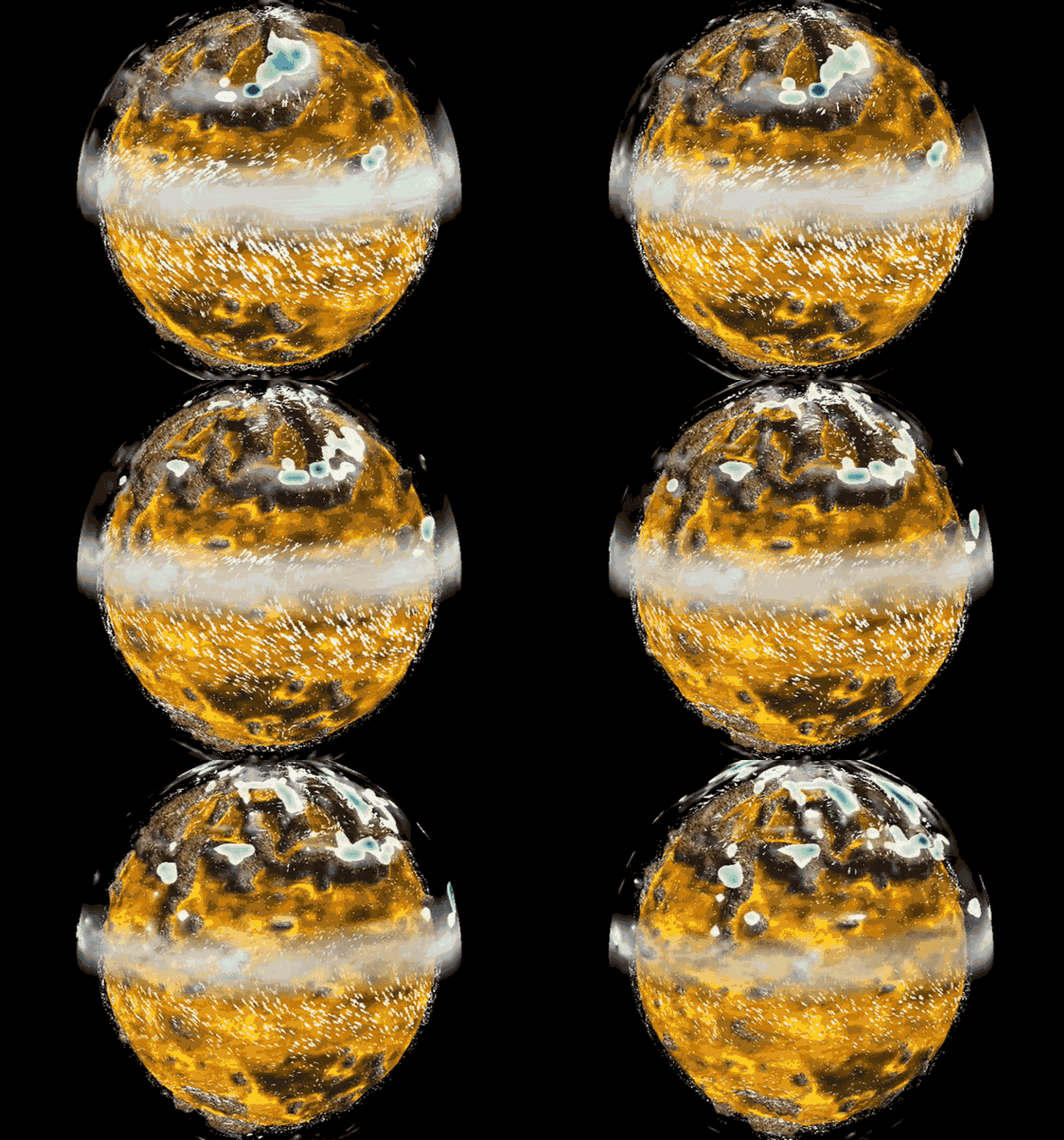 The visualisation of the planetary climate model of Arrakis.
The book says that there is no rain on Arrakis. However, the model does suggest that very small amounts of rainfall would occur, confined to just the higher latitudes in the summer and autumn, and only on mountains and plateaus. There would be some clouds in the tropics as well as Polar latitudes, varying from season to season. The book also mentions that Polar ice caps exist, at least in the northern hemisphere, and have for a long time. But this is where the books perhaps differ the most from the model, which suggests summer temperatures would melt any Polar ice, and there would be no snowfall to replenish the ice caps in winter. Unlike the book, the mid-latitudes, where most people on Arrakis live, are actually the most dangerous in terms of heat. In the lowlands, monthly average temperatures would often be above 50-60°C, with maximum daily temperatures even higher. Such temperatures are deadly for humans.
Of course, Frank Herbert wrote the first Dune novel way back in 1965. In a science context, this was two years before recent Nobel-winner Syukuro Manabe published his land-breaking climate model, and Frank Herbert did not have the advantage of modern supercomputers, or indeed any computer. Given that, the world he created in a climate sense sort of works, given a few hacks. (Source: Farnsworth, A., Farnsworth, M. & Steinig, S. (2021) Could humans survive on Dune’s Arrakis? TheConversation.com.)
|
 © IPCC, used under fair use in the context of a review
 |
Summer 2021 The IPCC's 6th Assessment Report's Science Working Group (WGI) has released its publication. The UN's Intergovernmental Panel on Climate Change has published its first Working Group Report: this relates to the climate change science the IPCC base their Assessment on, with the other two working groups relating to 'impacts & adaptation' and 'mitigation' respectively. The Science report notes that the Earth’s surface temperature has increased by around 1.1°C compared with the pre-industrial temperature (the average between 1850–1900). The Earth was last this warm 125,000 years ago before the last glacial and in the last interglacial.
To be extremely brief, much of the warming estimates are broadly similar as they were for the 5th Assessment Report WGI (2013) but the probability ranges have narrowed. With regards to forecasts, its moderate-emissions scenario that features little change from today’s global-development patterns (and so are sort of analogous to the first, 1990, Assessment's 'business-as-usual' scenario) average global temperatures are predicted to rise by 2.1–3.5°C. But even if the COP 21 Paris Accord (2015) commitments to curb emissions are fully implemented then we are still likely to surpass the 1.5 °C warming limit goal, before dropping back below it towards the end of the century.
|
|
|
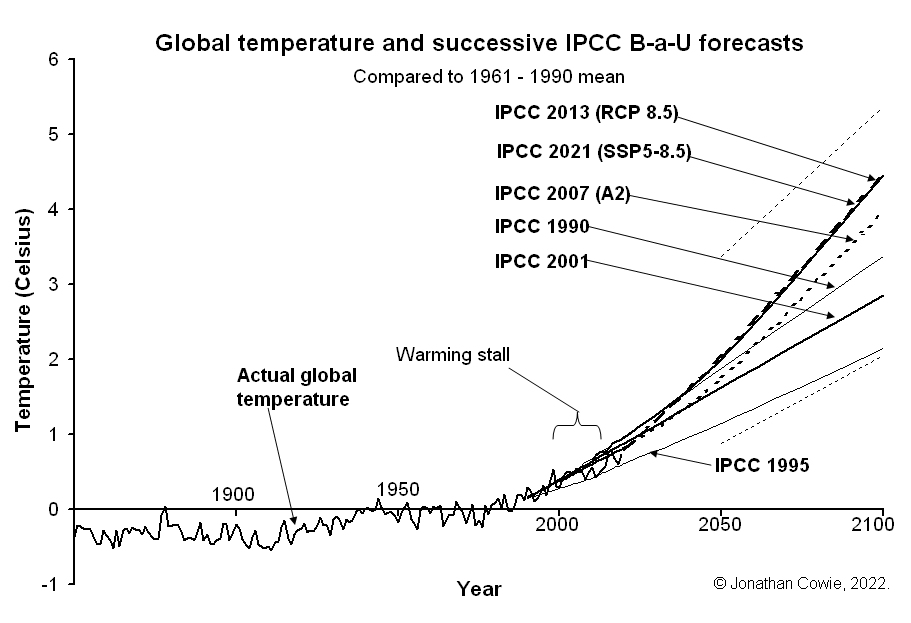
Now, I have to confess that I find the way the IPCC have presented their forecast scenarios across their various Assessments a little irritating. The IPCC Assessment Reports for 2007, 2013 and 2021 all use slightly different emissions scenarios in what in the first IPCC Assessment (1990) would be the Business-as-Usual scenario. This I can forgive. What is annoying is that some of the Assessment use a different baseline temperature: some use the pre-industrial temperature, some the 1990 temperature (which made some sense in that a number of climate policy documents of the 1990s and early 2000s refer to that temperature) and some have a baseline temperature relating to that of a few years prior to that year's Assessment. Confusing, huh?
What this means that it is impossible to compare like-with-like and see how the IPCC's Business-as-Usual (B-a-U) type scenarios compare across Assessments.
Lucky old you, because I had to do it for another piece of work, I have done the heavy lifting for you. I have taken the various IPCC Assessments B-a-U forecasts and standardised them to the temperature of the second half of the 20th century (the 1961 to 1990 average). I have also added in the actual global average temperature as we have had three decades of real-world experience since the first IPCC Assessment in 1990. Finally, I have added the upper and lower estimated for the IPCC 1990 B-a-U forecast between the years 2050 to 2100: these are represented by the upward slanting dotted lines.
This is all depicted in the graph below. From it you can see: that all the Assessments' B-a-U type forecasts are within the 1990 upper and lower estimates; and that the forecasts between 1990 and 2020 do track the real-world temperature.
It should be said that the IPCC openly say (albeit within the hundreds of pages of the Working Group Report's text) that their scenario forecasts do not include long-term feedback effects. These include such things as the warming from methane release from melting permafrosts, or the slowing down of surface-to-abyssal ocean currents. Here, the IPCC caution, we need to be wary of possible climate surprises.
|
|
|
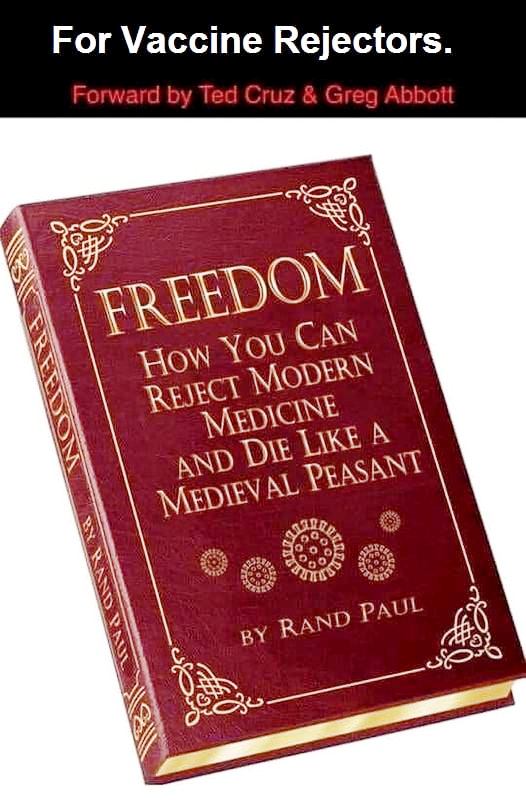
Summer 2021 The CoVID-19 vaccine rollout seems to be a success, though it is a shame that some are shying away from vaccination. Fortunately, vaccination rejection seems to be more rampant in the US but there are some over here in Brit Cit who refuse to get vaccinated. While all with whom I am in regular contact are vaccinated, I do know of a handful who are not. This includes one person who wants to keep their body pure, this despite him being heavily tattooed…! I know. Go figure.
Meanwhile, I have been sent this (see left) which apparently has been doing the rounds of social media. I don't do social media myself and so share this for others like me. Enjoy…
The one issue I have associated with the UK vaccine rollout is that some politicians are seeking to take the credit! Let's be absolutely crystal, the first UK vaccine rollout was the ChAdOx-1 Oxford Astra Zeneca vaccine that used a platform previously developed by those in the UK 'Science Base' and then adapted using genomic data. (The 'Science Base' being research conducted by Research Council funded research, and not Government Departments/Ministries.) Here, politicians have nothing whatsoever to do with determining what Science Base research is done. This is part of the British constitution enshrined in what is called the Haldane Principle (look it up if you have not heard of it). Astra Zeneca did the manufacturing and sold it at cost. The roll out was undertaken by the National Health Service which has been around for many decades before the current crop of here today, gone tomorrow politicians. As for the speed of ChAdOx-1's regulatory approval and trial phase overlap, there I sense the steady hand of the Chief Scientific Advisor, Patrick Vallance: nearly all of the Government's Cabinet have arts/humanities degrees and wouldn't know the definition of a randomised, controlled double blind trial even if their life depended on it (which in this case it did).
|
|
|
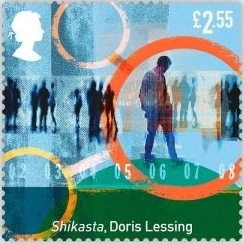
Spring 2021 The Royal Mail has released a set of science fictional stamps. What's not to like! Six classics are celebrated:-
- The Time Machine - H. G. Wells
- Frankenstein - Mary Shelly
- Brave New World - Aldous Huxley
- Childhood's End - Arthur C. Clarke
- Shikasta - Doris Lessing
- The Day of the Triffids - John Wyndham
And, save for the Lessing, I've read all the rest.
Don't ask me to rank them, though the art on some of the book covers (see example left) gives the Royal Mail a run for their money.
The stamps are depicted below...
|
|
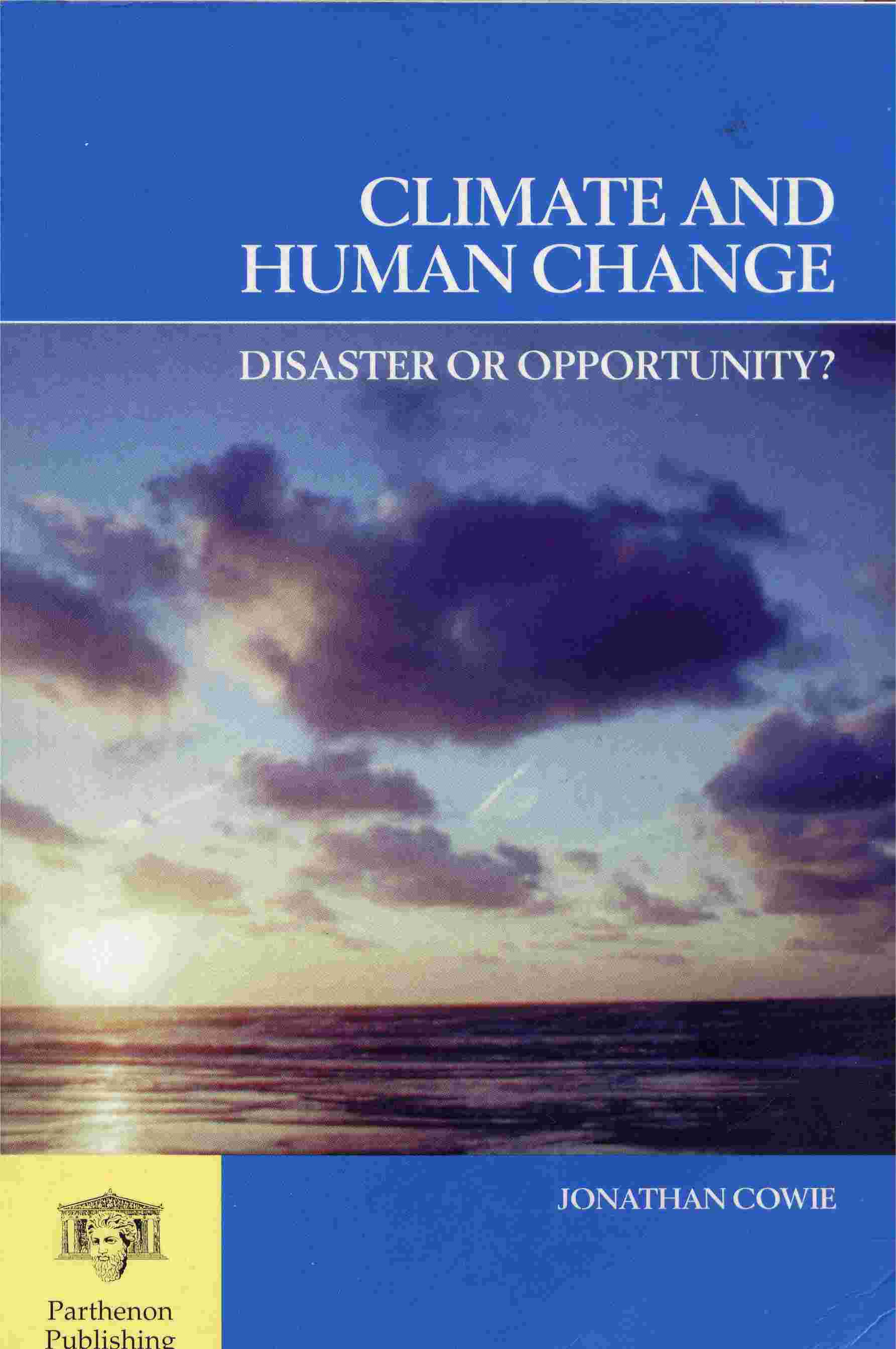
A quarter of a century on from its publication, politicians on both sides of the political spectrum, and on both sides of the Atlantic, are beginning to tout Climate and Human Change: Disaster or Opportunity's? core message. Who would have thunk it?
|
Spring 2021 The World's leaders have held a virtual climate meeting ahead of the UN Climate COP, Glasgow, this November. As someone once opined nearly a quarter of a century ago, we are heading towards a climate disaster but equally there are opportunities (jobs, cleaner air, green economy, reduced fossil energy imports etc.) to be had.
That was then, today we have the world leader virtual summit.
Launching the summit, the US President Biden said: "I see an opportunity to create millions of good-paying, middle-class, union jobs.
I see line workers laying thousands of miles of transmission lines for a clean, modern, resilient grid.
I see workers capping hundreds of thousands of abandoned oil and gas wells that need to be cleaned up, and abandoned coalmines that need to be reclaimed, putting a stop to the methane leaks and protecting the health of our communities.
I see autoworkers building the next generation of electric vehicles, and electricians installing nationwide for 500,000 charging stations along our highways.
I see engine- — the engineers and the construction workers building new carbon capture and green hydrogen plants to forge cleaner steel and cement and produce clean power."
Which begs the question as to what he, or his speech writer, has possibly been reading?
Stop Press (July 2022): British Member of Parliament Penny Mordaunt has been making the case that fossil carbon 'net zero' should be seen as an opportunity rather than a cost. Penny Mordaunt was a candidate in the leadership race to replace Boris Johnson as Leader of the Conservative Party and Prime Minister. In the election contest, she made it through to the penultimate Parliamentary round, and then was knocked out, before the broader Conservative Party membership vote on the final two Conservative Parliamentary selected candidates (Rishi Sunak and Liz Truss). Penny Mordaunt noted that 'opportunities' included the transition to green energy generating "millions of jobs over the next decade". Expanding renewables (like wind and solar) would, she says, "rapidly enhance the UK's energy security".
Which begs the question as to what she, or her speech writer, has possibly been reading?
|
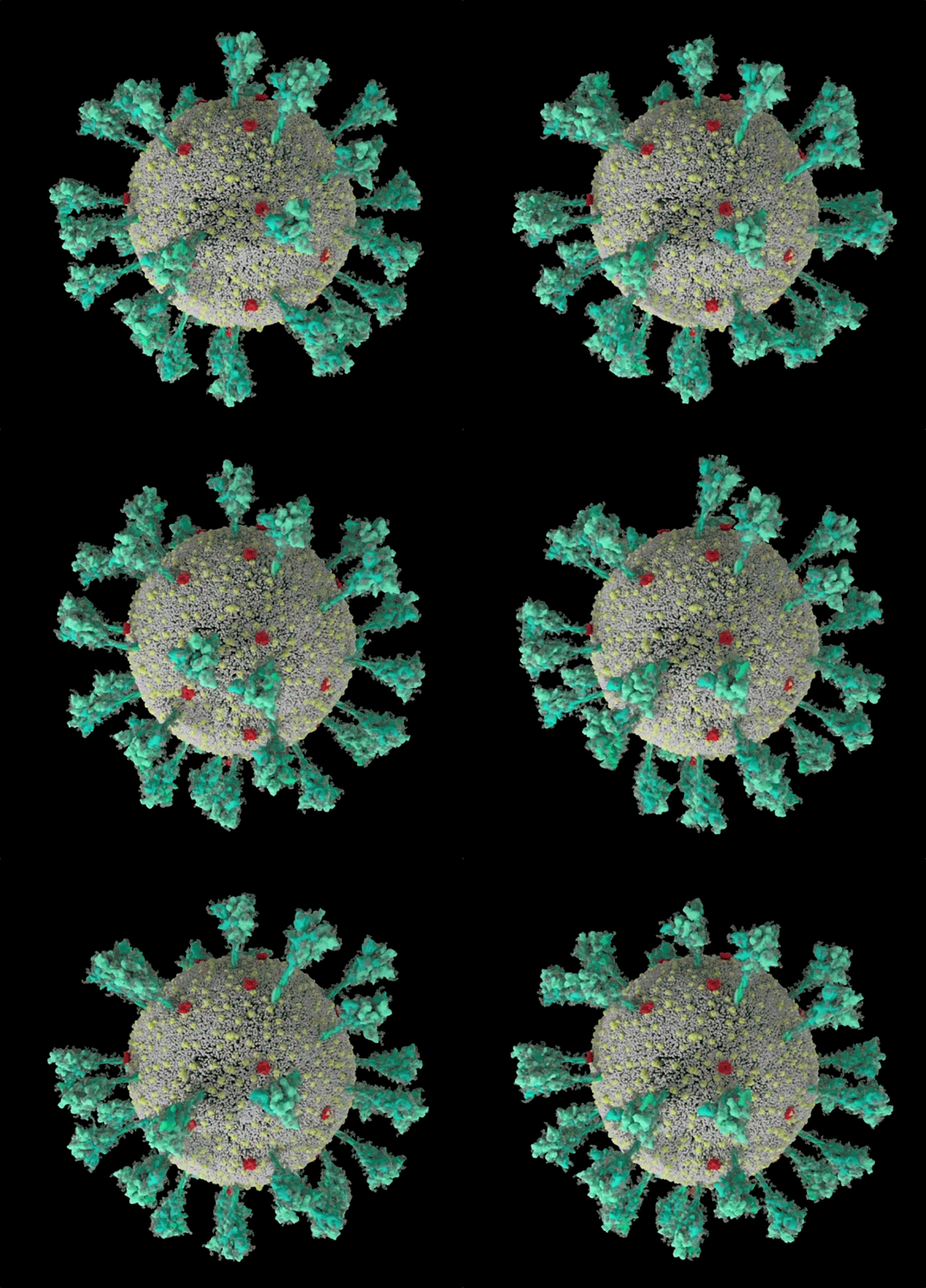 Computer simulation of the
SARS-CoV-2 virus. |
Spring 2021 Spring is here and so is the long-awaited vaccination against SARS-CoV-2 / CoVID-19. Hurraaay! Take that you pesky virus.
For those that care about such things (and I fully accept that most don't), I have had the Astra Zeneca vaccine. This vaccine is scientifically known as the ChAdOx1 nCoV-19 vaccine (Changed-Adenovirus-Oxford-1). It is based on a whole chimpanzee-adenovirus (simian adenovirus) that has been modified to include the genes from the SARS-CoV-2 for the whole SARs-CoV-2 surface protein spike (that includes the receptor-binding domain – RBD – the protruding bits of the virus that lock on to proteins on the surface of human cells). Like Janssen's Ad26CoVS1, the Oxford/AstraZeneca ChAdOx1 is also replication-incompetent in that it cannot replicate inside the cells of the vaccinated person. It works because the modified simian (monkey) adenovirus has the surface protein spikes of SARS-CoV-2 and it also tricks human cells into making the spikes. These spikes fool the vaccinated person's immune system into thinking that the real SARS-CoV-2 virus is there and so the person develops an immune response. This is also similar to the way the Janssen's Ad26CoVS1 vaccine works.
Huge thanks: to the Oxford team, to Astra Zeneca for making it available at cost, and to the NHS for the roll-out. Well done all.
No disrespect to the wonderful ChAdOx team, but when it comes to a booster, I hope I get a different vaccine – Moderna looks good – as it is best to mix them up: this confers better protection.
[Past news 2019/20]
[Bioscience interactions | Climate change interactions | Science & Fiction interactions | What is Concatenation all about? | Home ]
|
|