Now, it is oft said that a joke's efficacy is in the timing. Whether or not this is so, this particular joke took over 30 years....
Way back in May, 1993, Richard Gott III, published a 'hypothesis' paper: Gott III, J. R. (1993) Implications of the Copernican principle for our future prospects. Naturevol. 363, p315-319. (The 'hypothesis' papers were a series that the then editor, John Maddox devised so that scientists might fly a kite: float an idea to Nature's readers.)
I should perhaps say that I do not buy into all the aspects of Gott's paper, but his opening, core thesis can be summarised as this... An object's existence has a lifetime (L) which might be anything but will be 100% of whatever it is. Graphically, one might draw a line representing the time period (L) and you (a random observer as per the Copernican principle) might randomly select a point somewhere on this timeline. If it is a truly random selection then there will be a 95% chance that you will select somewhere along the mid-95% of this length. i.e. somewhere after the first 2.5% of the length and somewhere before 97.5% of the length. There are 40 lots of 2.5% in 100%. So, under Gott, asuming you (randomly) come across a thing/object, the longest this object is likely (with a 95% chance) to continue to exist into the future (having already seen its first 2.5% of time elapsed) is 39 times its life-time to date. And the least time it is likely to continue to exist (with 95% probability) is 1/39 times its lifetime to date. If you know how old this object/thing is when you encountered it, you can then calculate the upper and lower limits of the likely (95% chance of your being accurate) time for it to continue to exist.
Richard Gott gave two examples to illustrate his idea. He visited Europe from Australia in 1969 and saw Stonehenge. Applying his analysis he predicted that Stonehenge would likely continue to exist for at the very least 99 years, hence still exist when his paper was published 23 years later in 1993. (The maximum Gott 95% chance future lifetime of Stonehenge would be nearly six millennia.)
In 1977, he visited the then 55 year old USSR. Under his analysis the then USSR might cease to exist less than a year and a half after his 1977 visit and at most a couple of millennia: its then future life would be between these times. Indeed, it ceased to exist after only 14 years later.
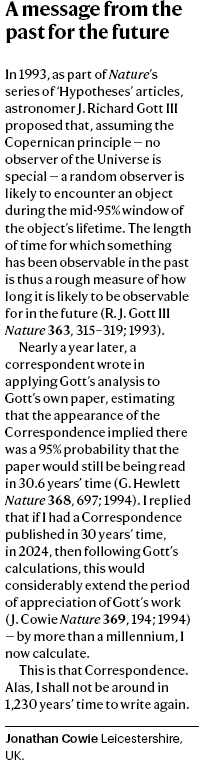
A year after Gott's paper, Guy Hewlett wrote into Nature (Hewlett, G. (1994) Longest read? Nature, vol. 368, p697.) regarding Gott's paper and, applying a Gott analysis to his nearly one-year later correspondence, predicted that we would still be corresponding on this topic in 30.6 years time.
I then followed this up with my own letter (Cowie, J. (1994) 21st century read. Nature, vol. 369, p194.) as to the interpretation and recognition of the assumptions Gott made, and that if I wrote into Nature 30 years later, in 2024, it would greatly further the likely (95%) Gott correspondence window.
As said, I do not buy into all the aspects of Gott's original Nature paper, though I do think it has an intruiging notion. However, it has causes some debate in addition to the fun Guy Hewlett and I had in that journal. For more discussion then check out Guinnessy, P. & Rodgers, P. (2000) Physicist refuses to bet on the dogs. Physics World, March, p12. and Life, longevity, and a $6000 bet in Physics World. Also there is Caves, C. M. (2000) Predicting future duration from present age: A critical
assessment. Contemporary Physics, vol. 41, p143-153.
Autumn 2024Planetary Geoscience, 2-day symposium. More continuing professional development (CPD, or CME if you are a biomedic - continuing medical education) with a two-day event organised by the Geological Society and the Royal Astronomical Society.
A number of the papers are of relevance to the deep-time co-evolution of life and planet science narrative on which I am working (and which has exobiological implications). Sadly, this event comes after the academic cut-off for a major co-evolution project I am just finalising, so the information gleaned will just have to go into the next one.
Papers of particular interest include:
- Numerical Simulations for the Hydrothermal Evolution of Early Mars & Habitability Computations
- Enceladus: Sampling the Plume
- Hidden in plain sight? On the challenges of detecting molecular markers for life in typical planetary samples
- Reconstructing the stratigraphic architecture at the apex of a Martian sedimentary fan system at Gnaraloo Bay, Jezero crater, Mars
There was an interesting paper on water-delivery to the primordial Earth and I had a brief chat with the presenter in the tea break. Irrespective of the paper's merits, we both agreed that all the major water delivery theories -- asteroid, magma ocean-hydrogen atmosphere interaction, and Solar wind interaction on primordial dust -- suggest that all habitable zone terrestrial planets should have water.
Autumn 2024Climate scientist distress has been reviewed. Every now and then I am asked when my next climate change book will be out? My wonderful copy editor for the last two (climate books 2 & 3) from Cambridge University Press when working on both each time commented to me, "we are ****ed aren't we?" And of course, regular visitors to this site know of my opinion as to whether we can beat the climate crunch. The last book came out a tad over a decade ago and, to be honest, the climate and impact trajectories as to where we are going have not changed and, while new science has provided extra detail, there has been little that significantly adds to matter. This lack of motive combined with looking at climate and impact scenario forecasts, which are incredibly depressing, has meant -- that while I now keep a loose eye on the new science -- several years ago I moved my principal focus away from current and prospective climate change to the deep-time evolution of life and planet (news of this new area to come in a few months time).
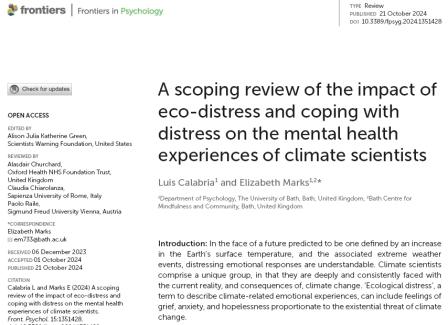
Indeed, I have been increasingly aware, both from the literature and through coffee/meal encounters with others at climate symposia, that I am not alone; that depression among climate scientists has become a thing. This month has seen a psychological review of the issue. It concludes that: Climate scientists have an essential role to play in helping society and policy makers understand the implications of climate change and identifying the most useful responses. As such, it is integral that the psychological wellbeing of this group is understood and cared for.
Well, good luck with that: nothing is going to change our being on a runaway bus. As was said in the closing scene of the final episode of The Young Ones, "Lookout, CLIFF!!!"
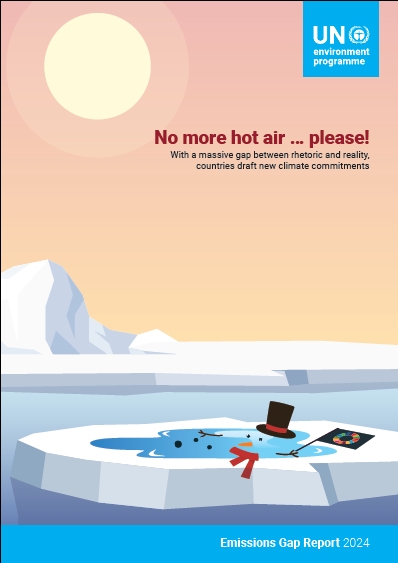
United Nations FCCC (2024). Nationally determined contributions under the Paris Agreement. UN Framework Convention on Climate Change. FCCC/PA/CMA/2024/10
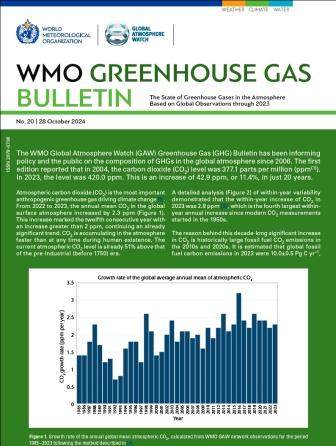
Atmospheric Environment Research Division, Science and Innovation Department (2024). WMO Greenhouse Gas Bulletin. World Meteorological Organisation: Geneva, Switzerland.
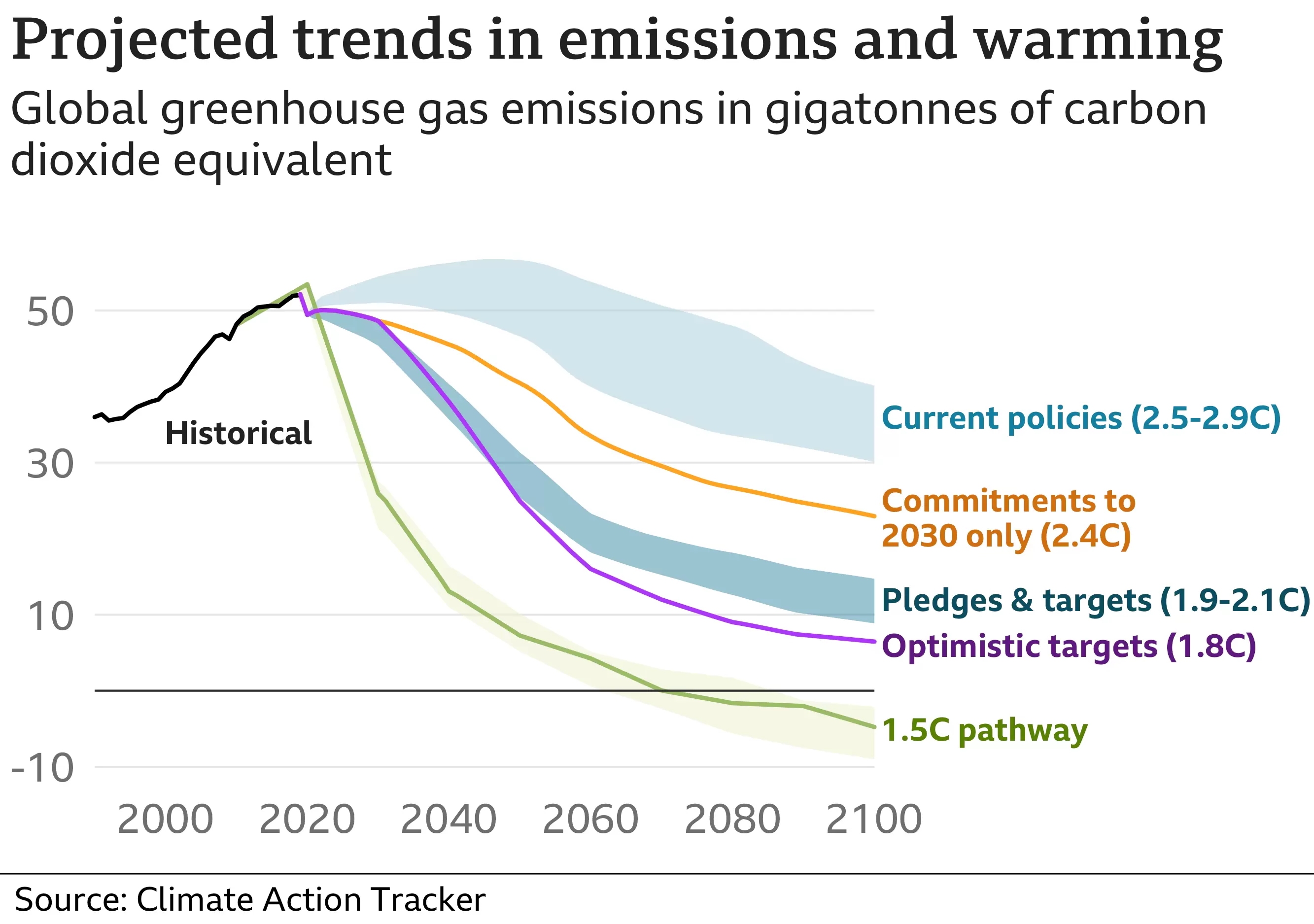
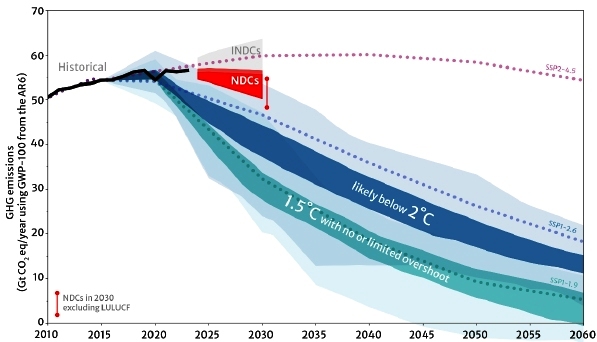
It suggests that from 2019, by 2030 emissions will likely fall by just 2.6%: conversely, a 43% reduction by 2030 is needed to keep the world on track for net-zero carbon by 2050 and net zero all greenhouse gases by 2100.
The below graph is a composite based on the IPCC 6th Assessment Report WGI (2021) scenarios as to what is needed to keep warming below 2°C and 1.5°C as well as actual emissions (the black line) and the COP policy goals, NDCs (which exclude land-use emissions). As can be seen, we are even missing the 2°C by 2100 limit by a mile (excuse the technical terminology).
Once again, our political class is letting us down... See also next item below...
Meanwhile, the same day the UN's World Meteorological Organisation released its 2024 Greenhouse Gas Bulletin. It reported on the globally averaged surface concentrations for carbon dioxide (CO2), methane (CH4) and nitrous oxide (N2O) reached new highs in 2023, with CO2 at 420.0 parts per million , CH4 at 1,934 parts per billion and N2O at 336.9 per billion.
Atmospheric carbon dioxide reached 151% of the pre-industrial level in 2023, primarily because of emissions from the combustion of fossil fuels and cement production.
If (note the 'if') all nations implement their 'nationally determined contributions' (NDCs) in addition to all their 'net zero' pledges, then there is a 77% chance of exceeding 1.5°C and a 20% chance of exceeding 2°C.
If you think this is frightening, then you are right: it is! If you don't think it is frightening then, regrettably, you are not up to speed with the climate science, and this, sadly applies to nearly all of the global political class.
As I have pointed out before, a decade-and-a-half ago, in my Can we beat the climate crunch? (2009) essay, we are unlikely to keep warming below 2°C. My conclusions then, to which I still adhere, are that we will exceed the 2°C limit this (21st) century.
This latest UNEP report joins the list of mounting evidence following my 2009 essay that supports this terrifying conclusion...
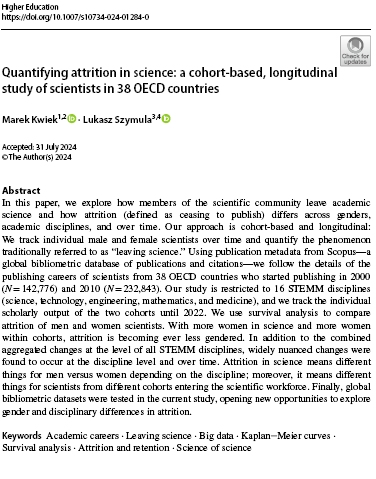
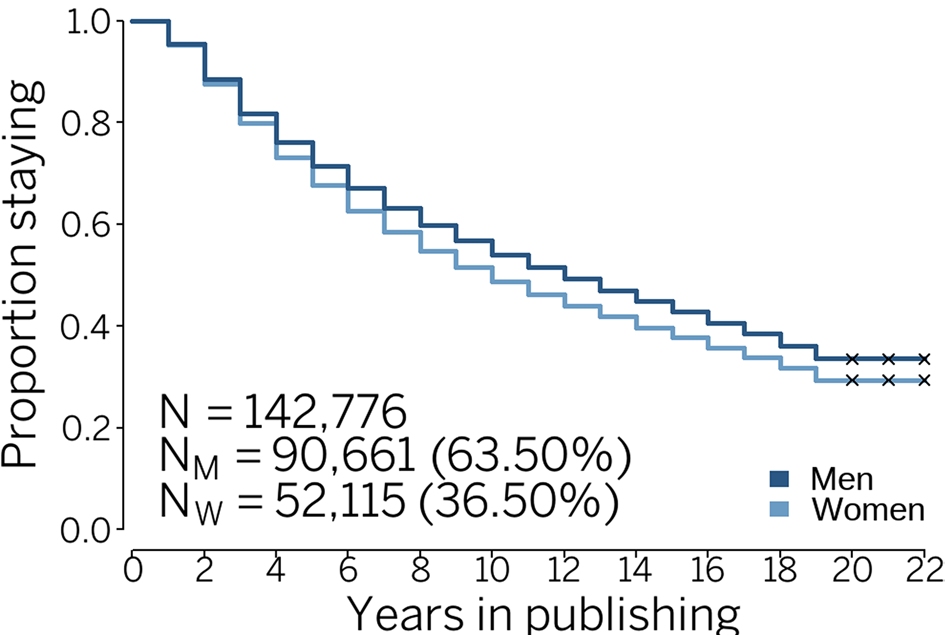
Autumn 2024Over half scientists leave research in 22 years an analysis reveals! Having worked for a science body charged (by Royal Charter) to represent biology for most of my career and with (mainly biological) and alongside other learned scientific (other science disciplines) bodies for even longer, I have more than a little interest in the 'health' of science as a profession. At face value, this survey of 142,776 scientists in developed (OECD) nations is telling. My initial gut reaction is that it reveals that science as a career does not sustain a person's living in the long-term. This may well be so. In Britain (and elsewhere) there is a problem in young scientists leaving the early-career insecurity, of having to transfer from one short-term contract to another, for the long-term security of later career tenure and its paid salary: young researchers stay in short-term contracts far too long -- often at different establishments -- which makes putting down roots (such as getting a mortgage or starting a family) difficult. And the survey reveals that women researchers are lightly more disadvantaged than men, though broadly both genders suffer almost to the same degree.
But is science truly a career that for many (most) will not sustain them in the long-term? Here, we really need to be careful of jumping to conclusions.
I once had dinner at the Royal Society with one of its officers (think of an officer as one of its limited-term board members) who grandly proclaimed that the Royal Society was the nation's body representing science. As you will suspect, I could not let this pass and was quick to correct. You see, the person in question was defining 'science' as 'science research' and in the main university and research institute (civil government-funded research bodies) research, but science, as a work sector, is much more than that. Science also exists in, and scientists also work in, industry but their research tends to be commercially sensitive and so is not always (rarely) available to the public. Scientists also work -- not in research but -- in, say, environmental monitoring (air, water quality and so forth), or they can work in science publishing, communication (press, writing etc), policy-making (civil service), teaching (schools) and a host of other sectors. This is why the professional bodies for science (such as the Institute of Biology re-branded a few years ago as the Royal Society of Biology, the Institute of Physics, the Royal Society of Chemistry and so forth) are actually the representative bodies for the various science disciplines while the Royal Society principally brings together senior research scientists mainly from 'academia'. Scientists are not synonymous with academic research publishing which is what this survey is all about. It is therefore natural to expect some scientists starting their career in academia (after all they qualified from college) and then over time move from that into some of these other sectors; some might even have left research publishing but remain in academia having been promoted to research institute management!
Before we can draw any conclusions as to the long-term viability of science research (as defined as being research in the public domain) as a career, we need to find out not only just how many scientists left and when (which is what this analysis does), but why and where did they go to? If they continued their career as scientists but in other science employment sectors then their specialist training and expertise has not necessarily gone to waste: that would only have happened if they left science research to become, say, a train driver or (worse) a politician (though we do need more scientists in Parliament)... This analysis reported above was comparatively easy to do as for over 20 years one organization has been tracking scientists and their publicly available research, Scopus -- a global bibliometric database of publications and citations. Finding out why scientists left academic research publishing and where they went to is a daunting task. The Council for National Academic Awards (CNAA) which used to do this for polytechnics, but John Major got rid of these and the CNAA in 1991/2. So that's that. We may never know unless, that is, someone does a survey of all the Fellows of the various professional science bodies and does a statistical comparison with the Scopus defined attrition rate... But that would be a fair bit of work and entail a lot of cooperation by all the professional bodies across many disciplines and countries. I cant see that happening any time soon.
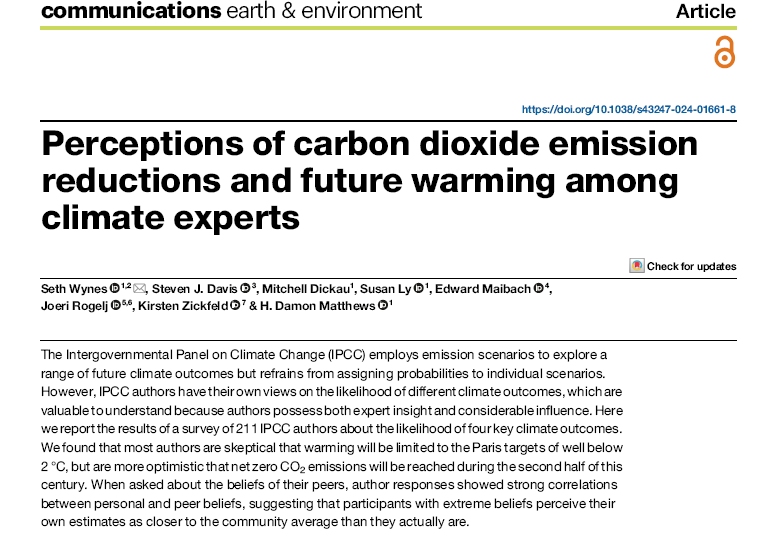
Autumn 2024Climate scientists are sceptical that warming will be limited to the Paris targets of well below 2°C a survey reveals. A of a survey of 211 Intergovernmental Panel on Climate Change (IPCC) scientist authors as to the likelihood of four key IPCC climate scenario outcomes reveals that the climate scientists are most pessimistic of keeping warming below the higher 2°C Paris Accord limit (2015). 86% of participants estimated maximum global warming of greater than 2°C by or before the year 2100. 58% of the sample believed that there was at least a 50% chance of reaching or exceeding 3°C by or before 2100. Does this surprise me?
Go back a over quarter of a century and I expressed severe doubt as to whether there was the global political will to keep warming below 2°C and was promptly sternly told off by a rather senior, British-based Governmental science advisor. This reprimand prompted me, along with the climate questions commonly asked following my then many climate talks given, my writing the Can we beat the climate crunch? (2009) essay. My conclusions then, to which I still adhere, are that we will exceed the 2°C limit this (21st) century.
Back then I was something of a lone voice; hence my being reprimanded. From this latest survey it would appear that I now have the company of leading IPCC science authors. It truly gives me no comfort in saying 'I told you so' and so instead will do a Sheldon Cooper and say, 'I informed you thusly'.
That visit showed me how the Peak District's Neolithic landscape must have been quite open -- I was in the apparently mistaken belief that over 5,000 years ago the landscape was predominantly Oak/Ash forest. Conversely, because the stone circles were clearly constructed in sight of one another, it suggests a more open landscape where fires within the circles could be seen by those at other nearby circles. My guide suggested that one hypothesis was that pigs had been used to help clear out the landscape as they would dig around roots(?) Whatever the case, the Peak District's Neolithic landscape was clearly more connected.
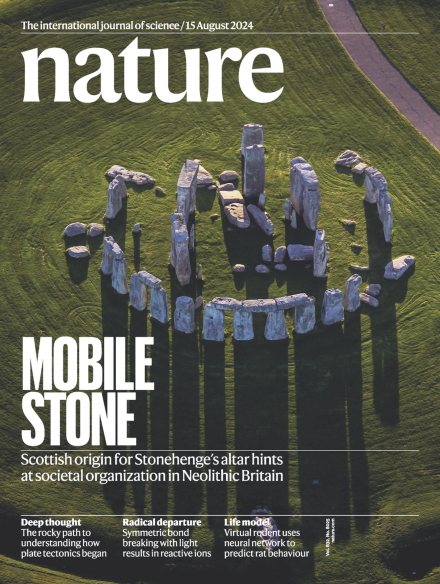
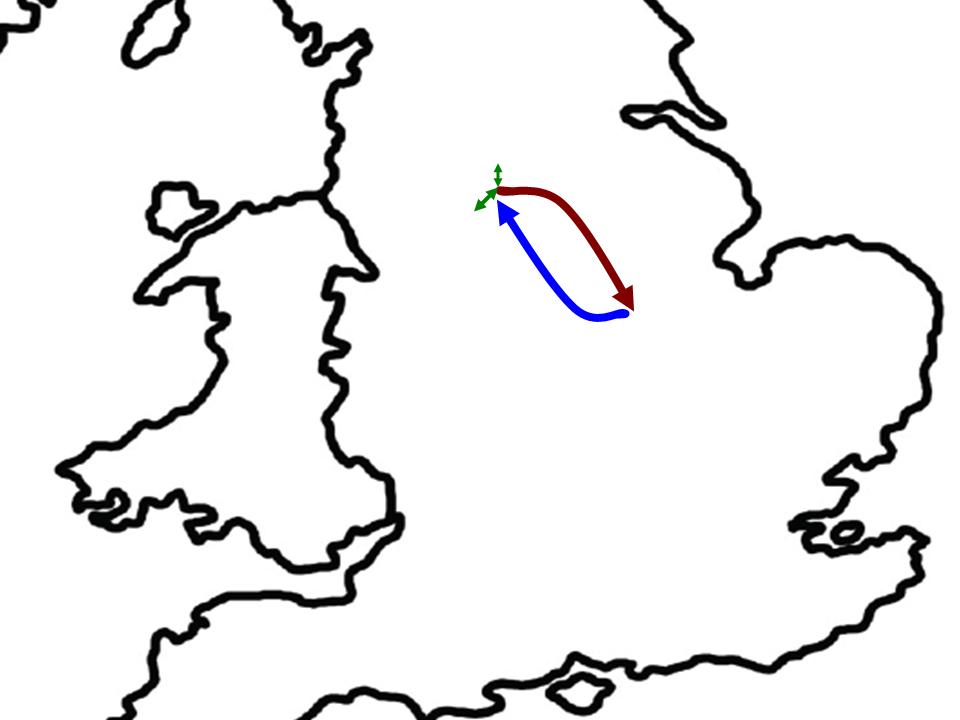
A few days later, this Nature paper is published and with Stonehenge's Alter Stone detrital zircon, apatite and rutile grains revealing that it came from Orcadian Basin in northeast Scotland some 466 miles (750 kilometres) distant, this demonstrates that Neolithic Britain was more connected than thought.
It seems that, even when having a few days break, I keep following the science...
Summer 2024Had a few days in the Peak District with a hop up and across England's spine, visiting a few sites, socialising and catching up with friends.
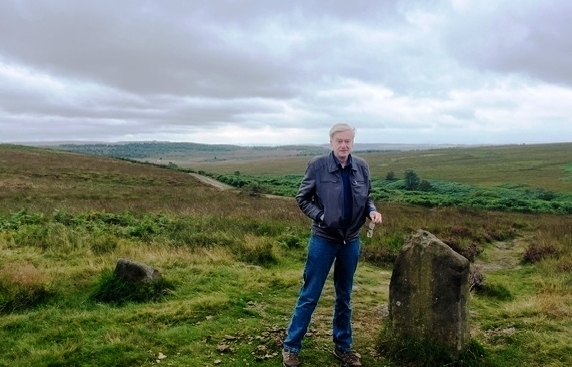
First up was the Barbrook One circle. It is an is embanked stone circle with one large standing stone (about a metre high) surrounded by 11 smaller stones (5 cm
to 25 cm high) in a circle with a 13 metre diameter.
Nearby (couple of hundred yards/metres) is Barbrook 2, a ring cairn with a
rubble bank with a diameter also about 13 metres.
Both are within distant line of site of Gardom's Edge (see the hill on the skyline to the left of my head in the picture): I visited the Gardom's Edge stone a couple of years ago. (We didn't get to see Barbrook 3 circle over a mile to the north.)
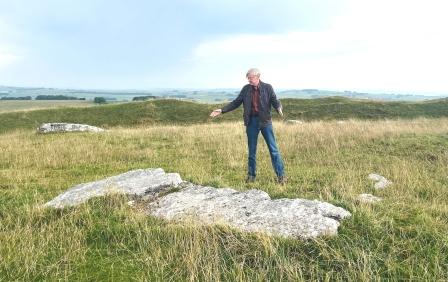
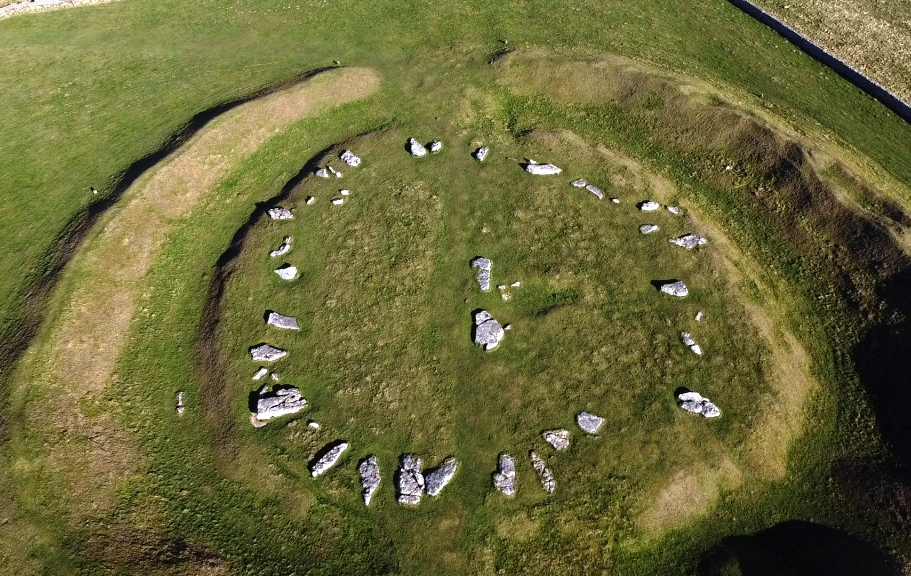
Also visited was Arbor Low which is a Neolithic henge surrounding a stone circle. The circle -- or more correctly the ellipse -- consists of 50 limestone blocks surrounding a couple of central blocks. All appear to have fallen over (apparently there is some debate about this, but I don't believe they were not meant to be upright). It is possible that there were originally a few fewer stones but that some fragmented. In the picture left I am standing by pair of the four central stones, the main one is getting on for three yards/metres long.
In the far background, just to the left of me, is the distant Barbrook site. It now seems clear that if fires were lit on ceremonial nights (solstices and equinoxes?) the light from these different sites could be seen by one another. This could only happen if the landscape was partially open and not completely forested: I had assumed that Neolithic Britain was heavily wooded. My guide for the tour proffered the idea Oliver Rackham is said to have offered that the Neolithic landscape was opened up by pigs or boar digging around the roots of trees. Not that I know anything about this, that suggestion may well be right, or even a factor. However, I wonder if the much less drained Neolithic landscape had more water logged lowland inhibiting woodland? Recent work, using DNA, pollen analysis etc., on the Neolithic landscape around Stonehenge chimes with that from other Neolithic sites, does suggest that marsh land and flood plains were open. What is certain is that all the Neolithic monuments are on slightly higher ground. It would appear as if the Neolithic 'society' in the Peak District was reasonably connected.
Nearby, a couple of hundred yards away, was the barrow of Gib Hill. It is actually a Neolithic oval barrow with a subsequent, early Bronze Age round barrow superimposed at one end.
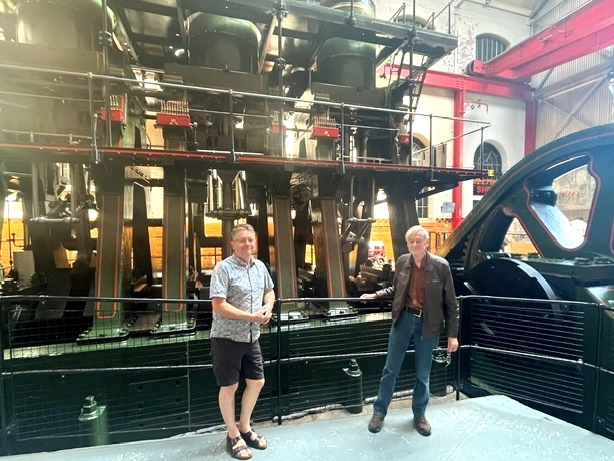
Then there was a day in Sheffield, aside from a previous evening socialising with those discipline-adjacent to environmental studies/science -- 'we are not planners -- only my second ever visit there: my last being a fleeting one with Hatfield alumni back in the early 1980s when I was leaving Salford U. postgraduate studies. We took in the Kelham Island Museum that is a repository of the city's industrial heritage. I was surprised that Sheffield had been a centre of steel making and working as recently as the late 1970s, well within my lifetime. Among much seen was a demonstration of the River Don Engine: a 1904-built, 12,000 horsepower (in new money, 8.9 megawatts) steam engine used for hot rolling steel armour plate. It only retired to the museum in 1978 with its last use being for rolling out reactor shield plates for nuclear power stations.
Finally, we had an afternoon at the Abbeydale Industrial Hamlet between Sheffield and Chesterfield. It is a former hand forge complex in listed buildings that provides a fascinating window on early nineteenth century life: not an easy one. The site itself has had iron works even earlier, going back at least 500 years: there is evidence of metal working on the site from before 1200AD.
Having done some press liaison work for a decade in the 2000s for the nineteenth century Crossness Engines (the pumps that ended London's cholera and Great Stink) and, though I can't afford to spend much time on it, I do have a soft spot for industrial heritage.
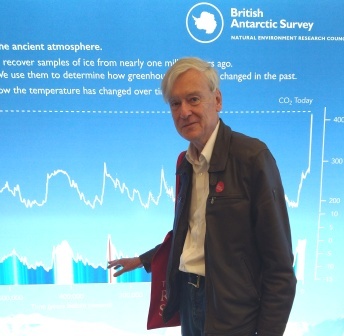
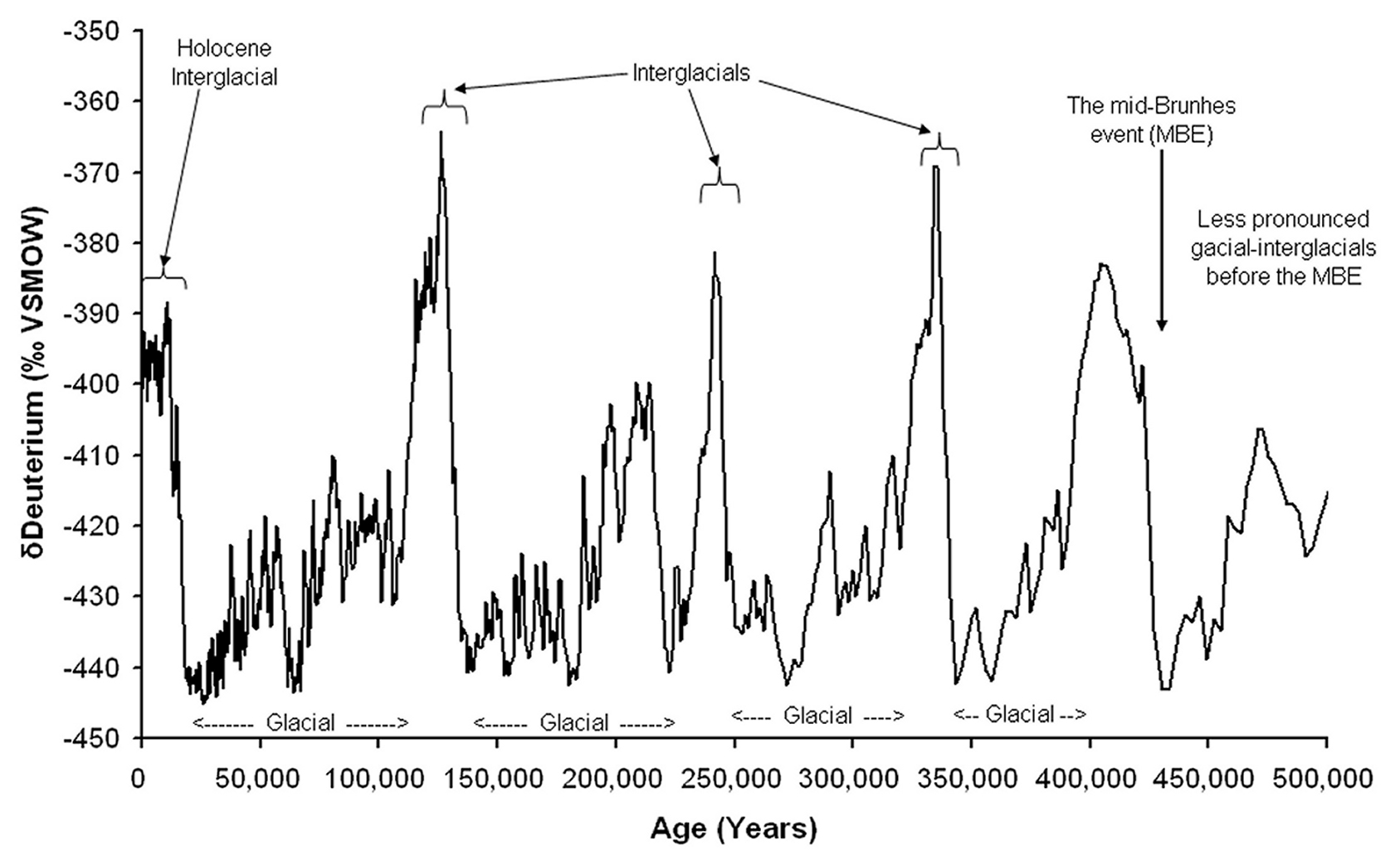
900,000 years Antarctic ice core record
Pointing to a discontinuity after which
glacial-interglacials become more intense.
I'm pointing to the MBE critical transition.
Summer 2024The 2024 Royal Society Summer Exhibition has taken place. I missed this last year, but this year went with: an old Institute of Biology colleague and her partner, an SF² Concatenation team mate and his partner, and an old school friend. (Well, science should be sociable.)
There were the usual dozen or so science research exhibits manned by research students and a senior researcher. I had a brief discussion with a lead researcher into dark matter. Long story short, they don't know whether it exists or whether Newton's Laws of motion are not correct over large (1,000s) of light years distance.
The exhibit I had the most interest in was on the follow-up to the European Project for Ice Coring in Antarctica (EPICA). This original EPICA project reported its first results exactly 20 years ago (EPICA community members (2004) Eight glacial cycles from an Antarctic ice core. Nature, vol. 429, p623-8.). And now the Beyond EPICA project has already drilled to a depth of more than 1,800 m in an attempt to get a one million year climate record (carbon dioxide, methane, deuterium palaeo-temperature, and electrical conductivity dust palaeo-rainfall indicator). Going back this far should cover the Mid-Pleistocene Transition (MPT -- also known as the mid-Pleistocene revolution). The Earth has been cooling throughout the Pleistocene but before the MPT the glacial-interglacial cycles periodicity were about 41,000 years, and after the MPT the periodicity transitioned to having a duration of about 100,000 years.
However, even with just the original EPICA results, we could see another (smaller) transition before and after what is called the mid-Brunhes event (MBE) about 430,000 years ago. (I am pointing to this in the picture left of a graph of the palaeo-indicators.) Before the MBE the amplitudes of glacial cycles seem to have been smaller than the more recent four glacial-interglacial cycles than have seen colder glacials and warmer interglacials. No-one knows for sure why; though theories abound including Milankovitch forcing changes.
Both the MPT and the MBE represent critical transitions. (Some call these 'tipping points' but I don't like that term as it suggests that you can tip back as easily as you can tip forward: conversely 'critical transitions' or 'critical thresholds' suggest something more serious.) The question is, that with our current hitting the Earth system with a burst of human-generated fossil carbon, are we heading for another critical transition? (Those of you that know me might suspect my answer to that one.)
As you might guess, I am looking forward to the Beyond EPICA project results which will hopefully be published in the journal Nature.
Antarctic region temperature (as reflected by deuterium water ice concentration)
for the past half-million years. (Heavier than hydrogen, deuterium takes more energy [heat]
to evaporate from the ocean before falling as snow becoming ice.)
This graph is actually based on another Antarctic ice-core data set (which I used for
some work of my own) but I have adapted it showing when the MBE transition ocurred.
Deuterium concentration is a palaeotemperature-indicator/proxy of (simplistically speaking,
near hemispheric) regional temperature. The Vienna standard mean ocean water (VSMOW)
is a water standard defining the isotopic composition of ocean water.
The oldest geoscience learned society
in the world.
The Geological Society's Lower Library the ground floor of which also acts as the Foyer to the lecture hall.
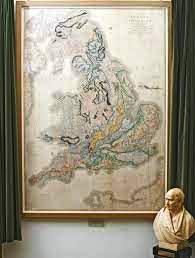
The two earliest geological maps of England and Wales hang side-by-side at the foot of the stairs at the Geological Society. There is the William Smith’s map of 1815, made from him travelling the country and when needed, digging down through the soil. And there is this one: the Geological Society’s own map, issued five years later and drawn by George Bellas Greenough, one of the founders of the Society and its first President. Both are usually covered by a curtain to protect them from the light, so you need to ask to see them.
Summer 2024Geological Society AGM and President's Day 2024. Though I am an environmental scientist with bioscience leanings, I come to past climate change, deep-time biological and Earth-system evolution through the geological record, and so of my learned society memberships I am also a Fellow of the Geological Society, and this was my first Geol Soc Annual General Meeting (AGM) and President's Day for over half a decade: since before CoVID-19. This year's AGM was all very good news.
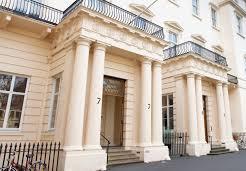
Since 1874, the Geological Society, has been based in Burlington House that dates from 1664 and which is named after one of its early owners, the first Earl of Burlington. It shares the building along with: the Linnean Society (with whom I regularly used to work, especially in the 1990s-2000s as it became one of over 80 biological societies affiliated to the Institute of Biology, IoB); the Royal Society of Chemistry (the cousin body to the IoB, but for chemists, with whom I also used to work as Institute of Biology liaison and as part of which was on its Parliamentary (Science) Committee -- excellent luncheons as science Parliamentarians attended), the Royal Astronomical Society (with whom I have had no professional connection but have been to a few of their lectures); the Society of Antiquaries of London; and the Royal Academy of Arts.
The societies had enjoyed a peppercorn rent, but in 2002 the Government wanted to charge a new commercial rate. This, being for a central London, West End, high street site, would have been unaffordable and the learned societies would have had to have moved out. However, a deal has now (2024) been negotiated with the Geological Society having played a central role (it diligently planned and costed all its options and so made its case from a highly informed base). (Indeed, had there been no deal, London would have lost its, arguably principal, central west end seat of learning it had enjoyed for over 150 years.) The Societies will now pay a one-off fee in return for a 999-year lease.
This is very good news. 'Plan B' would have seen us move from our central London HQ, lose our over 170-seater lecture hall and much of our library, not to mention synergies with the other tenant bodies.
(Separately, I was surprised to learn that the Geological Society's magazine, Geoscientist, online iteration gets less than 1/16 the monthly page views that our SF² Concatenation genre arts wing garners! Concat' must be doing something right?)
The afternoon saw the presentation of the Society's Prizes and Awards and talks by three of the winners on the subjects of: flood risk management, the triggers and frequencies of volcanic eruptions, and deep Earth tectonic processes -- the latter speculative but interesting. All rounded off with an early evening reception.
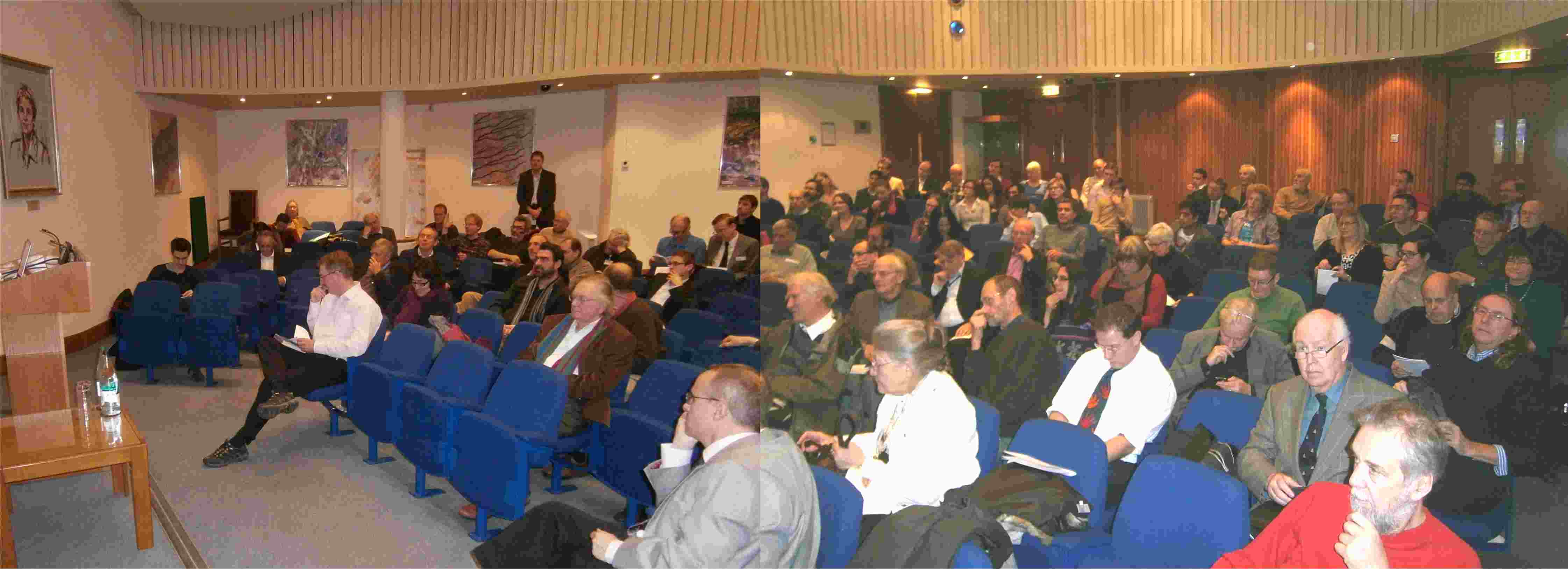
The lecture hall as was in 2011 when
I attended an exo-Earth symposium.
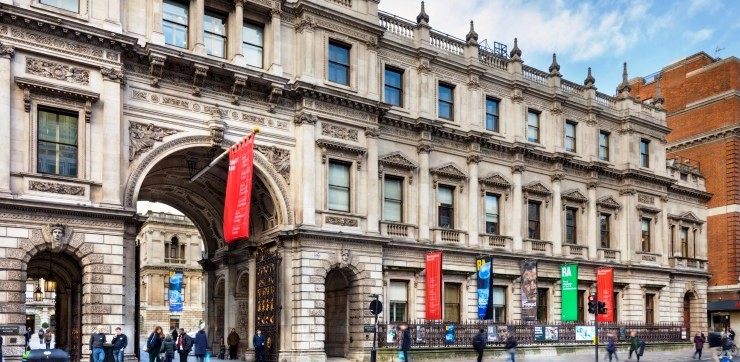
Burlington House, Piccadilly, London.
The Geological Society occupies all three floors (and basement) of the front, east wing,
to the far right of the complex's main, archway entrance (at the building's end).
If you have been following this site (not that many, if any, have), you will note that over one and a half decades ago, back in 2009, I wrote an online essay, 'Can We Beat The Climate Crunch' that concluded that "it is too late to avoid significant climate change and that we are very likely going to exceed the our 'safe' 2°C above pre-industrial level (or 1.2°C above the Earth's 2006/7 temperature) warming, it might seem pointless in adopting expensive low-fossil carbon economies. However the more the Earth warms the more the chance of one [climate threshold/tipping point] taking place".
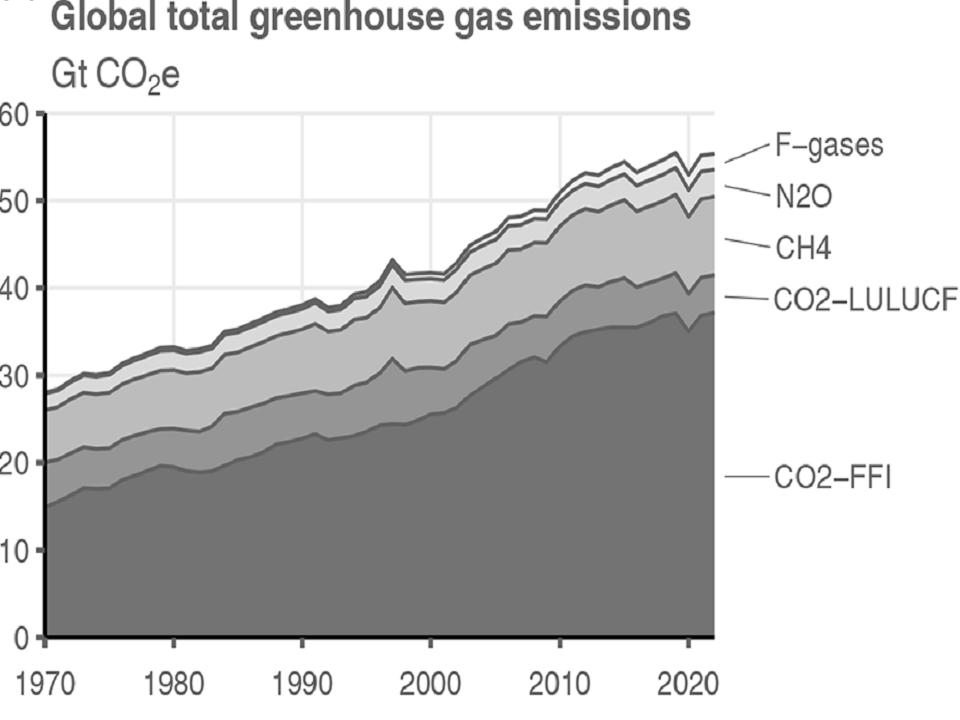
Since then, more and more science research has taken place that affirms my then conclusion that we will exceed 2°C. And so, at the bottom of that essay I added references to this corroborating science: a list that has continued to grow and grow... The latest of these is Foster, P. M., Smith, C., Walsh, T., et al (2024) Indicators of Global Climate Change 2023: annual update of key indicators of the state of the climate system and human influence. Earth System Science Data, vol. 16, p2,625–2,658. It concludes that we have just a few years left of emitting greenhouse gases at the rate we currently do (see graph left) before enough are in the atmosphere to take warming over 1.5°C above the IPCC's pre-industrial temperature and that we will do this before 2034. (1.5°C above the IPCC's pre-industrial temperature being the 2015 COP preferred 'safe' warming limit.) So, if we exceed 1.5°C before the next ten years are up, then the 2°C limit comes next.
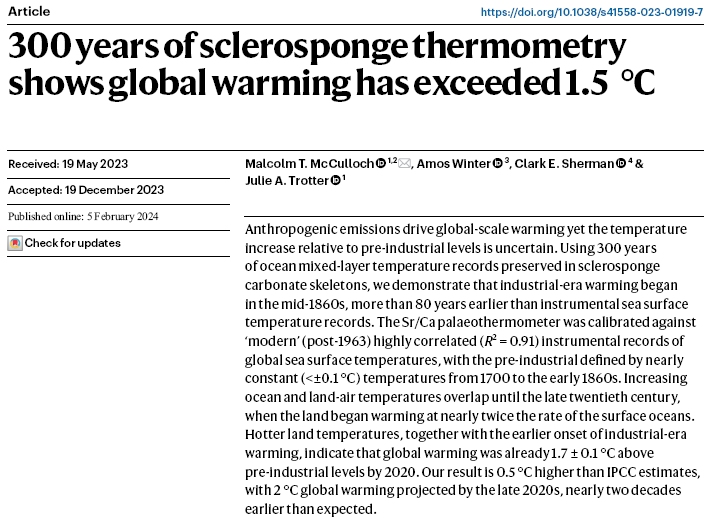
Spring 2024Sponges reveal that the Earth has possibly already warmed by over 1.5°C! You may recall that the 2015 COP's Paris Accord had the goal of keeping global warming to below 1.5°C above the pre-industrial temperature. However, have you ever considered what the 'pre-industrial' temperature was? Ship-based instrumental measurements of sea surface temperature only began in the 1850s and with land-based instrumental measurements also from that time. This means that the Intergovernmental Panel on Climate Change (IPCC) uses the global temperature from the 1850s as being representative of the pre-industrial temperature and even here there are issues as measurement back then was not as comprehensive as today with more sites at which measurements are made.
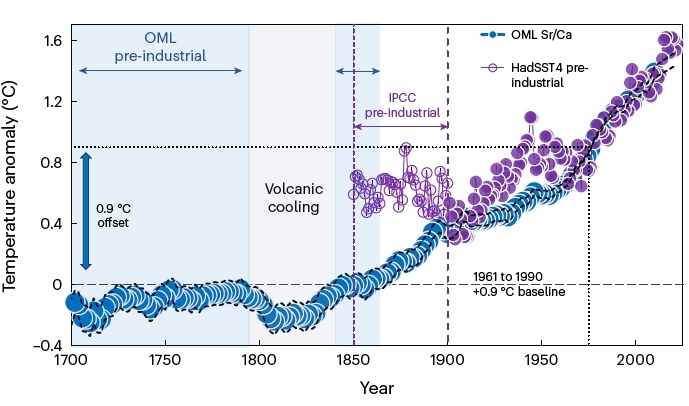
Here, the latest research small US and Australian based collaboration, with the lead author being Malcolm McCulloch, has now used Strontium/Calcium (Sr/Ca) ratios in sponges in the Caribbean at depths of between 40 and 80 metres. (This depth was below the vagaries of varying turbulent ocean/atmosphere interaction.) This Sr/Ca serves as a proxy for temperature. And they used Thorium-Uranium isotope ratios (230Th/238U) to date the remains of sponges' carbonate skeletons. This way they could plot temperature over time for 300 years, far longer than the 175 year period used by the IPCC.
They found that between 1700 and 1800AD the temperature was broadly speaking stable, but that after then (following a short dip due to a few volcanic eruptions) warming began and continued through to the 20th century (see the below graph). Further, because the data set the IPCC use (HadCRUT5 data) includes land temperature measurements, there is a difference between that and the sea's temperature as revealed by sponges' Thorium-Uranium isotope ratios.
All this means is that (at least for the Caribbean at depths of between 40 and 80 metres) the pre-industrial temperature was cooler than the IPCC consider and that this new, ocean mixed layer (OML) temperature rise over 300 years, as revealed by sponge skeletons, is greater than that the IPCC considers as the pre-industrial temperature rise. In short, the Earth may have already warmed by 1.7°C and this is more than the 1.5°C Paris Accord limit! What we need now are other OML palaeotemperature records from a range of locations about the globe to see whether or not this 1.7°C warming over past couple or so centuries is planet-wide and not just a -- what Jerry Pournelle called an 'it rained on Mongo' -- local effect.
(The engineer and author Jerry Pournelle said that bad SF writers and film makers tend to consider a whole planet as a small local place and so say, for example, that 'it rained on Mongo'. When considering climate proxies -- be they tree rings, lake sediment pollen analysis, ice core isotopes, whatever... -- we need to consider whether what we are seeing is a local effect, or alternatively is representative of something happening planet-wide to the Earth system as a whole.)
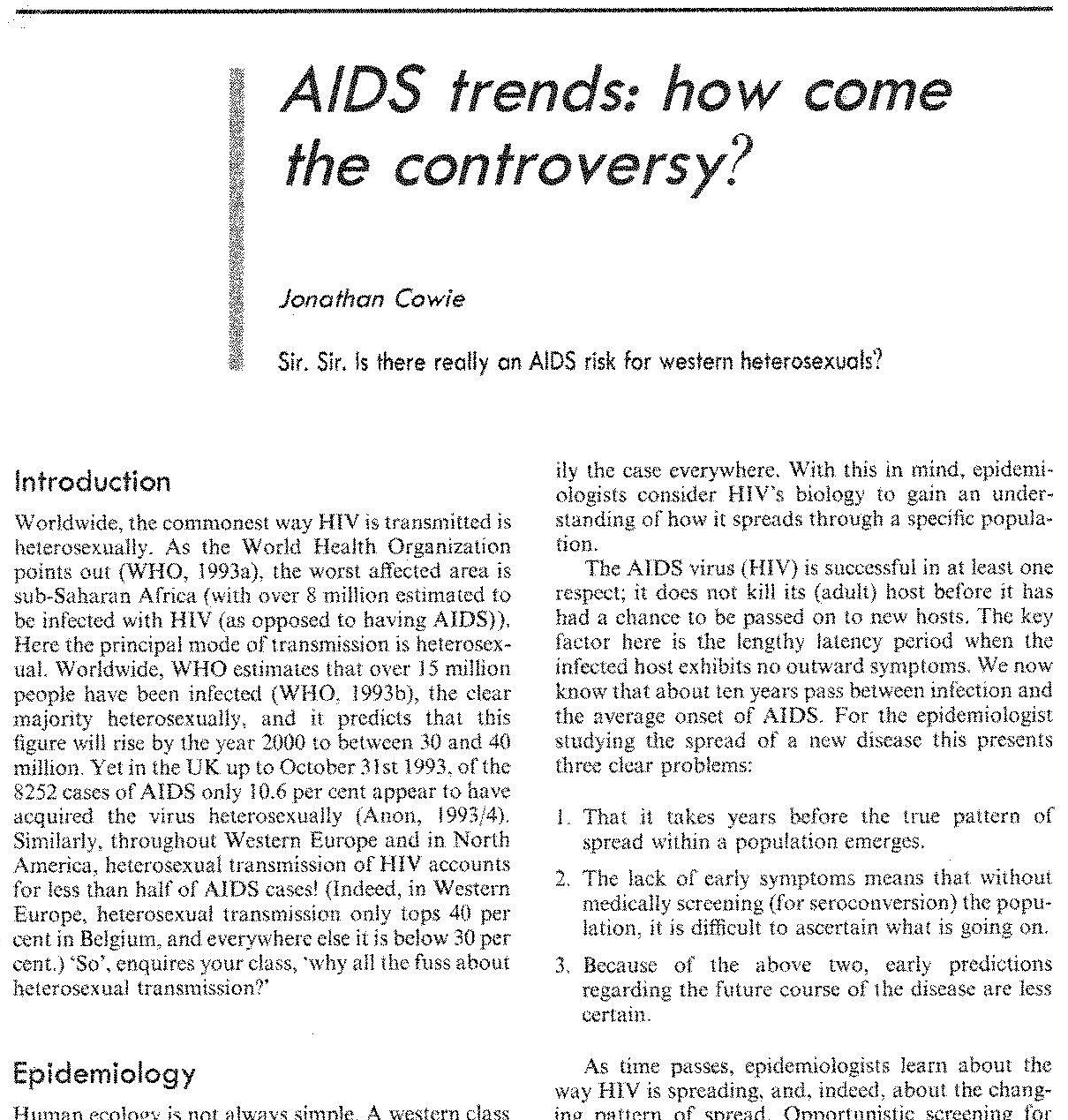
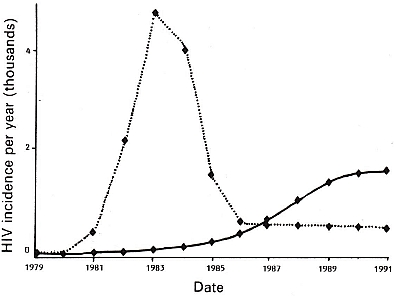
AIDS trends: how come the controvery?
HIV transmission mode 1971-1991.
Solid line heteroseχual transmission
Spring 2024Thirty years ago and newspaper headlines were proclaiming that you could not catch AIDS heteroseχually and that AIDS was not caused by HIV! This was only thirty years ago but, with regards to AIDS denialism, thankfully since then we have come a long way. Now, you might expect the tabloids like The Sun (the UK largest circulation popular newspaper) to say that heteroseχuals were safe from AIDS, which it did in 1990, but media misconceptions continued and myths propagated. In 1993, supposedly quality papers, such as The Sunday Times and The Sunday Telegraph, gave coverage (hence some may say some credibility) to one Peter Duesberg who -- to be fair to the media -- had his HIV-does-not-cause-AIDS views published in some peer-reviewed journals.
Anyway, thirty years ago this year I was transitioning from being the Institute's publications manager to take on science policy duties (but retaining some book publishing activity), and I was asked to write a briefing piece for the Journal of Biological Education (a science journal for biology school teachers and, back then, university lecturers) from the Institute of Biology (subsequently, more recently, just a few years back, the Institute was re-branded as the Royal Society of Biology). This briefing appeared as Cowie, J. (1994) AIDS trends: how come the controversy. Journal of Biological Education, vol. 28 (2), p127-129. (Click on the afore title link for an archive PDF.) It was also a follow-up to a previous JBE item of mine: Cowie, J. (1990) AIDS and Education -- an update. Journal of Biological Education, vol. 24 (4), p259-261.
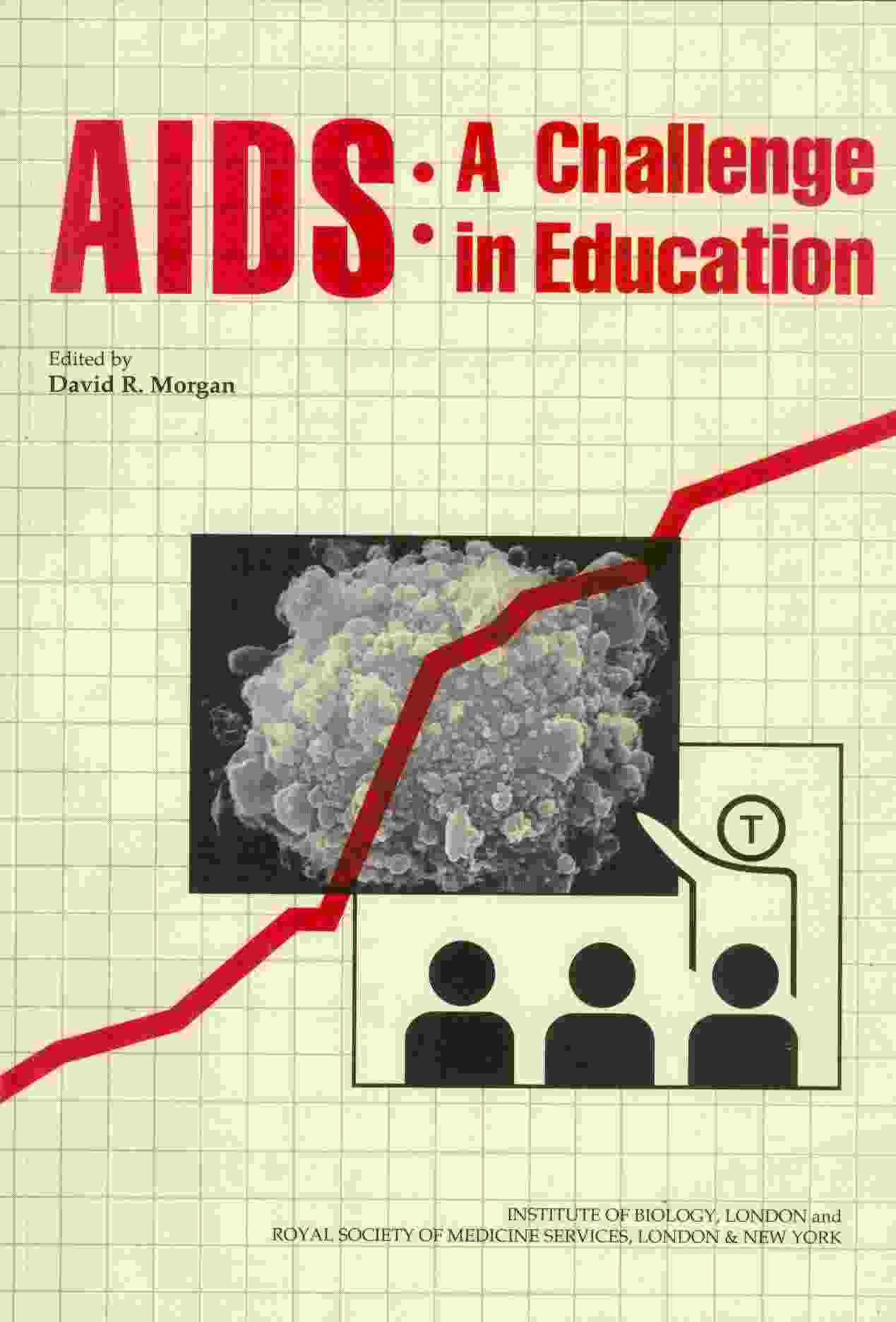
Previously, in 1990 as the Institute of Biology's Head of Publications, I was responsible for publishing AIDS: A Challenge in Education (see left for cover) and for this task was given a nice round figure production budget of £0 and so I teamed up with the Royal Society of Medicine: they marketed to clinicians and we marketed to biologists in education, splitting the profits once the production costs were met.
Science myths come and go and since then I have had my share of tackling a few including spending a fair bit of time on human-induced (anthropogenic) climate change denial; a perspective to which some -- fortunately a just a few but a few too many -- politicians today continue to subscribe.
Of course, today we still have to challenge science myths when they arise. However, today my counterparts have the additional factors of myth dissemination through social media, artificial intelligence deep fakes and the like. I am glad that I am now very much retired and have every sympathy for those today fighting the good fight.
It was hot and sticky and all of us above
saw our hair run rampent...
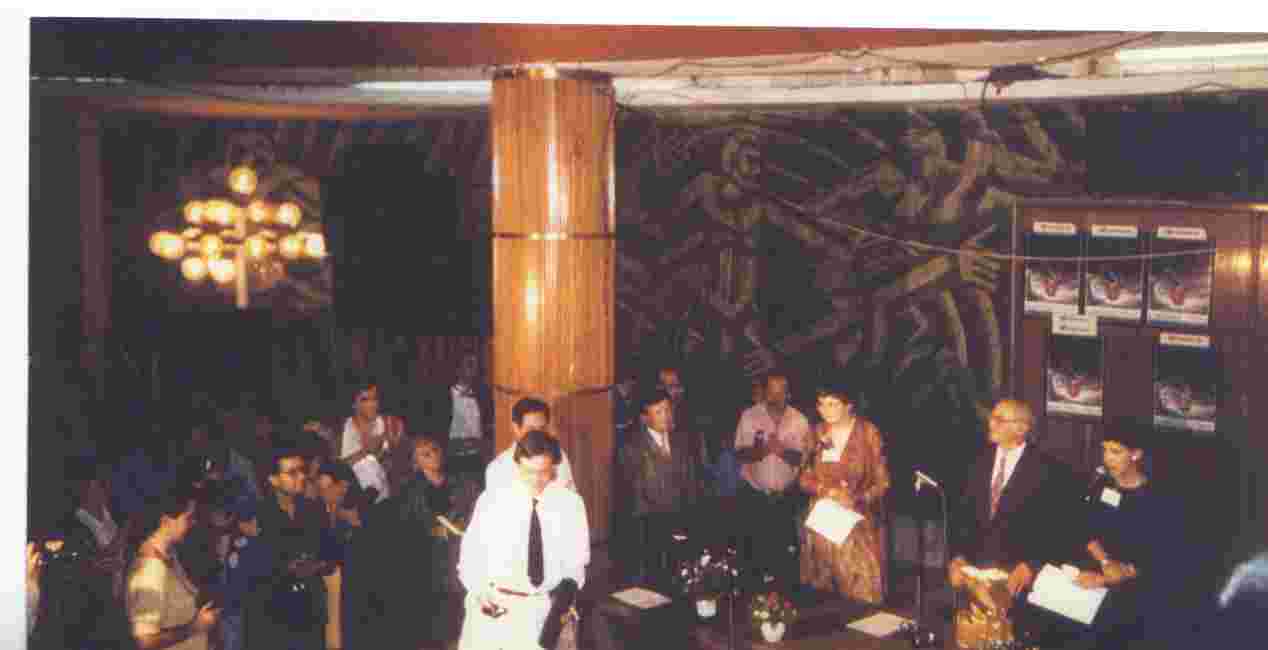
Spring 2024Exactly 30 years ago I was invited to the 1994 Eurocon in Timisoara, Romania. This Science Fiction gathering was rather special. It was only four short years since the fall of the Iron Curtain and a revolution in Romania and so this was a fascinating visit to a nation that had been effectively cut off from the West for half a century. I went with one of that year's Eurocon's Guests of Honour, John Brunner. I had met John at well over a dozen previous conventions in Britain and was the Press Officer for the 1984 Eurocon he fronted in Brighton (see the next item below). I myself was one of the 1994 convention's Special Guests along with reproductive biologist Jack Cohen: we were both meant to wax lyrical on biological matters (there is a lot of science fact that is genre-adjacent to SF). Back in the 1990s Jack and I crossed paths a fair bit as not only were we regularly on science panels at SF conventions Jack was a Fellow of the Institute of Biology and had terms on its Council and Biomedical Science Committee, the latter was one of the Institute's policy committees I serviced (and, of course, the Institute was subsquently re-branded as the Royal Society of Biology). At the Timisoara Eurocon, while much of my focus was on climate change (in 1990 there was the first IPCC Assessment so the public were already well aware of the issue), it being an SF event inevitably Jack and I were asked to discuss exobiology; something that Jack does well (for example, see this article in Biologist).
I went to the event a week in advance to scope out what was what and meet members of the H. G. Wells society, staying with the family of a Romanian author, Silviu Genescu. 'H. G. Wells Society?' I hear you cry. Well, under the communist dictatorship all groups and clubs had to be state approved and one way Timisoara's SF community got around this was to name their society after H. G. Wells as they could explain to the authorities that Wells was a socialist...
Local English and French college students acted as translation guides to groups of westerners. My own hosts spoke very good English with Silviu's day job being a journalist translating stories from western newspapers.
And that event saw our genre arts and science wing, SF² Concatenation, pick up its first European SF Society Eurocon Award: we had produced a tri-lingual edition (we were a print magazine back in the day before our online incarnation) in English, Romanian and German (with a Swiss accent) especially for the Eurocon.
Seacon '84 promotional poster.
Artwork by Pete Lyon.
The Organisers, order as appearing in the Programme Book:
+ Arnold Akien - Technical Manager
+ John Brunner - Co-Chair
+ Marjorie Brunner Jonathan Cowie - Press & Space Exhibit
+ Alan Dorey - Publications and BSFA rep
+ Rochelle Dorey - Crèche
Paul Dormer - Sponsorship Assistant
+ Chris Donaldson - Programme
+ John Fairy - Treasurer
+ Colin Fine - European Secretary
Pete Garratt - Brighton Liason
+ Gerbish - Hotel Liaison/ World SF Joy Hibbert- Games Room
+ Martin Hoare - Co-Chair
+ Chris Hughes - Publicity
+ Jan Huxley - Publicity
Bob Jewett - Operations
Anthony Johnston - Films
+ Pete Lyon - Art Show Hugh Mascetti - Security
Graham Middleton - Road Crew
+ Pauline Morgan - Registrations
+ Paul Oldroyd - Coordinaton Anne Page - Masquarade
David Rowley - Games Room & IT
Bruce Saville - Video Room
Tim Stannard - Legal
John Steward - Accounting John Stewart - Road Crew
Chris Suslowicz - Fan Room Martin Tudor - Programme Assistant
John Wilkes - Book Room Ian Williams - Initial Fan Room Planner Simon Ounsley - Initial Publicity
+ = Member of Steering Committee
Report on the convention's
press operation
Easter 2024Exactly forty years ago and I had a short break from the British Medical Association to run the press liaison op' for the first, combined SF Eurocon and Eastercon! How time flies. The event's promotional poster (see left) saw a spacecraft crash into a futuristic, Brighton seaside. (Brighton being the venue town and the spacecraft really a beer mug: bars at these gatherings are pivotal for networking.) That event, the first of, to date, just two combined Eurocon and Eastercons, saw some 1,700+ of the genre community gather (up to then the largest Eastercon)* for four days and a half-dozen parallel programme streams of talks, panels and films in addition to art displays and book-dealer halls. And, of course, there were the BSFA and Eurocon Awards. (Back then, I would never have believed that SF² Concatenation would eventually be a recipient of a few of the latter...)
The event's Guests of Honour were all big genre names back in the day: Pierre Barbet, Waldemeer Kumming, Josef Nesvadba, Christopher Priest and Roger Zelazny. Announced once the event won the Eastercon site selection vote, one Isaac Asimov was meant to be a Guest of Honour too but ill health 1982-3 prevented his attendance. (And then in December 1983 he had heart surgery but it was only until 2002 we learned that the blood transfusion he then received came with an unwanted extra.) John Brunner was the figurehead Chair of the organising committee, though the hands-on organiser coordinator was Martin Hoare. All now sadly gone, as have too many of my fan friends and author acquaintances (not to mention a few author friends) of that era.
You may notice that one of the organisers had their name and (former) home address on the poster. With ID theft and scammers, such would be unthinkable today: forty years ago was a very different time. It was also pre-internet, so much material from back then is simply lost to us today. Though I dare say that the SF Foundation based at Liverpool University would have similar gems from yesteryear.
It being 1984, I used George Orwell as one of the press hooks. Though I had to explain to one reporter who George Orwell was as well as Nineteen Eighty-Four; only one of the most famous reporters and literary SF works respectively in history! (You tell that to the kids these days....)
There was considerable local press coverage, both newspapers and radio (including coverage in advance of the event which helped boost numbers -- the convention estimated that 300 to 400 attended the convention through advance and first-day press coverage -- making it the largest (1,700+) of such gatherings up till then and since). As well as a handful of articles in the national press, and the aforesaid extensive local coverage, there was also a half-hour BBC Radio 4 and a 15 minute BBC World Service programme (see 'Archival addendum' below) devoted to the event also in the mix. (The only time an Eastercon had a dedicated half-hour programme on national radio.) Sadly, over-enthusiastic hotel room service 'tidied up' (took away) my pile of local newspapers with all their coverage!
And so it goes.
Because the press operation was so (ahem) successful, I was encouraged to do a write-up for convention organisers which appeared as a small booklet, The 1984 Eurocon Press Report. (See left for cover.) With the coming of the internet, blogs, social media etc, much of this guidance is now very dated. However, a one-size-fits-all press release still needs to be avoided and personal cultivation of individual press contacts' relations encouraged.
Archival addendum. For those that wish to hear the 1984 BBC Radio 4 Kaleidoscope programme, I recently unearthed (stumbled across) a cassette the Beeb kindly sent me and this I converted to MP3. You can listen to it here or alternatively download it (74MB).
For those that wish to hear the 1984 BBC World Service Outlook programme, you can listen to it here or alternatively download it (19MB).
* An Eastercon attendance record that has yet to be broken.
Friday 16th February 2024
"Bad men need nothing more to compass their ends,
than that good men should look on and do nothing" John Stuart Mill (1867).
New Year's Day 2024Sad news, just before New Year's we lost John Burns (85) and a couple of weeks before Christmas, Ian Gibson (77). Both were artists with 'the Galaxy's greatest comic', 2000AD. A number of us on Concatenation's genre wing team, including Graham Connor, have been avid fans of 2000AD from way back when Alan Grant was editor (that's the late 1970s for those keeping count) and we were personally acquainted with a number of the 2000AD command module crew from that time. Alas we never met neither John Burns nor Ian Gibson but we were very much aware of, and hugely enjoyed, their artwork.
Both artists had a distinctive style: Gibson's was more impressionist and sharp-angled whose art was outlined in pencils and inks, and Burns' more colourful, working with paint.
Ian Gibson drew for a number of strips including over two score Judge Dredd adventures (1978-2007), and all the early Robo-Hunter adventures (1978-1985). He was also the artist behind the 2000AD strip that turned out to become a classic graphic novel, The Ballad of Halo Jones, with a script by the legendary Alan Moore. Queue Transvision Vamp and Halo Jones video file), courtesy The Cathode Ray Choob or listen to it at YouTube.
John Burns' oeuvre reads like a history of British comics from the mid-1950s through to 2023. His early genre work included Space Family Robinson for Lady Penelope (a spin-off from TV Century 21 and UFO for TV Action and even Dan Dare for the revived Eagle comic (1990-'91). For 2000AD he drew a number of Judge Dredd strips (1991-2013) but is possibly best known for his work on Nikolai Dante (1999-2012). Through to the end he was a traditionalist and unlike other artists who submitted their work electronically as PDFs, he physically mailed in his artwork rolled up in tubes. His final story artwork for 2000AD, 'Nightmare New York', with frequent collaborator Kek-W, will be published posthumously later this year.
Both will be missed by Squaxx dek Thargo, fans of 2000AD.
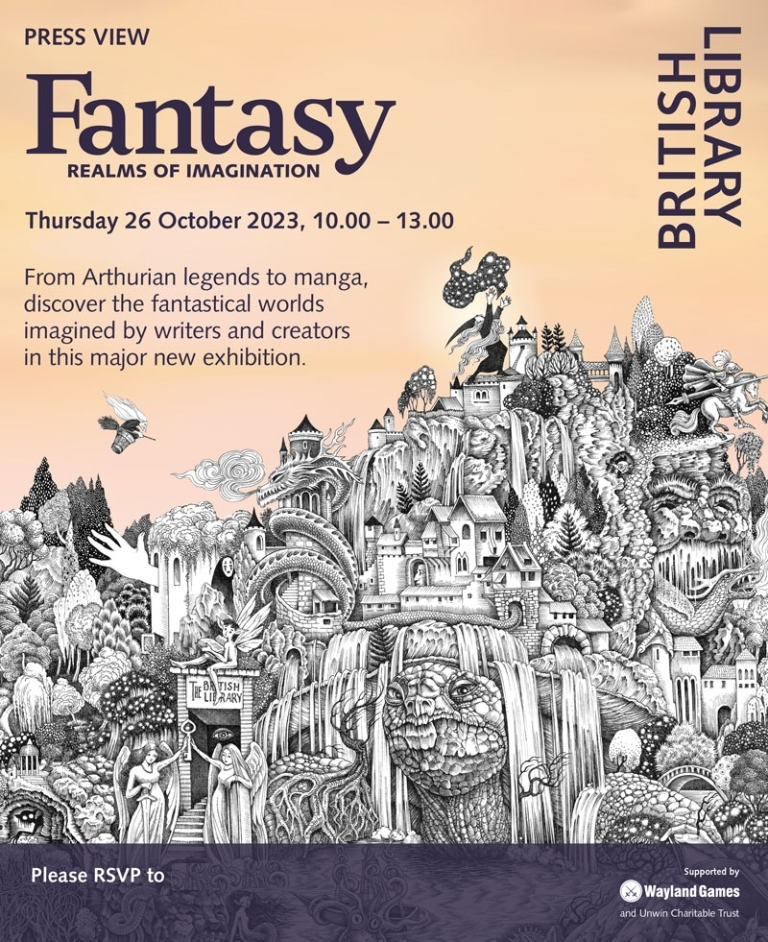
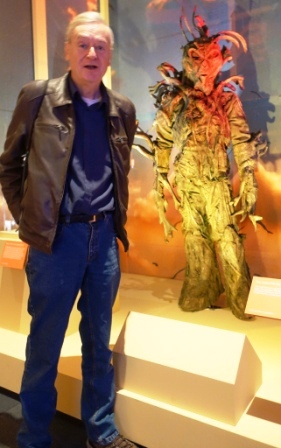
Autumn 2023British Library fantasy exhibition. The press launch of the British Library's 'Fantasy: Realms of the imagination' exhibition was one of the last jollies of the year for a couple of us attached to SF² Concatenation's genre wing. Though I am decidedly more into science fiction -- especially hard SF and wide-screen (interstellar) space opera -- than fantasy, I have occasionally been known to imbibe: indeed fantasy is the other side of the speculative fiction coin.
Of course, this is not the first time that the British Library has put on a genre exhibition, the last one was on science fiction itself and that was over a decade ago in 2011. Time flies.
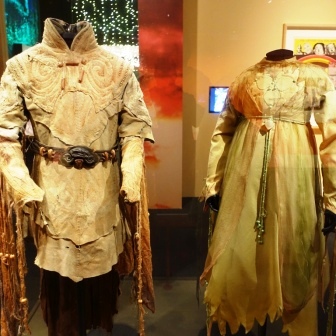
The exhibition explores the evolution of Fantasy. From ancient folk tales and fairy stories, gothic horror and weird fiction, to live action role-playing games inspired by fantasy worlds, the exhibition will celebrate the genre and its enduring impact. It includes historical manuscripts, rare first editions, drafts of iconic novels, scripts and maps, film props and costumes. There is review of the exhibition over at SF² Concatenation.
Part of the exhibition, a 15th century, Caxton printed edition of King Arthur and the Knights of the Round Table.
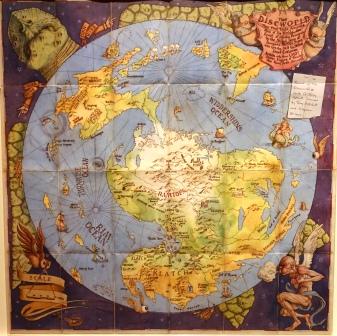
Left: With a friend. Below: Just three of the very many other exhibits.
Terry was hesitant about having a map of his Discorld. (Having a map is something of a 20th century fantasy novel cliché and also he did not want to be constrained by it.) However, several Discworld novels later, in 1995, he allowed Stephen Player (under careful guidance) to produce this one.
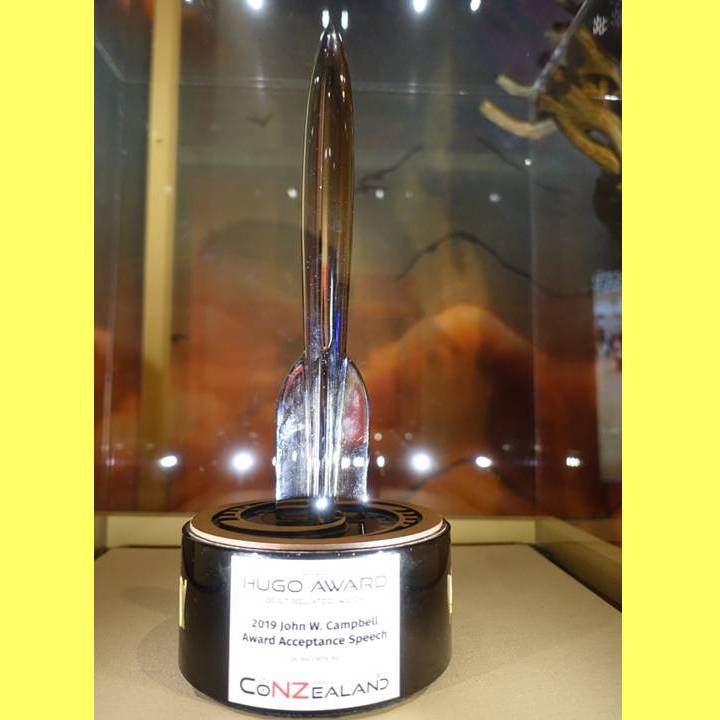
This is one of the Hugo Awards for 'SF achievement' (designed by Pete Weston) technically presented at the 2020 SF Worldcon in New Zealand. Alas, though I was due to go, none of us did due to CoVID lockdown. This Hugo Award in the 'Best Related World' category went to Jeanette Ng for her acceptance speech at the previous year's Worldcon for the John W. Campbell Award for Best New Writer. Jeanette outed editor John W. Campbell for his racist beliefs. As a result, the John W. Campbell Award was subsequently re-named the Astounding Award after Astounding magazine. Jeanette loaned this to the exhibit.
Late Summer 2023Terry Pratchett stamps launched by the Royal Mail. Our genre wing's (SF² Concatenation) co-founding editor, the physicist Graham Connor, was a huge Terry Pratchett fan. Though personally I am not that into fantasy, I did have the privilege of meeting Terry a number of times. (This is not that big a deal as it might sound as we both regularly attended Eastercons in the 1980s.) An early encounter included a 1980s Eastercon when he came up to me saying: 'I'm a published author. Buy me a drink.' Being then only just free of two degree years' worth of student poverty, I declined. If he was offended by my not providing him with an offering to Bacchus, he got me back years later when Terry and I breakfasted at the 1990 Dortmund Eurocon. We were at the toast and marmalade stage when I asked him whether he would kindly autograph a 'Discworld' book of his. As he was doing it, I said it was not for me but the son of a friend. He quipped back, 'That's what they all say.'
Anyway, it is now 40 years on since the first of the Discworld books, The Colour of Magic, and the Royal Mail are marking the occasion with stamps featuring: Rincewind, The Librarian, Granny Weatherwax, Sam Vimes, and Great A’Tuin, as well as specially commissioned artworks of Death and Mort, Tiffany Aching and Moist von Lipwig. All are by the artist Paul Kidby, who was Terry’s preferred illustrator for the Discworld books.
Graham would have loved these.
Summer 2023We will miss climate target says world-leading climate scientist. Professor Sir Bob Watson, is a former head of the UN's IPCC, and former UK government departmental (DEFRA) Chief Scientific Advisor. He is reported by the BBC as saying: "I think most people fear that if we give up on the 1.5 [Celsius limit] which I do not believe we will achieve, in fact I'm very pessimistic about achieving even 2°C, that if we allow the target to become looser and looser, higher and higher, governments will do even less in the future."
It also came the same week as the UK government released its Third National Adaptation Programme (NAP3) and the Fourth Strategy for Climate Adaptation Reporting of which the geoscientist Bill McGuiresaid: "There is so much wrong with it that it’s hard to know where to begin." And: "You won’t find anything in the programme about how the country will cope when temperatures don’t just top 40°C for a day but for a week or more, when river and surface floods arrive that dwarf anything we have seen, or when the sea comes in and stays in. As it stands, it is simply not fit for purpose."
And so it goes...
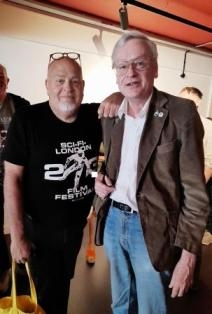
With the Fest's founder and director
Louis Savy.
Summer 2023My first film festival since CoVID-19! It is good to be going to them again and so I went with a few friends to the 2023 Sci-Fi London. Although this year it was spread out across a Shoreditch and three West End cinemas but once back in Blighty and having got down to London, its local transport is so good that there was little problem getting between venues. Sadly, two rail strike days and some evening screenings (we would have got back too late) meant I did not see as much as I would have liked, though what I was able to was all solid stuff. I also managed to briefly touch base with a longstanding acquaintance, the Fest's founder and director, Louis Savy. How he manages to put on a Fest year after year is anybody's guess.
This year there was also some science in the mix (in the past I have contributed to SFL's programme, once co-leading a science for film-makers workshop and then, with microbiologist Lewis Dartnel, a presentation on exobiology). This year it was climate change and the cinematic arts. I was not involved and this was possibly a good thing: the discussion was mainly on the challenges of addressing climate change (mitigation) whereas my focus is the science and impacts of climate change. Furthermore, the past half decade I've moved more to other aspects of Earth system science (deep time co-evolution of life and planet) as I found myself getting too depressed investigating the climate trajectory we seem to be firmly on. Anyway, this year, preceding the discussion there was a screening of four climate-themed SF shorts to help spark audience and panel debate.
Also in the mix was the launch of Henry Chebaane's and Stephen Baskerville's graphic novel, The Phanharmonion Chronicles. (I caught a panel discussion with them.) In addition there was an evening on mutually assured nuclear destruction which included a screening of the BBC documentary The War Game (1966). When I saw that back in the mid-1970s it scared me witless, so I gave it a miss this time round: though do not let that put you off; everyone, especially politicians, should see it!
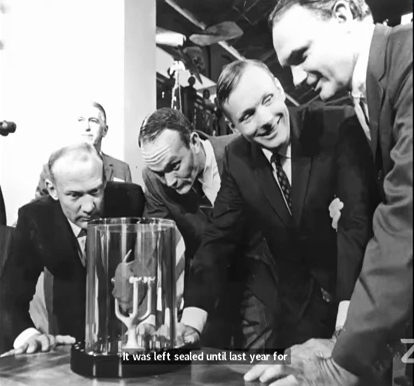
Apollo 11 astronauts being wowed by
the Smithsonian's collection of Moon meteorites.
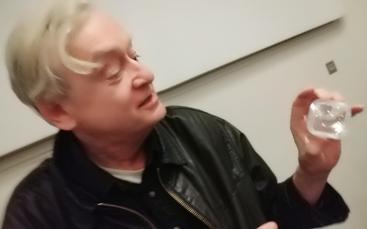
Good to be able to see meteorites
close up. Here with a meteorite
that orginated from the Moon.
Summer 2023Science lectures are back! Prior to CoVID, I used to go to several science lectures and three or four one or two day symposia a year. All that stopped early in 2020 with CoVID lockdown and while things began to open up in 2021 with the vaccine rollout, in person science symposia and lectures -- at least those associated with my usual haunts other than the Royal Society -- have not taken place. (Sorry, virtual symposia and events just don't do it for me: for one thing no real networking and discussion opportunities.) However, the Geological Society has now resumed its public lectures and I was pleased to attend one by Natasha Stephen on Extra-terrestrial Fieldwork; the adventures of an Earth-bound Astronaut.
This lecture looked at geologists who hunt for meteorites from the Moon, Mars and asteroids and how they track them back to their likely point of origin.
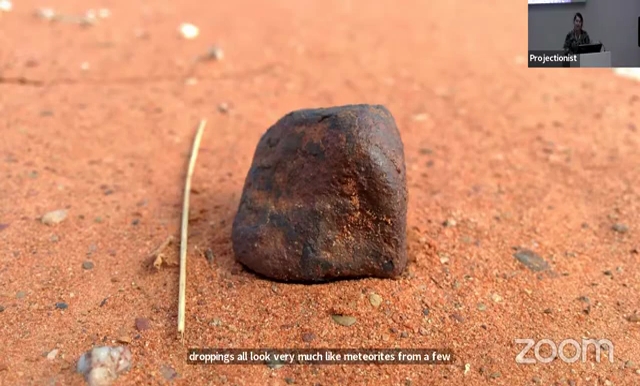
Apparently there are 71,633 scientifically classified meteorites (excluding those on folks' mantelpieces unclassified). Over 95% of classified meteorites are finds and the rest are tracked down from an observed fall. One of the best ways to find meteorites is to go to a desert as the meteorites will stick out in the landscape. Having said that deserts contain creatures such as camels or kangaroos (depending on which desert) and it is surprising how many suspected meteorites soon turn out to be animal poo. But such expeditions can be fruitful. Natasha Stephen's last meteorite hunting field trip, in 2019 just before CoVID hit, turned up 46 meteorites in 8 days.
As Natasha explained, she finds meteorite hunting and the subsequent analysis fascinating. Apparently, even the Apollo 11 astronauts were intrigued when they visited the Smithsonian's collection of Moon rock meteorites (see picture left).
And one advantage of an in-person lecture was being able to see actual meteorites close up, and even hold a meteorite that originated from the Moon.
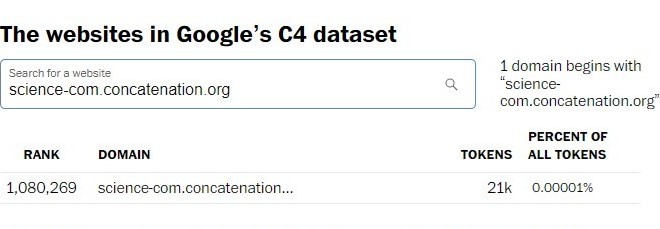
Screenshots of this Science-Com and
the SF² Concatenation C4 rankings
Stop Press Autumn 2023: US authors George R. R. Martin, John Grisham, among others through the Authors Guild, are suing ChatGPT-owner OpenAI over assertions that their material was used, hence copyright infringed, to train the system. Separately, the comedian Sarah Silverman is also suing. I can't say I blame them: I am uncomfortable with this site, our genre-wing SF² Concatenation, and I suspect my books, being used to train AI.
Summer 2023Concatenation Science-Com and SF² Concatenation help make ChatGPT AI sound smart! Which, come to think of it, is not that much of a tribute...
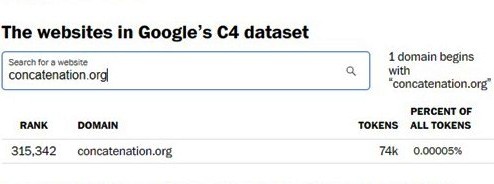
2023 seems to be the year of Artificial Intelligence (A.I.) Chat bots, such as ChatGPT from Open AI. However, to make them speak seemingly with intelligence they have to be trained. One of the data bases used to train them is a raft of 15 million websites that make up what is called the Colossal Clean Crawled Corpus, or C4 for short. The Google version of this is the Google C4 and it is this that is used as one of the ways to train many of the current, major ChatBots. And guess what, it transpires that both the Concatenation Science-Com and its genre arts wing SF² Concatenation websites are included as two of the 15 million websites on this database.
Google C4 ranks its websites with top ranking sites getting a low C4 score, much like the old Alexa rankings used to work. Here worryingly (as I am not sure I like websites I helped create being used to train A.I.s) both Concatenation Science-Com and SF² Concatenation are ranked in Google C4 as being in the top 10% of C4 websites with a score of 1,080,269 for Science-Com and a surprisingly good 315,342 for SF² Concatenation: indeed, SF² Concatenation ranks comparably with a number of learned biological societies.
It transpires that many science as well as science fiction websites are in the top 10% of the 15 million Google C4 sites. Here are a few and their scores together with some major non-SF/science sites:
2 Wikipedia
7 The Guardian
48 Nature
2,360 ScienceFiction.com
3,239 Locus SF
3,445 File770 Fan News blog
9,501 SF Site
61,481 Geological Society
86,207 Zoological Society (of London)
240,290 Royal Society of Biology
250,555 British Ecological Society
276,442 Marine Biological Association
315,342 SF² Concatenation
318,524 The Hugo Awards
432,213 Ansible SF News
602,572 Freshwater Biological Association
1,080,269 Concatenation Science-Com
2,819,110 Sci-Fi London Film Fest
4,442,055 World SF Society
5,508,074 European SF Society
It should be noted that no website asks to be crawled let alone gives permission to be used to train artificial intelligences... (So, don't blame us that the machines are taking over.)
Stop Press August 2024. It appears that science journal publishers are now selling their content to A.I. companies to train their A.I.s without getting researchers' permission. See Gibney, E. (2024) Has Your Paper Been Used to Train an AI? Probably. Nature, vol.632, p715-6.
According to a report in The Bookseller UK trade magazine, publisher Taylor & Francis has sold access to their research to
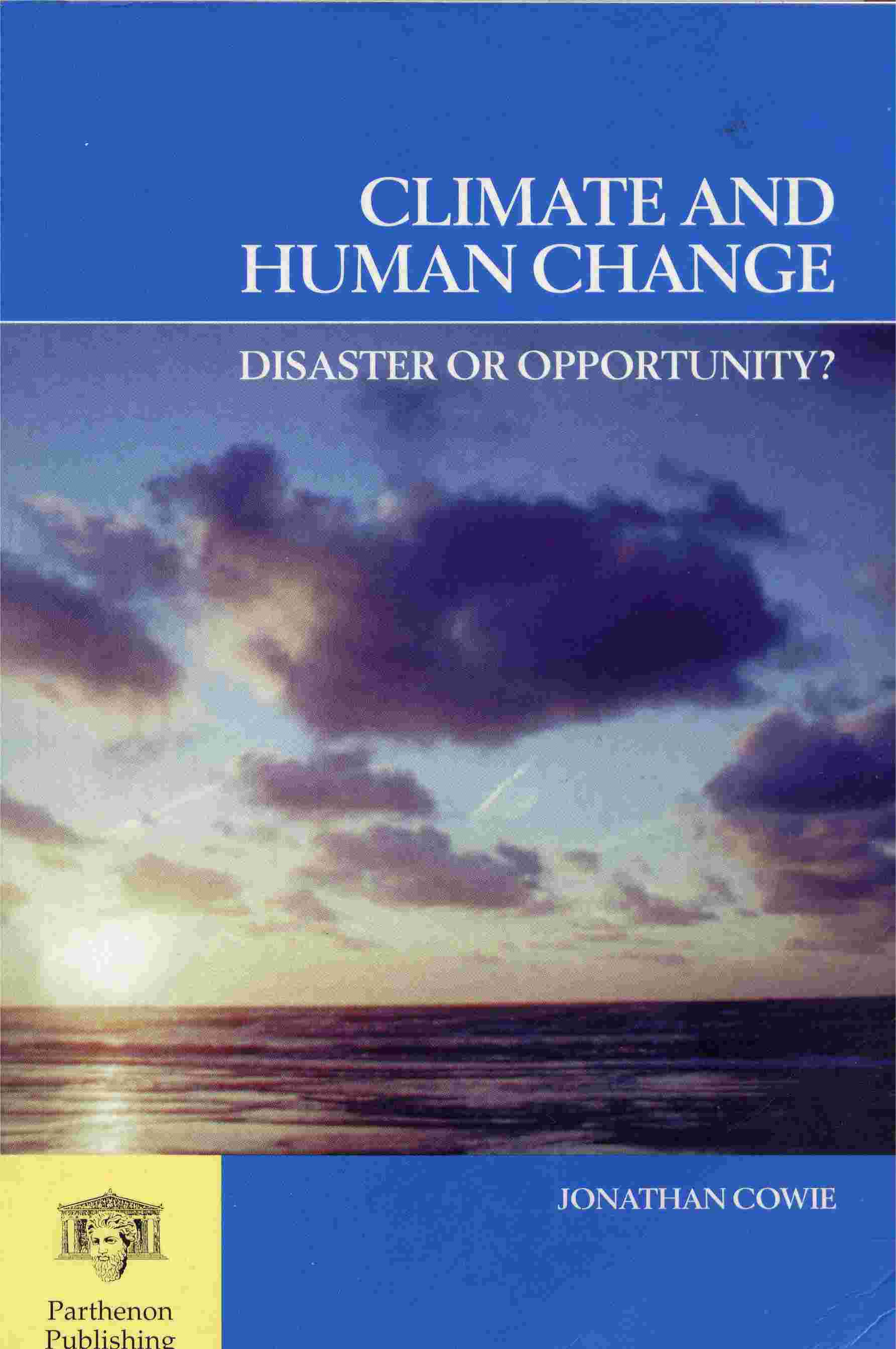
Microsoft AI. My Climate & Human Change: Disaster or Opportunity? book was taken over by Taylor & Francis (and its Routledge and CRC Press imprints) when Parthenon Publishing was sold. So it looks like that, almost certainly, has been used to train AI without my permission. Indeed I have heard nothing from T&F regarding my book's transfer though I see that it is being sold by bookshops with them and their imprints listed as the publisher. Ho hum.
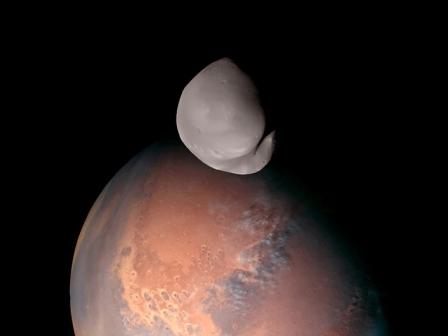
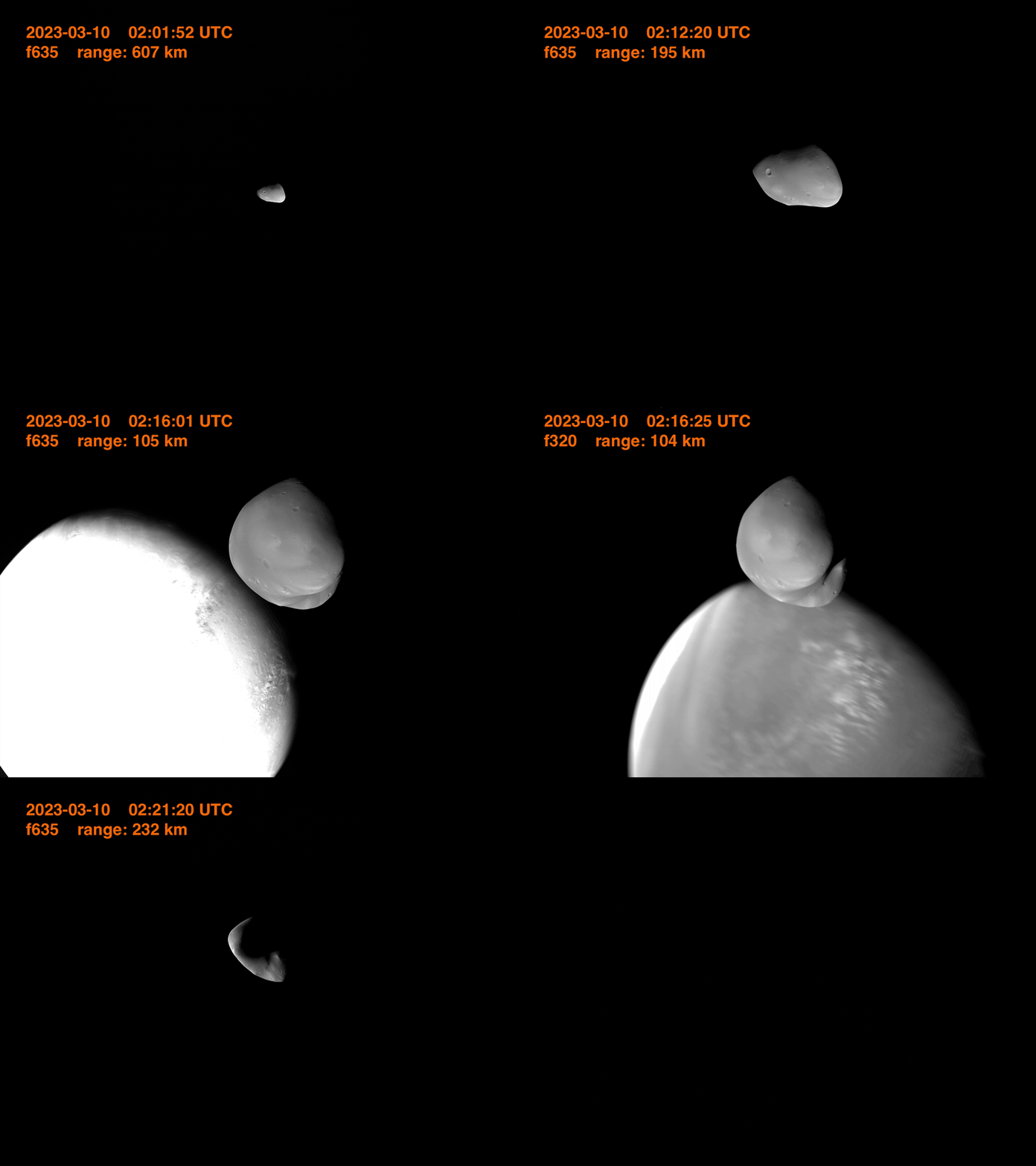
Spring/Summer 2023The first close up picture has been taken of the Mars moon Deimos. It has to said that I have a soft spot for space exploration. (I wish I was a spaceman, the fastest guy alive.) The United Arab Emirates’ space probe Hope has taken the first, high-resolution images of the far side of Mars’s smaller moon Deimos. Deimos is about 7.5 miles (12km) in diameter. Deimos and the slightly larger Martian moon Phobos are named after the twin sons of Ares, the Greek god of war. (Mars is named after the Roman god of war.) Phobos was the deity of panic and fear, and Deimos the deity of terror and dread. Deimos is tidally locked to Mars and so probes arriving at Mars passing by the moon, and observations from Earth space telescopes, have only seen one side. The Hope fly-by therefore was not only the first close-up but afforded views of both sides of this moon. See the fly-by animation below...
The actual press conference saw the Secretary-General of the United Nations, António Guterres, call for action and that we need to do "everything, everywhere, all at once". This being a popular cultural reference to a recent indie hit film that, over at our arts genre wing back in January, we (our genre wing's team) rated as one of the Best SF Films of 2022.
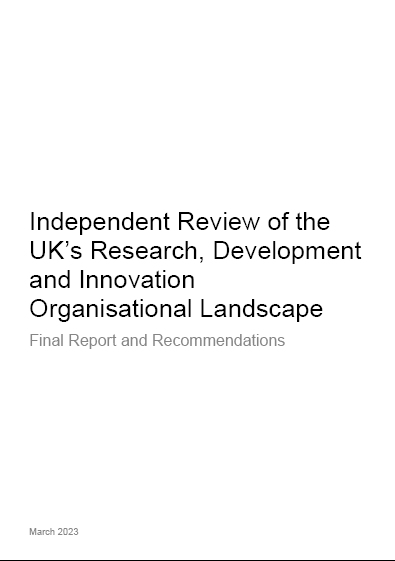
Spring 2023Distinct déjà vous with the publication of Sir Paul Nurse's Independent Review of the UK’s Research, Development and Innovation Organisational Landscape.
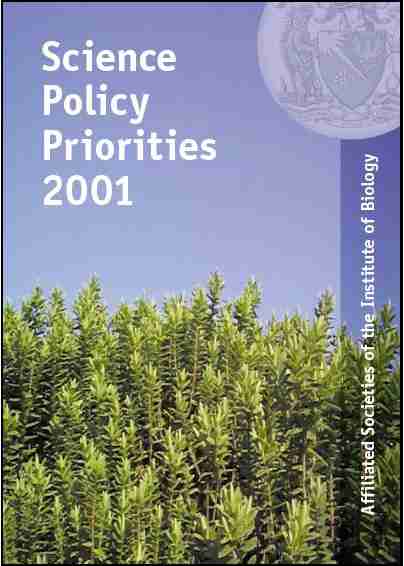
With its conclusions of marked science underinvestment (especially compared to our other nation competitors as a proportion of GDP) and the lack of clearly defined career prospects for young researchers, the report echoes one I compiled for UK bioscience over 20 years ago! Science Policy Priorities 2001 from the Affiliated Societies of the Institute of Biology noted that UK investment in R&D had a real-term decline by over 20% since the early 1980s (page 2, paragraph 6). It also highlighted the need for researchers’ career structures and remuneration (pages 4 and 5).
Meanwhile Prof. Sir Paul Nurse's Independent Review of the UK’s Research, Development and Innovation Organisational Landscape highlights that the total UK R&D investment in 2019 was 2.6%-2.7% of GDP, but the UK still lags behind nations such as the USA, South Korea and Germany, which invested 3.2 to 4.6% of GDP. Further, strip out charity and industry funded R&D, to focus on UK Government science research expenditure this still only comprises 0.5% of GDP putting the UK in 27th place in the 36 OECD nations, well behind the top ten nations, who committed between 0.69–1.01% of GDP to R&D (page 16).
The review goes on to say that ensuring high-quality training, tackling the perceived lack of long-term job prospects, and creating a better understanding of the range of opportunities to move careers between research organisations are important to ensure the sustainability of the R&D and innovation landscape (page 20).
Our Science Policy Priorities 2001 looked back 20 years to the 1980s noting investment and career decline, and 20 years on from that we now have Prof. Sir Paul's review which paints a poor picture despite the current government's ambition for the UK "to become the most innovative economy in the world and a Science and Technology Superpower". (Don't laugh: their words, not mine.)
There are other similarities between the two reports published over two decades apart, but these two illustrate my point well.
So, for four decades we have failed to see adequate investment and structuring of UK science. Further, in our schools, with individual biology, chemistry and physics merged into catch-all 'science' classes and with an unacceptable proportion of schools unable to recruit biologists, chemists and physicists to teach their respective disciplines, it is no wonder that none of today's youngsters in my personal social sphere (mainly the daughters, sons, nieces and the nephews of friends) are studying science, technology, engineering or medicine/mathematics (STEM) at university. And why should they? It's a route with few good prospects... (Ho hum.)
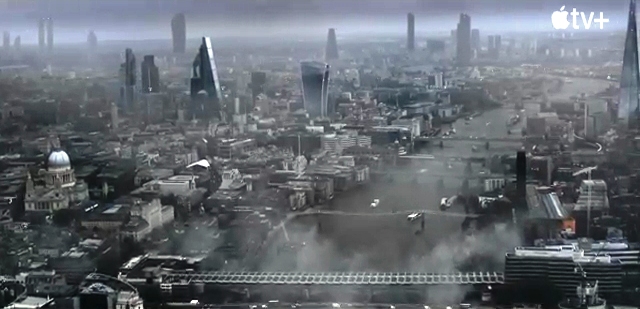
Spring 2023A new climate change drama series, Extrapolations is airing on Apple+. Now, I don't usually give a puff to specific shows, but for those interested in human-induced climate change, this one deserves a tip of the hat. The Extrapolations series comes from the writer Scott Z. Burns (Contagion), who also directs and is an executive producer. It explores a near-future where the chaotic effects of climate change have become embedded into our everyday lives. It features eight interwoven stories about love, work, faith and family from around the world that explore the intimate, life-altering choices which must be made when our warming world is changing faster than the population can adapt. Each story is different, but the fight for our future is universal. And when the fate of humanity is up against a ticking clock, the battle between courage and complacency has never been more urgent. Are we brave enough to become the solution to our own undoing before it’s too late? The series stars: Meryl Streep, Kit Harington, Edward Norton and Tobey Maguire among others. See the trailer here.
London 2070AD as portrayed in Extrapolations.
St. Pauls far left and the Shard far right are two of a number of familiar landmarks.
Spring 2023Is climate change coverage in general biology textbooks declining ? "CLIMATE-CHANGE CONTENT SHRINKS IN US UNIVERSITY TEXTBOOKS" shouts (yes, they did it in CAPS) a news headline in the 12th January 2023 Nature which in turn refers to a more soberly titled December 2022 primary research paper in PLoS ONE. So is climate change content shrinking in US early college/university-level textbooks? And, perhaps more importantly, is there less climate change education in biology lectures?
A careful read of both the paper and the Nature news article suggests that the answer to the first question (coverage in textbooks) is 'possibly', and the second (education in classes) is 'not necessarily'.
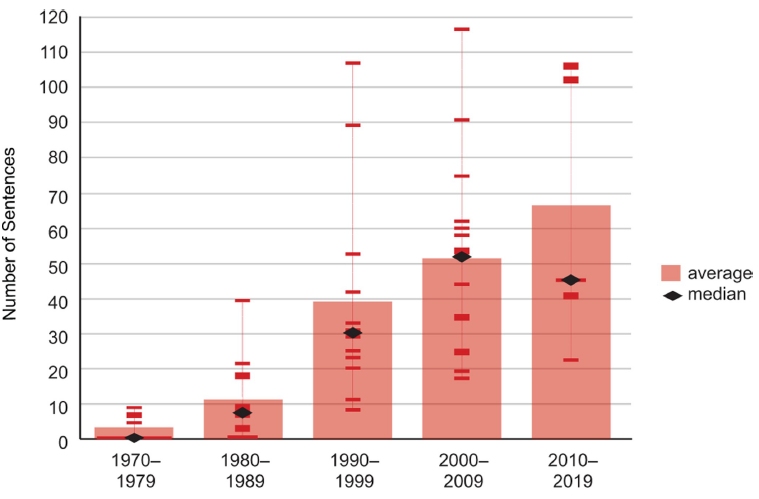
The paper states that the total number of climate change sentences in biology textbooks has in fact steadily increased but that the median number has in the decade 2010-2019 declined (see Figure left). So maybe climate change has less of a biology climate textbook profile(?).
But does this mean that climate change teaching in biology lectures is declining? The authors of the PLoS research paper themselves acknowledge that biology lectures are not the sole source of climate change education: they note that climate change is addressed in politics, sociology, and economics too, and here I would add geology and geography. Further, the authors of the paper acknowledge that textbook use in early university biology courses has been declining. Indeed, the Nature news item echoes this and it also points out towards its end that textbook coverage is not the only metric suggestive of the amount of climate change covered in university lectures. It notes that as biology develops with new discoveries so different topics come to prominence and yet university introductory biology textbooks cannot increase in size indefinitely. Finally, I would add that, in addition to college-level introductory biology textbooks, there are now specialist university-level textbooks on climate change biology: Climate and Human Change: Disaster or Opportunity (1998) or Climate Change: Biological & Human Aspects (2007, expanded 2013) anyone?
Having said all of this, I do have some sympathy for some of the paper's authors' views. They note that over the decades molecular and cellular biology teaching has increased while whole-organism and ecosystem level bioscience has decreased. For many years at the Institute of Biology we shared this concern at the bioscience research level (investment in whole-organism and ecological research had been declining compared to cellular and biomolecular research -- see paragraph 2.3 here). Further, in 2018, when my science son was considering which courses to study at university, I checked on what environmental studies and environmental science courses there were in the UK (this being my own area of initial academic training). I was disturbed to find that the number of these had markedly declined compared to my time back in the late 1970s! (Including my own at Hatfield - Hertfordshire U. - at the time considered one of the best environmental courses in the country arguably second only to one at the University of E. Anglia, and my postgrad Environmental Resources Unit at Salford U. is also no more!) This loss of environmental studies/science courses is despite on-going species habitat -- and its consequential biodiversity -- loss, the increased recognition of the value of ecosystem services, the growth in public environmental concerns (including climate change) and the increased threats to the environment due to our growing global human population.
There does seem to be something wrong somewhere.
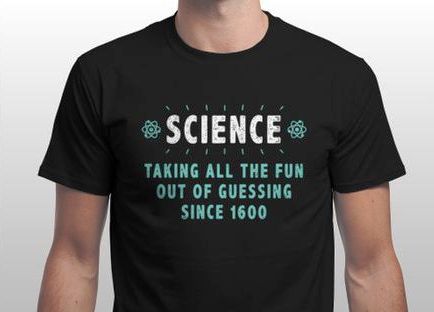
Now, you may be wondering why I do not like this T-shirt (see picture left)? After all, it seems to be a pro-science garment… Right? Wrong!
Notwithstanding, I hypothesise, that science never took the fun out of anything – science is fun – guessing is an important part of science, plus it is fun seeing if it -- the guess -- is right.
The Nobel winner Richard Feynman explained it well in one of his 1961-'3 lectures (see below). Of course, the guessing must not be random but be in general agreement with the laws and observations of the environment and universe. I say 'general agreement' because our observations and the laws as we understood them up to today may not be precise enough: we may have more precise detectors on the drawing board.
Here's the thing, having made your educated guess, it is fun making the observation or carrying out the experiment to ascertain whether or not the guess has any merit.
Richard Feynman said: “Now I’m going to discuss how we would look for a new law. In general, we look for a new law by the following process. First, we guess it (audience laughter), no, don’t laugh, that’s the truth. Then we compute the consequences of the guess, to see what, if this is right, if this law we guess is right, to see what it would imply and then we compare the computation results to nature or we say compare to experiment or experience, compare it directly with observations to see if it works. If it disagrees with experiment, it’s WRONG. In that simple statement is the key to science. It doesn’t make any difference how beautiful your guess is, it doesn’t matter how smart you are who made the guess, or what his name is… If it disagrees with experiment, it’s wrong. That’s all there is to it.”
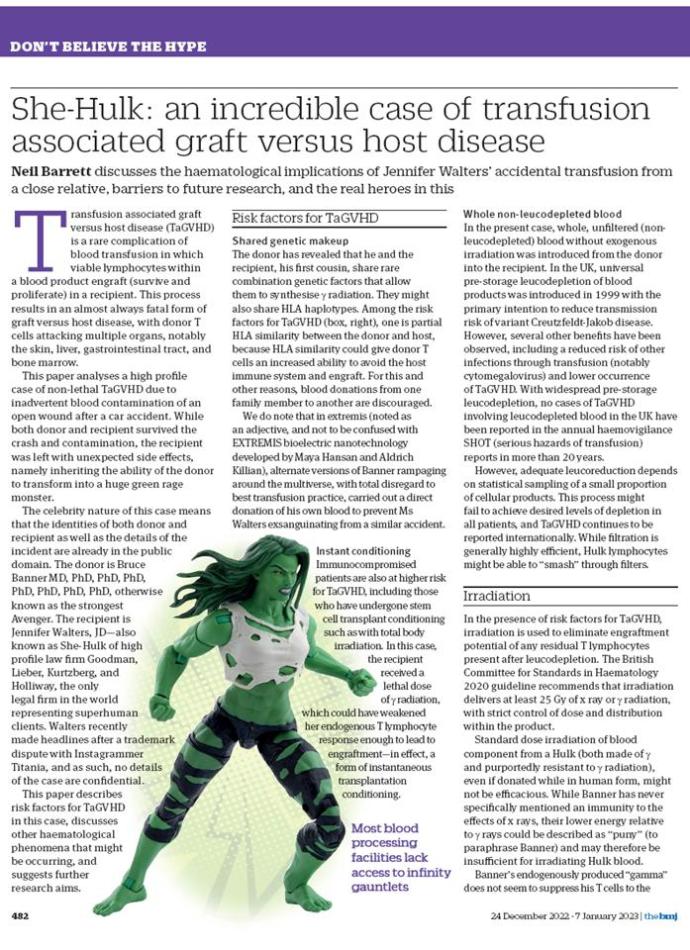
New Year 2023Superheroes encourage blood donation! The festive season sees many weekly science journals have a Christmas/New Year double issue and some also have a bit of festive fun. This year the British Medical Journal had a number of interesting offerings including one that looked at the biomedical aspects of super-heroes giving blood transfusions. Transfusion associated graft versus host disease (TaGVHD) is a rare complication of blood transfusion in which viable lymphocytes within a blood product survive and proliferate in a recipient. This process results in an almost always fatal form of graft-versus-host disease, with donor T cells attacking multiple organs.
This discussion paper analyses a high profile case of non-lethal TaGVHD due to inadvertent blood contamination of an open wound after a car accident. While both donor and recipient survived the crash and contamination, the recipient was left with unexpected side effects, namely inheriting the ability of the donor to transform into a huge, green-rage monster.
The celebrity nature of this case means that the identities of both donor and recipient as well as the details of the incident are already in the public domain. The donor is Bruce Banner MD, PhD, PhD, otherwise known as the strongest Avenger. The recipient is Jennifer Walters, JD – also known as She-Hulk of high profile law firm Goodman, Lieber, Kurtzberg, and Holliway, the only legal firm in the world representing superhuman clients.
The paper concludes that, while superheroes as blood and bone marrow donors capture the imagination, the safety of engaging super-powered individuals as donors is far from established. However, this case will hopefully encourage normal humans to donate blood – allowing them to become the real heroes.








 John Burn's Dredd.